
Imagine it’s 9:15 AM and your carefully planned school photo day schedule is already starting to slip. The Year 3 classes are stuck in an extended assembly, a group of Year 1s has arrived ten minutes early with untidy collars, and a restless queue of siblings is beginning to crowd the corridor. For many Adelaide staff, this high-pressure scenario is a familiar dread. It is a day where logistical precision is often sidelined by the unpredictable nature of a busy campus, leaving coordinators feeling more like air traffic controllers than educators.
We believe that photo day should be a celebration of your school community rather than a source of stress. You shouldn’t have to settle for another year of bottlenecks and frustrated teaching staff. You can master your school’s photography logistics with our comprehensive scheduling guide and downloadable template, which we have designed specifically for the unique needs of South Australian educators. In this article, we will show you how to organise seamless class transitions, manage sibling photos without losing your recess, and select the best hall locations to ensure every portrait reflects the high standards of your institution.
Key Takeaways
- Understand why a structured timetable acts as the operational backbone for a successful shoot, significantly reducing stress for both students and staff.
- Learn how to identify the “Golden Windows” of lighting in Adelaide to ensure your outdoor and hall-based portraits maintain professional quality throughout the day.
- Evaluate the benefits of different scheduling models, such as Year Level Blocks or House-Based structures, to find the perfect fit for your school’s unique culture.
- Follow a practical step-by-step process to build a robust school photo day schedule that accounts for student counts and the number of photography stations required.
- Discover how partnering with an experienced local team can streamline your logistics and provide rapid-delivery proofs for a more efficient administrative experience.
Mastering the School Photo Day Schedule: Why Logistics Matter
A robust school photo day schedule is the operational backbone of the entire event. It’s the difference between a day that feels like a coordinated celebration and one that feels like a chaotic scramble. When we talk about the logistics of a successful photo day, we’re looking at the precise movement of hundreds of students through a single point of contact. This level of organisation isn’t just for the sake of the photographers; it’s a vital tool for reducing anxiety. Students who arrive at a calm, ordered station are more likely to feel relaxed, which directly translates to more natural smiles and higher-quality professional school portraits.
Beyond the immediate atmosphere, there’s a tangible financial benefit to a well-oiled schedule. Rushed sessions often lead to missed details, such as a stray hair or a crooked tie, which can result in the need for costly re-shoots. By investing time in the planning phase, Adelaide schools can save hours of administrative follow-up later in the term. When you develop a school photo day schedule, you aren’t just filling out a spreadsheet; you’re protecting the school’s most valuable resource: time.
The Impact on Teaching and Learning
Schools exist to teach, and a poorly managed schedule can cannibalise vital instructional time. By prioritising core subjects like Maths and English in the early morning blocks, coordinators can ensure that students are focused during their primary learning windows. It’s equally important to cross-reference the run sheet with specialist timetables. Nothing causes more friction than pulling a class out of a Science lab or a PE lesson unexpectedly. When teaching staff understand the “why” behind the timing, they’re far more likely to support the process, ensuring classes arrive on time and properly presented.
The Photographer’s Perspective: Why Flow is King
From behind the lens, flow is everything. A steady, predictable stream of students allows our team to focus entirely on the artistic elements of the shot, such as lighting adjustments and genuine engagement with the child. Bottlenecks in the school hall or gym create a high-pressure environment that rushes the process. To avoid this, we always recommend incorporating buffer times into your plan. These small gaps act as a pressure valve, absorbing the inevitable five-minute delays that occur in a busy school day. A calm photographer and a relaxed student always produce a better result than a rushed session.
Essential Components of a High-Efficiency Photography Timetable
Building a high-efficiency school photo day schedule requires balancing several moving parts. You must consider the total student count, the number of photography stations, and the variety of images requested. A school with 800 students and three photographers operates very differently from a small primary school. It’s fundamentally about calculating the throughput per hour while maintaining the artistic integrity of every shot. A common mistake is forgetting to factor in transition time. If a class has to walk from the far end of the oval to the school hall, you lose five minutes of shooting time before they even arrive. These small leaks in the timetable can lead to significant delays by lunch.
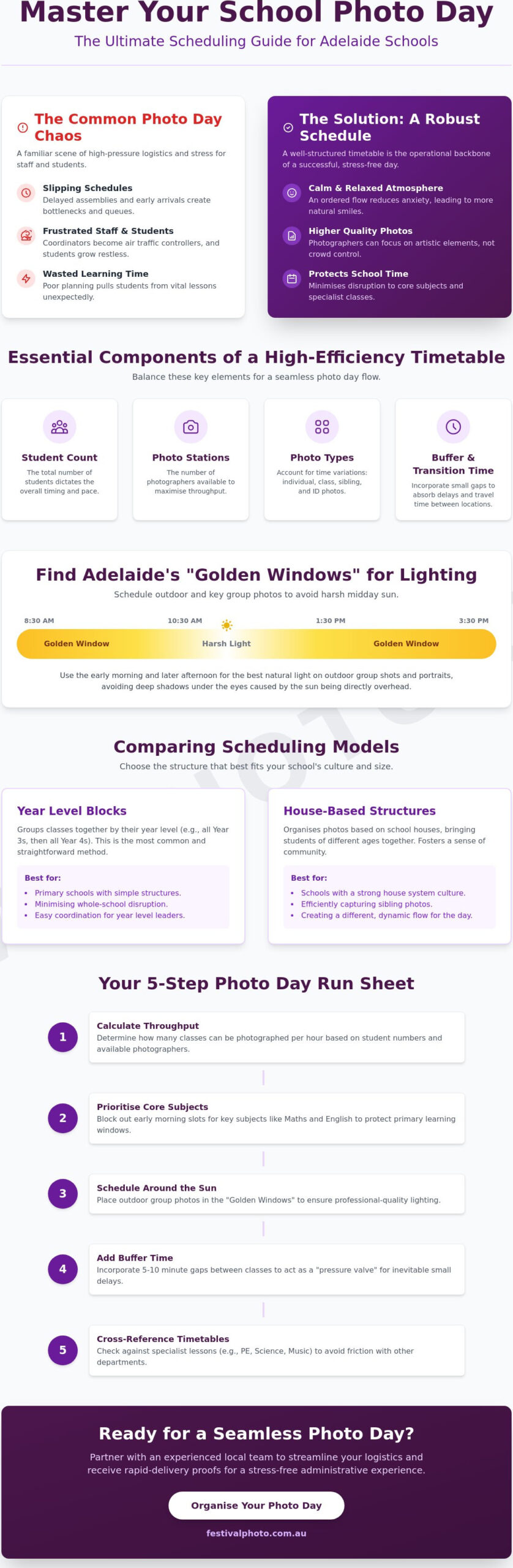
The South Australian sun can be unforgiving. Between 10:30 AM and 1:30 PM, the harsh overhead light often creates deep shadows under the eyes. We call the periods before and after this block the “Golden Windows”. These are the ideal times for outdoor group photos or senior portraits in the courtyard. If you’re using the gym, be mindful of high windows that might cast unwanted light across the backdrop. To help you navigate these choices, our school photography Adelaide buyers guide provides deeper insights into selecting the right environment for your shoot.
Accounting for Different Photo Types
Individual portraits are generally fast, but class group photos require precision and time to arrange students by height. High school cohorts often need student ID card captures, which are high-speed and should be grouped together to maintain momentum. Leadership and school captain photos require more artistic direction; we recommend scheduling these during the softer morning light when students are at their freshest. Our team can help you map out these details to ensure your day runs like clockwork. You might consider reaching out to Festival City Photography to discuss your specific campus layout.
Environmental Factors in South Australia
Adelaide’s weather is notoriously fickle, so a “Plan B” is essential. Whether it’s a sudden winter downpour or a 40-degree summer heatwave, having an indoor backup space ensures the day isn’t a total loss. Beyond the weather, consider the logistics of uniform changes. If seniors need to swap into blazers or sports teams need to change into full kits, you must build “change windows” into the run sheet. Without these buffers, the entire afternoon session can quickly become a bottleneck.
Comparing Scheduling Models: Which Structure Suits Your School?
Choosing the right framework for your school photo day schedule isn’t a one-size-fits-all decision. The best model depends on your school’s size, age range, and daily rhythm. In many South Australian primary schools, the “Year Level Block” remains the gold standard. This model keeps students with their classroom teachers, ensuring that the transition to the photography centre is managed by a familiar face. It’s simple, linear, and easy for the front office to monitor at a glance.
Conversely, many Adelaide private schools favour a “House-Based” model. This approach organises the day by house groups rather than year levels, which is excellent for fostering school spirit and capturing house captain portraits. For large secondary colleges with complex timetables, an “Alphabetical Roll” model often proves most efficient. By calling students in alphabetical blocks, you can move through a cohort quickly regardless of which elective subjects they are currently attending.
One of the most frequent logistical hurdles is the seamless integration of sibling school photos. To avoid students wandering the corridors or missing class, we recommend one of two strategies:
- The Early Bird Session: Scheduling family portraits 30 minutes before the first bell. This works best for parents who drop their children off early.
- The Lunchtime Block: A dedicated window where siblings meet at a central point. This requires clear communication via the school’s internal messaging system to ensure everyone arrives at once.
The Primary School Approach (Reception to Year 6)
Success in a primary setting relies on timing. We always suggest starting with Kindy and Reception students. These younger children are freshest in the morning; their uniforms are neat, and their energy levels are high. As the day progresses, hair becomes messy and energy wanes. Utilising “buddy classes” is another effective tactic. Having a Year 6 class accompany their Reception buddies can help calm nerves and make the movement between buildings much faster.
The Secondary School Challenge (Year 7 to Year 12)
High school schedules must be more flexible to accommodate VET blocks, external exams, and study periods. A “Walk-In” model for Year 12s often works well, allowing seniors to visit the photographers during a free period. This reduces the pressure on their busy academic timetable. Don’t forget to reserve specific slots for staff portraits. Teachers are notoriously busy; providing them with 5-minute “express windows” during their non-instructional time ensures you get full staff participation without disrupting the curriculum.
Step-by-Step: Building Your Photo Day Run Sheet
Creating a school photo day schedule that survives the first bell requires a methodical, five-step approach. You cannot simply guess the timing for 500 students; you need a framework built on data and campus reality. Start by auditing your total student and staff count for the 2026 academic year. This number dictates everything from the amount of paper in the printers to the number of photographers we send to your site. Once you have your headcount, determine how many “stations” or photographers will be available. We generally recommend one station for every 250 to 300 students to ensure the day remains manageable.
Next, calculate your “Time Per Head”. For individual portraits, we usually allow 30 to 60 seconds per student. This provides enough time for a quick uniform check and a genuine interaction without dragging the day out. Before you start slotting in classes, map out the non-negotiables. Mark in recess, lunch, and any pre-planned assemblies or chapel services. Finally, layer in your classes. We suggest starting with the most complex groups first, such as large composite group photos or senior cohorts with specific uniform requirements, as these are the most likely to cause delays if left until the afternoon.
Calculating the Buffer: The 10% Rule
In a busy school, the unexpected is the only certainty. A student might have a sudden nosebleed, or a teacher might forget to check the daily bulletin. To absorb these shocks, we apply the 10% rule: add a five-minute buffer for every hour of shooting. This prevents a small delay at 10:00 AM from becoming a thirty-minute crisis by 2:00 PM. The buffer is the insurance policy for your schedule. It allows our team to handle “no-shows” or students with incorrect uniforms without the pressure of a ticking clock.
Managing Sibling Photos without the Stress
Sibling sessions are often the most requested yet most chaotic part of the day. There is a constant debate between “Before School” and “Lunchtime” sessions. While before-school slots are great for parents, lunchtime sessions often capture siblings more efficiently. We recommend a ticketing system to track which families have been seen. It’s also vital to ensure parents have reviewed the school photography price list and pre-paid through our portal. This removes the need for teachers to handle cash or envelopes on the day. Sharing our school photo day tips for Adelaide parents in advance can also help families arrive prepared, reducing last-minute uniform issues and morning chaos. If you’re ready to start building your custom run sheet, contact our professional photography team to discuss your school’s specific requirements.
Partnering with Festival City Photography for a Seamless Day
Festival City Photography understands that a successful shoot is built long before the first flash goes off. Our Adelaide-based team doesn’t just show up on the day; we assist in the entire planning phase to ensure your school photo day schedule is realistic and robust. We pride ourselves on our deep local knowledge of South Australian school layouts, from historic campuses in the city to modern facilities in the suburbs. This familiarity allows us to recommend the best indoor backdrops and outdoor spaces, ensuring we never waste time searching for a power outlet or the right light.
Efficiency is at the heart of our service model. Our rapid-delivery commitment means schools receive their proofs faster than traditional industry standards, allowing families to enjoy their memories sooner. We also ensure a technical bridge between our cameras and your administration office. We correctly map digital image files for school photos to your existing school database. This simplifies the process of updating student ID cards and internal records, removing the need for manual data entry by your busy office staff.
On-the-Day Support and Flexibility
We provide experienced “Floor Managers” to act as a bridge between the photographers and your teaching staff. Their sole focus is to keep the school photo day schedule moving by managing the flow of classes and resolving any minor issues before they become bottlenecks. If a technical glitch occurs, our team is equipped to handle it quietly and swiftly without stopping the session. This level of professionalism reflects your school’s own values, providing a seamless extension of your daily operations that maintains a calm atmosphere for students.
Next Steps: Booking Your 2026 Date
As we look toward 2026, we encourage schools to consider their preferred timing early. Term 1 and Term 2 slots are historically the most popular and fill up quickly. Booking ahead allows us to customise a package that suits your specific needs, whether that includes staff portraits, sports team photos, or special event coverage. Our goal is to provide an all-encompassing service that simplifies your administrative burden while delivering high-quality portraits that families will cherish.
Organise a site visit with our Adelaide team today to walk through your campus and discuss your requirements. We are ready to help you transform a complex logistical challenge into a smooth, rewarding experience for your entire community.
Transforming Your Next School Photo Day
Mastering your school photo day schedule is about more than just filling in time slots; it’s about creating a calm, predictable environment where every student can shine and every teacher feels supported. By implementing a structured run sheet with built-in buffer times and selecting a scheduling model that reflects your school’s unique culture, you can eliminate the stress that often accompanies these major events. A well-planned day ensures that the focus remains on capturing high-quality portraits rather than managing logistical bottlenecks.
Festival City Photography has been a family-owned Adelaide business since 1990. We are specialists in meeting South Australian Department for Education requirements and understand the specific logistical needs of our local schools. Our commitment to excellence includes a rapid turnaround on both digital and print packages, ensuring your community receives professional results without the long wait. We pride ourselves on being a dependable partner for educators across the state.
Download our 2026 School Photo Day Schedule Template and book your Adelaide session to start planning with confidence. We look forward to partnering with you to capture the story of your school community with precision and care.
Frequently Asked Questions
How long does a typical school photo day schedule take for 500 students?
A typical school photo day schedule for 500 students usually requires a full school day, from approximately 9:00 AM until 3:00 PM, when utilising two photography stations. This timeframe allows for both individual portraits and class group photos to be captured without rushing the process. It also provides enough flexibility to accommodate transition times between classes and the necessary breaks for staff.
What is the best time of day to schedule sibling photos?
The most efficient time for sibling photos is usually before the first bell, between 8:15 AM and 8:45 AM. Scheduling these sessions early ensures that students are neatly dressed and their hair is tidy before the school day begins. If an early session isn’t possible, a dedicated block during the first half of the lunch break is a reliable alternative for keeping families together.
Should we schedule staff photos before or during school hours?
We recommend scheduling a dedicated staff session at 8:00 AM before the students arrive on campus. This approach is the most effective way to capture the majority of your team in one window while they are fresh and available. For those who cannot make the early session, we can provide short five-minute “express slots” during their non-instructional periods throughout the day.
How much time should I allow for a class group photo session?
You should allow approximately 15 to 20 minutes for each class group photo session. This duration includes the time needed to organise students by height, conduct final uniform checks, and capture several frames to ensure every student is looking their best. Larger cohorts or composite group photos may require additional time to ensure the technical precision of the final image.
What happens to the schedule if it rains in Adelaide on photo day?
If it rains, the entire operation moves to a pre-arranged indoor “Plan B” location, such as the school hall, gymnasium, or a large undercover centre. Our team brings professional studio lighting to every shoot, which allows us to maintain the integrity of your school photo day schedule regardless of the weather. We are well-versed in Adelaide’s winter patterns and can pivot to an indoor setup quickly.
Can we schedule Year 12 graduation portraits on the same day as class photos?
Yes, graduation portraits can be integrated into the main schedule by setting up a dedicated station specifically for seniors. This allows Year 12 students to be captured in their academic dress or formal blazers without interrupting the flow of the younger year levels. It’s an efficient way to manage milestone photography while the professional team is already on-site.
How do we handle students who arrive late to their scheduled time?
Late students should be directed to wait until the next available buffer period or attend the catch-up session held at the end of the day. It’s important not to stop the current class session to accommodate one individual, as this causes a ripple effect that can delay the entire afternoon. Our floor managers are trained to track these “no-shows” and ensure they are captured before we depart.
How many photographers do we need for a school of 1,000 students?
For a school of 1,000 students, we typically recommend a minimum of four photography stations to ensure the day runs smoothly. This ratio follows our standard guideline of one photographer per 250 students, which prevents long queues and minimises the time students spend out of the classroom. Having multiple stations also allows us to run individual portraits and group photos simultaneously.