
Picture this: it’s class photo day, and before the photographer has even set up, two students are away sick, one has a grass stain on their shirt, and a third is squinting directly into the sun. Sound familiar? For many Adelaide school coordinators, this is less a nightmare and more a Tuesday. The good news is that Adelaide school composite group photos have quietly become the smarter solution that schools across South Australia are choosing for 2026, and once you understand why, it’s hard to imagine going back.
Organising a traditional group shot with thirty-plus children is genuinely chaotic. You already know the stress of chasing absentees, managing mismatched uniforms, and hoping nobody blinks at the critical moment. That pressure is real, and it’s completely reasonable to want a better way forward.
This article explains exactly why composite group photos are fast becoming the gold standard for inclusive, high-quality school memories in Adelaide. You’ll discover how the format solves the logistical headaches of photo day, why every child ends up looking their absolute best, and what to look for in a local Adelaide provider who genuinely understands your school’s needs.
Key Takeaways
- Adelaide school composite group photos solve the most common photo day headaches — absent students, blinkers, and logistical chaos — by digitally arranging individual portraits into a polished class layout.
- Composite photography eliminates the need for physical close contact and heavy equipment setup, making it a more practical and inclusive option for modern South Australian schools.
- A side-by-side comparison of composite versus traditional group shots reveals why more Adelaide schools are making the switch for guaranteed quality across every single student.
- Coordinating a smooth composite photo day comes down to a few key steps — learn what to prepare in advance so your school’s photo day runs efficiently from start to finish.
- Choosing a local Adelaide photography partner with deep roots in South Australian schools means direct support and genuine accountability — no national call centres, no guesswork.
What Are Adelaide School Composite Group Photos?
At their core, Adelaide school composite group photos are class portraits created by digitally arranging individual student portraits into a single, cohesive layout. Rather than gathering thirty children onto tiered bleachers and hoping for the best, each student is photographed separately against a consistent backdrop. A skilled editing team then assembles those individual frames into a polished group image where every face is clear, well-lit, and smiling.
It’s a meaningful shift from the traditional format, and the timing makes sense. Modern Adelaide schools are managing larger class sizes, tighter timetables, and greater expectations around image quality and inclusivity. The old bleacher-style shot, while nostalgic, simply can’t keep pace with those demands.
The Technical Magic Behind the Composite
Each student sits for a brief individual portrait session against a carefully controlled backdrop with consistent lighting. That uniformity is what makes the final composite look natural rather than pieced together. Professional editing then arranges each portrait into a balanced class layout, matching skin tones, adjusting scale, and ensuring the overall image reads as a unified whole rather than a digital collage. This same level of precision is why the composite format has become the preferred approach for graduation portraits in Adelaide, where the stakes for a polished, lasting image are highest.
The result? No squinting, no blinkers, no awkward postures. Every child looks their best because every child had a moment that was entirely theirs.
Inclusivity: Leaving No Student Behind
One of the most practical advantages of the composite format is what happens when a student is absent. Instead of that child simply missing from the class photo, they can be photographed on a separate occasion and added to the final image seamlessly. No retakes. No second photo day. No child left out of a memory that should belong to everyone.
There’s also a quieter benefit worth acknowledging. For students who experience anxiety in large group settings, a brief one-on-one portrait session is a far less overwhelming experience. That sense of calm shows in the final image, and it reinforces something genuinely important: every child in the Adelaide school community deserves to feel seen, included, and represented with dignity.
- No blinkers or closed eyes in the final image, because every portrait is individually selected.
- Consistent uniforms and backgrounds across the entire class, regardless of when each student was photographed.
- Absent students can be added later, ensuring complete class representation without a second full photo day.
- Reduced photo day stress for students and staff alike, with shorter, more manageable individual sessions.
Why Composite Layouts are Replacing Traditional Group Shots
The shift away from traditional group shots isn’t simply a trend. It’s a practical response to the real pressures Adelaide schools face every single term. Hauling heavy tiered platforms into a gymnasium, reorganising an entire morning’s timetable, and then hoping thirty-odd students all cooperate simultaneously — that’s a significant operational cost that rarely appears in any photography brief. Composite layouts remove it entirely.
Without the need for physical staging, photo sessions move faster and with far less disruption to the school day. Individual portrait sessions can be slotted into brief windows between lessons rather than consuming a full morning. Students cycle through in small groups rather than entire year levels, which means classrooms stay on schedule and front-office staff aren’t fielding a constant stream of queries about where to send which class next.
There’s also a genuine safety dimension worth acknowledging. Because each student is photographed individually, there’s no requirement for close physical contact between students or between students and staff. For schools managing health considerations or supporting students with sensory sensitivities, that separation is a meaningful advantage rather than a minor footnote.
Staff portraits fit naturally into this model too. A teacher with a free period on a different day, a support worker who works part-time, an administrator who was away during the main photo day — all of them can be photographed separately and integrated into the final composite without any visible seam. Experienced local Adelaide photographers who specialise in this format handle those last-minute adjustments as a matter of course, rather than treating them as exceptions.
Customisation is another area where the composite format genuinely outperforms its predecessor. Schools can select contemporary backgrounds that reflect their identity, incorporate school colours, or include branding elements that make the final image feel distinctly theirs rather than a generic class shot. That level of personalisation simply isn’t achievable when you’re working with a physical backdrop and fifty children in a hall.
Solving the ‘Photo Day Logistical Puzzle’
A flexible school photography Adelaide schedule is one of the composite format’s most underrated advantages. Sessions can be staggered across multiple days, reducing the bottleneck that typically overwhelms reception staff during a traditional all-in-one photo day. Student flow becomes predictable and manageable rather than reactive and chaotic.
Enhanced Marketing Assets for Schools
Adelaide school composite group photos deliver more than a keepsake for families. The individual portrait sessions that feed into the composite also produce high-quality digital image files for school photos that schools can use across yearbooks, ID cards, newsletters, and their digital presence. Every image carries the same controlled lighting and consistent backdrop, which means the school’s visual identity looks polished and unified across every platform it appears on.
- Yearbook ready: Uniform portraits slot directly into yearbook layouts without additional editing or reshooting.
- Student ID cards: Consistent backgrounds and lighting make individual portraits immediately usable for ID card production.
- Digital presence: Schools gain a library of professional, on-brand imagery suitable for websites and social channels.
- Staff integration: Staff portraits taken at different times are matched seamlessly to the student composite for a cohesive final product.
If your school is weighing up the switch for 2026, it’s worth exploring what a tailored composite session could look like for your specific cohort and timetable. Festival City Photography has been supporting South Australian schools in exactly this way since 1990.
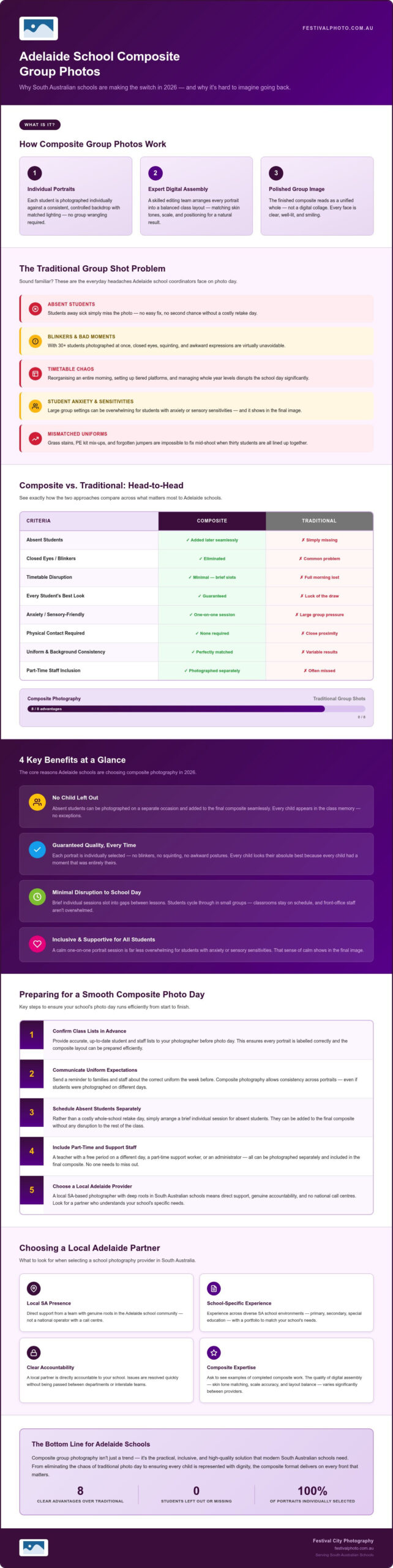
Comparing Composite vs. Traditional Group Photography
Both formats have their place. But for most Adelaide schools operating in 2026, the differences between them are significant enough to make the choice fairly clear. Understanding those differences properly, rather than relying on habit or familiarity, is what separates a smooth photo day from one you’re still managing weeks later.
Traditional group photography carries genuine nostalgic appeal. The tiered rows, the formal arrangement, the sense of occasion. For schools with a strong heritage culture, that aesthetic still resonates. But nostalgia doesn’t solve the practical reality: in a group of thirty students, the statistical probability of at least one person blinking, looking away, or pulling an unintended expression is high enough that most photographers will tell you it’s closer to a certainty than a risk. You’re essentially hoping the best frame is good enough, rather than knowing it will be.
Composite photography removes that uncertainty entirely. Every portrait is individually reviewed and selected before it ever appears in the final layout.
The ‘Blink’ Factor and Quality Control
A single traditional group shot gives the photographer a limited window to capture thirty individuals simultaneously at their best. Composite sessions eliminate that constraint. Each student’s portrait is assessed before it’s included, which means closed eyes, awkward expressions, and uniform issues are caught and corrected at the source. A student with a collar askew or hair out of place can be tidied before their individual frame is taken, rather than discovered after the final print has been ordered. For parents, that quality control translates directly into satisfaction. No phone calls to the school. No requests for retakes. No child left feeling self-conscious about how they appear in an image that will sit on a family’s wall for years.
Suitability for Different Age Groups
For kindy and early learning centres, the composite format is genuinely transformative. Young children are unpredictable in group settings, and coaxing an entire class of four-year-olds into a coordinated pose is an exercise in managed chaos at best. Individual sessions are shorter, calmer, and far more likely to produce a portrait where the child actually looks like themselves at their best. Sports team photos in Adelaide also benefit significantly from the composite approach, where consistent framing across a full squad creates a polished, professional result that clubs and schools can use for promotional materials with confidence.
Traditional group photography does retain genuine merit in specific contexts. Centennial celebrations, milestone anniversaries, or events where the physical gathering of a community is itself part of the story can benefit from the authenticity of a single captured moment. In those cases, the ‘imperfection’ of a real group shot carries meaning. But for everyday class portraits, where the goal is a high-quality keepsake that every family is proud to display, Adelaide school composite group photos consistently deliver a result that traditional formats simply can’t guarantee.
On cost: composite sessions typically involve a modest premium to account for individual portrait time and professional editing. That investment is offset by a measurable reduction in administrative follow-up, fewer retake requests, and the elimination of second photo days for absent students. When you factor in staff time and the operational cost of managing a traditional all-in-one photo day, the composite format often represents better overall value for the school as an institution, not just for individual families.
- Traditional group shots: Nostalgic appeal, lower editing complexity, but high risk of quality issues across large groups.
- Composite sessions: Guaranteed individual quality, flexible scheduling, and seamless inclusion of absent students.
- Best for kindy and early years: Composite, without question. Shorter sessions produce calmer, more natural portraits.
- Best for heritage events: Traditional, where the authenticity of a gathered community is part of the narrative.
- Best for everyday class portraits: Composite, for consistent quality that satisfies every family, every time.
Organising a Seamless Composite Photo Day in SA
A well-run composite photo day doesn’t happen by accident. It’s the result of four straightforward steps executed in the right order, and when each one lands properly, the difference is felt by everyone from the front office to the classroom.
Step 1: Coordinate the session flow early. Work with your Adelaide photographer to map out a schedule that slots individual portrait sessions into natural breaks in the timetable. The goal is minimal classroom disruption. Small groups cycling through in five-to-ten minute windows keep the school day running without the bottleneck of an entire year level descending on the hall at once.
Step 2: Sync your student data in advance. Accurate naming in the final composite layout depends on clean, up-to-date student records. Before photo day, confirm your class lists are current and share them with your photography provider in the agreed format. A small data error caught before the session is far easier to fix than one discovered after the composite has been assembled.
Step 3: Send uniform and grooming guidelines to families. A brief, friendly note home one week before photo day sets clear expectations without feeling prescriptive. Remind families about correct uniform, hair, and any accessories that may not photograph well. This single step eliminates the most common source of parent dissatisfaction with the final image.
Step 4: Schedule a catch-up session for absent students. This is where Adelaide school composite group photos genuinely outperform every traditional alternative. Rather than accepting that an absent child simply misses out, build a brief catch-up session into the calendar. A local provider with SA-based operations can accommodate this without the logistical complexity that a national franchise would struggle to manage.
Administrative Simplicity for the Front Office
Modern school photography providers offer online portals that allow coordinators to manage student lists, track orders, and field parent queries from a single dashboard. When individual portraits feed directly into student ID card production alongside the composite, the front office gains a unified workflow rather than two separate processes to manage. Fewer parent phone calls follow naturally from a clear, organised ordering system that families can navigate without assistance.
Preparing Students for the Portrait Session
A focused 60-second individual session consistently yields a more natural, relaxed portrait than fifteen minutes of shuffling a full class into position. For shy students or those with sensory sensitivities, the controlled, one-on-one environment of a composite session is a genuinely calmer experience. Photographers who work regularly in South Australian schools understand how to draw out an authentic smile quickly, using simple prompts rather than forced posing.
- Brief, friendly prompts work better than formal directions for younger students.
- Consistent lighting and backdrop reduce sensory unpredictability for students who find new environments difficult.
- Short session windows mean students return to class before restlessness sets in.
- Catch-up sessions are scheduled as standard, not as exceptions.
Festival City Photography has been managing exactly these logistics for South Australian schools since 1990. Talk to the team about building a photo day schedule that works for your school’s 2026 calendar.
Choosing a Local Adelaide Partner for Your School Composites
There’s a meaningful difference between a photography provider that services Adelaide and one that is genuinely of Adelaide. When something goes wrong on photo day, or a family has a query three weeks after delivery, that distinction becomes very real, very quickly. A national franchise routes your call through a central support desk. A local partner picks up the phone and already knows your school’s name.
Festival City Photography has been serving South Australian schools since 1990. That’s more than three decades of understanding how Adelaide schools operate, what coordinators need, and how families respond to the final product. It’s not a head office statistic. It’s lived experience, built one school relationship at a time.
Local operations also mean faster delivery. Because editing and printing are handled by an SA-based team rather than a centralised facility interstate, Adelaide families receive their orders sooner. There’s no logistics chain stretching across state lines, no delays waiting for a national production queue to clear. The turnaround reflects the fact that your school’s images never leave South Australia to be processed.
The Advantage of Family-Owned Accountability
As a second-generation family business, Festival City Photography operates with a level of accountability that a corporate structure simply can’t replicate. The same professional team returns to your school year after year, which means they already understand your timetable preferences, your student cohort’s particular needs, and the small logistical details that make your photo day run smoothly. That continuity matters enormously for coordinators who don’t want to re-brief a new provider every twelve months.
Local knowledge runs deeper than logistics, too. Understanding the rhythms of the South Australian school calendar, the specific pressures on SA coordinators, and the expectations of Adelaide families shapes every decision, from how sessions are scheduled to how orders are communicated. No national competitor can offer that level of contextual understanding from a call centre in another state.
For schools weighing up Adelaide school composite group photos for 2026, that combination of heritage, local accountability, and genuine relationship-building is the clearest reason to choose a partner with roots in the community you serve.
Next Steps for Your 2026 School Calendar
Preferred dates in the Adelaide school term fill quickly, particularly in Terms 1 and 4. Taking the next step now means your school secures the session windows that suit your timetable rather than working around what’s left.
- Request a sample composite layout to present to your board or P&C committee before committing.
- Confirm your 2026 dates early to lock in your preferred term and avoid scheduling conflicts.
- Discuss your school’s specific needs directly with the Festival City Photography team, including class sizes, catch-up session requirements, and any staff portrait logistics.
Organise your school’s 2026 photo day with Festival City Photography today.
The Smarter Choice for Every Adelaide School in 2026
Adelaide school composite group photos have moved well beyond a novelty. They’re a practical, proven solution that solves real problems: absent students, unpredictable expressions, timetable disruption, and the administrative follow-up that traditional photo days leave in their wake. Every child gets a portrait they can be proud of, and every coordinator gets a photo day that actually runs to plan.
The case for going local is equally straightforward. When your photography partner has spent more than 30 years serving South Australian schools as a second-generation family business, you’re not starting from scratch each year. You’re building on a relationship that already understands your school’s rhythms, your families’ expectations, and the logistical realities of the SA school calendar.
2026 term dates fill faster than most coordinators expect. Don’t leave your school’s photo day to chance when a better option is already trusted by schools across Adelaide.
Enquire about our Adelaide school composite photo packages for 2026 and secure your preferred dates with a team that genuinely knows South Australian schools.
Frequently Asked Questions About Adelaide School Composite Group Photos
What exactly is a composite school group photo?
A composite school group photo is a class portrait created by digitally assembling individual student portraits into a single, cohesive layout. Each student is photographed separately against a consistent backdrop with controlled lighting, and a professional editing team arranges those individual frames into a unified class image. The result looks like a traditional group shot, but every face is sharp, well-lit, and at its best.
Can a student be added to the class photo if they missed photo day?
Yes, absolutely. This is one of the most practical advantages of the composite format. Absent students can be photographed in a brief catch-up session and integrated into the final class layout without any visible difference. No second full photo day is required, and no child ends up missing from a memory that belongs to the whole class. Festival City Photography schedules these catch-up sessions as standard practice, not as an exception.
Are composite photos more expensive than traditional group shots in Adelaide?
Composite sessions do typically involve a modest premium to account for individual portrait time and professional editing work. That said, the overall value calculation for schools is broader than the upfront cost. When you factor in the reduction in administrative follow-up, fewer retake requests, and the elimination of second photo days for absent students, the total operational cost for the school is often comparable to, or better than, a traditional group photo day.
How do you ensure the composite group looks natural and not ‘photoshopped’?
Consistency is the key. Every individual portrait is captured against the same backdrop, under the same controlled lighting conditions, which gives the editing team a uniform foundation to work from. Professional compositing then matches scale, skin tones, and positioning so the final image reads as a cohesive whole rather than a digital collage. When the groundwork is done correctly in-session, the editing is a refinement rather than a rescue job.
Do you provide composite photos for sports teams and clubs as well?
Yes. Festival City Photography offers composite group photos for sports teams alongside its school photography services. The format works particularly well for sporting squads, where consistent framing across a full team produces a polished, professional result suitable for club promotions, presentation nights, and display purposes. Individual sports portraits can also be incorporated into the same workflow, giving clubs a complete set of imagery from a single organised session.
How long does it take to receive the final composite group prints in South Australia?
Because Festival City Photography’s editing and production work is handled by a local South Australian team, turnaround times reflect that proximity. Orders don’t travel through an interstate production queue, which means Adelaide families and schools receive their prints sooner than they typically would through a national provider. For specific timeframes relevant to your school’s session, it’s best to confirm delivery windows directly with the team when booking.
Can we include school staff and leadership in the composite layouts?
Yes, and this is one of the format’s genuine strengths for school administration. Staff members who work part-time, were absent on the main photo day, or have limited availability can be photographed at a separate time and integrated seamlessly into the final composite. The consistent backdrop and lighting used across all sessions means there’s no visible difference between a portrait taken on day one and one taken a fortnight later.
What happens if a student has a wardrobe malfunction on the day?
Because each student is photographed individually, issues like a collar askew, a stray hair, or a minor uniform problem can be identified and corrected before the portrait is taken, rather than discovered after printing. The photographer can pause briefly to help the student tidy up, which is far simpler than noticing the same issue in a traditional group shot after the moment has passed. It’s a small but genuinely useful advantage of the one-on-one session format.