
What if your school’s photo day felt less like a logistical storm and more like a quiet, well-oiled machine? Most administrators dread the inevitable curriculum disruption, the frantic search for missing students, and the headache of managing sibling photos while trying to maintain a normal timetable. You likely believe that a successful day requires a miracle, but in reality, it simply requires a shift in strategy from reactive to proactive.
This comprehensive school photo day checklist for administrators is designed to transform that chaos into a seamless, almost invisible experience. We understand the pressure to deliver high-quality portraits while keeping staff and students calm. By following this 2026 guide, you’ll master the logistics of data management and space allocation to ensure every student is captured perfectly. We will walk you through the essential steps to minimise class interruptions, implement the latest child safety codes, and ensure the easy integration of student ID cards and digital files. From pre-day preparation to the final delivery of class group photos, this guide provides the structure you need for a stress-free event that parents will truly value.
Key Takeaways
- Establish a solid “Admin Foundation” by exporting accurate student data from your management system at least four weeks before the event to prevent ordering errors.
- Use this comprehensive school photo day checklist for administrators to master the “Rule of Three” communication strategy, keeping parents and staff informed at critical intervals.
- Select a venue with high ceilings and indirect light, such as the school hall, to ensure technical precision and high-quality portraits without the glare of harsh sunlight.
- Reduce the administrative burden on office staff by implementing a clear post-day management plan for late orders and rapid digital file delivery.
- Partner with local, family-owned experts to benefit from deep community trust and specialised knowledge of South Australian school requirements and graduation milestones.
The Pre-Photo Day Foundation: Logistics and Data Management
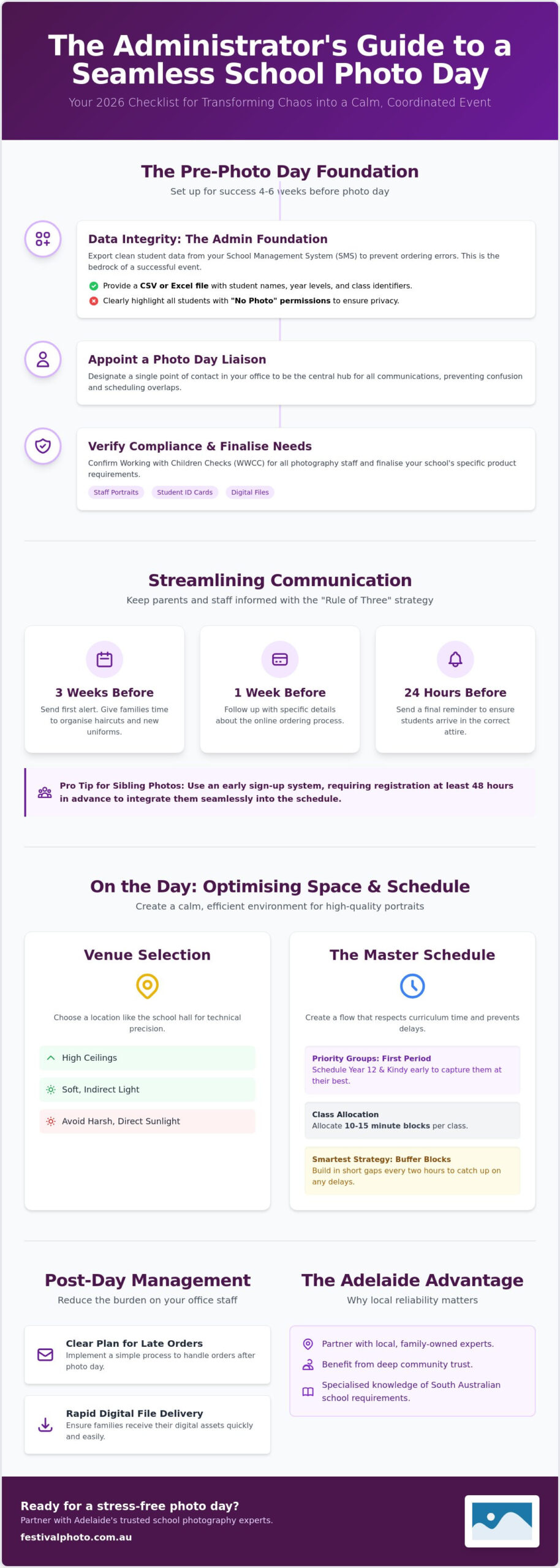
The “Admin Foundation” begins roughly four to six weeks before your photographer arrives on site. This period is the most critical phase of your school photo day checklist for administrators, as it sets the technical parameters for everything that follows. During this time, your focus shifts from high-level planning to granular data accuracy. Without this technical precision, even the most talented photographer will struggle to deliver a seamless experience for your families. It’s the bedrock of a successful event.
Exporting clean data from your School Management System (SMS) isn’t just an admin task; it’s the only way to prevent ordering errors and ensure every child receives the correct package. A reliable photography partner will require a CSV or Excel file containing student names, year levels, and class identifiers. Simultaneously, you should designate a single “Photo Day Liaison” within your office. This person becomes the central hub for questions from staff, parents, and the photography team, preventing the confusion that leads to scheduling overlaps. This is also the time to verify Working with Children Checks (WWCC) for all external staff and confirm your specific product needs, such as staff portraits and student ID cards.
Data Integrity and Class List Preparation
Every student must be linked to a specific class group to ensure efficient sorting during the production phase. This step is a crucial component of any school photo day checklist for administrators because it directly impacts the accuracy of the final delivery. You must clearly highlight students with “No Photo” permissions in your data export to avoid privacy breaches. Including teacher names and room numbers helps the photography team navigate the school grounds without constantly radioing the front office for directions. This level of detail ensures that the day remains “invisible” to the rest of the school’s operations.
The Master Schedule: Balancing Curriculum and Camera
Creating a flow that respects the classroom is vital for maintaining a calm environment. Allocate 10-15 minute blocks per class, depending on the volume of students. It’s often best to schedule Year 12 and Kindy students during the first periods of the day. These groups often require more time for formal poses, and catching them early ensures they look their best before the playground takes its toll. While the history of school portraits shows that these sessions have become more efficient over time, building in “buffer blocks” every two hours is still the smartest way to manage the day. These gaps allow the photographers to catch up if delays occur, ensuring the afternoon session doesn’t spill into the final bell.
Streamlining Communication: Engaging Parents and Staff
The most robust school photo day checklist for administrators is only as effective as the communication strategy supporting it. When parents and staff feel informed, anxiety levels drop, and the day proceeds with technical precision. A fragmented approach to messaging often results in a flurry of last-minute phone calls to the front office; this can derail your morning roll call and delay the entire session. By establishing clear expectations early, you create a culture of cooperation that benefits everyone involved.
We recommend the “Rule of Three” for parent notifications. Send the first alert three weeks before the date to allow families time to organise haircuts or new uniforms. Follow up one week before the event with specific details regarding ordering, and send a final 24-hour reminder to ensure students arrive in the correct attire. This rhythmic approach builds anticipation and ensures high compliance with uniform standards. For sibling photo requests, an early sign-up system is essential. By requiring parents to register siblings at least 48 hours in advance, you can integrate these sessions into the master schedule without causing classroom bottlenecks.
Parent Notification Timelines and Channels
Digital platforms like SkoolBag or SeeSaw are invaluable for providing instant push notifications. Use these channels to share a newsletter blurb that clearly outlines the expected uniform, whether it’s full winter dress or a specific sports kit. Transparency in the online ordering process also helps. When parents understand how to view and purchase individual portraits or class group photos digitally, they are less likely to seek assistance from your administrative team. As you manage these digital interactions, adhering to data privacy best practices ensures that student information remains secure and builds community trust.
Briefing Staff and Volunteers
Teachers are your primary allies on the ground. Host a brief five-minute meeting prior to the event to distribute a “Cheat Sheet” for their morning roll call. This document should highlight the specific time their class is due at the venue and any students with photo restrictions. Assigning a “Line Manager”, such as a volunteer or School Support Officer, keeps the queue moving and allows teachers to focus on student behaviour. Providing each staff member with a copy of the school photo day schedule eliminates confusion and ensures everyone is aligned. Selecting a professional photography partner who prioritises this level of structured communication will make the entire process feel effortless.
Optimising the Physical Space for Efficiency and Quality
A successful photo day relies on the physical environment as much as the digital data discussed earlier. When selecting a venue, prioritise light control and floor space. The school hall or a performing arts centre is usually ideal because high ceilings allow professional lighting to diffuse naturally, creating those soft, high-quality portraits parents expect. Avoid rooms with large, unshaded windows; direct sunlight creates harsh shadows and causes students to squint, which even the best post-production techniques cannot fully rectify. This technical consideration is a vital entry on any school photo day checklist for administrators.
Safety and technical precision go hand in hand. Ensure the photography team has easy access to power outlets, but use gaffer tape or cable covers to eliminate trip hazards. A “One-Way Flow” system is the most effective way to manage student movement. By having classes enter through one door and exit through another, you prevent the bottleneck of students waiting in the hall. This reduces noise and keeps the schedule on track, allowing the creative team to focus on capturing the best possible narrative of each student. A small “Grooming Station” near the entrance with a mirror and tissues allows students to check their appearance before they step in front of the camera, leading to higher parent satisfaction and fewer retakes.
Selecting and Prepping the Ideal Location
The school gym or performing arts centre typically provides the best environment for light control. Before the day, check for background distractions like permanent posters, fire extinguishers, or trophy cabinets that cannot be moved. These elements can ruin the technical precision of individual portraits and staff headshots. Ensure the chosen space is fully accessible for students with mobility requirements, providing enough room for wheelchairs to navigate the lighting equipment and backdrops safely. Allocating a quiet corner for individual portraits ensures a calm atmosphere for students who may feel nervous.
Managing Student Movement and Sibling Photos
Floor markers or coloured “spots” are incredibly helpful for younger students who may feel overwhelmed. These visual cues show them exactly where to stand in line, maintaining order without constant verbal instruction. Managing sibling school photos requires a dedicated strategy to avoid curriculum disruption. We suggest scheduling these sessions before school or during recess to avoid pulling multiple students from different year levels during class time. Having a staff member check off these sibling groups as they arrive ensures no family bond goes uncaptured, making this a key priority in your school photo day checklist for administrators.
Post-Day Management: Orders, Deliveries, and Digital Assets
The work doesn’t end when the cameras are packed away. In fact, the post-event phase is where your school photo day checklist for administrators ensures that the initial logistical success translates into long-term administrative efficiency. Establishing a clear timeline for the delivery of physical photo packages is your first priority. Most families expect a turnaround within a fortnight or two, and having a firm date allows you to manage these expectations through your regular communication channels. This transparency maintains the community trust you have built throughout the process.
A significant oversight in many school photography plans is the failure to integrate new portraits into the school’s digital ecosystem. Modern school photography should do more than fill frames on a mantelpiece; it should populate your School Management System (SMS) without requiring manual data entry. Ensuring that digital image files for school photos are correctly mapped to student ID numbers allows for an instant bulk-upload. This technical precision saves your IT department hours of work and ensures that every student’s record is updated with their latest likeness for security and administrative purposes.
Simplified Ordering and Enquiry Systems
To keep the front office clear of unnecessary traffic, direct all parent pricing and ordering enquiries straight to the photographer’s online portal. This shift in accountability ensures that your staff aren’t caught in the middle of transaction queries. We suggest keeping a “Master Set” of proofs in the office for quick reference if a parent loses their login details. Once the physical packages arrive, plan a structured “Distribution Day” to ensure every class group and individual portrait reaches the right student. If you want to streamline this transition, consider partnering with a service that handles the heavy lifting of post-day digital logistics.
Digital Assets for Yearbooks and Admin
High-resolution files are the lifeblood of a professional-looking school yearbook. Request files that are specifically formatted for your chosen software to avoid pixelation or cropping issues during the design phase. These assets should be securely stored and backed up, providing a reliable resource for school newsletters, websites, and awards nights throughout the year. Verifying the quality and accuracy of student ID cards before they are handed out is the final quality-control step. Checking for name spellings and photo clarity ensures that these cards remain a functional tool for library loans and transport throughout 2026. This final verification is a cornerstone of any comprehensive school photo day checklist for administrators.
The Adelaide Advantage: Why Local Reliability Matters
Choosing a photography partner is the final, most consequential decision on any school photo day checklist for administrators. While national providers offer scale, they often lack the nuanced understanding of the South Australian educational landscape. A second-generation, family-owned business brings a level of community trust that can’t be replicated by a distant corporate office. We understand the specific rhythm of Adelaide school terms and the unique traditions that define your campus. This local expertise allows us to act as a seamless extension of your administrative team, providing on-site support that is just a short drive away if your schedule requires a last-minute adjustment.
Reliability in institutional photography is built on long-term relationships rather than one-off transactions. When you work with a team that knows your school’s culture and history, the results are more than just images; they are a consistent narrative of your school’s journey. This familiarity ensures that the technical precision of your portraits remains uniform year after year, creating a cohesive look for your archives. Whether you are managing the daily logistics of individual portraits or the high-pressure environment of special events, having a local partner ensures that accountability is never more than a phone call away.
Long-term Partnerships vs. One-off Transactions
Consistency in photography style is vital for maintaining professional school archives. When the same team returns each year, they already understand your school’s specific preferences, from the preferred backdrop in the hall to the way you organise your staff headshots. This relationship-based model also offers incredible versatility. A local provider who understands your standards can easily transition from standard class photos to covering sports days, awards nights, or school formals. This continuity reduces the need to constantly re-brief new contractors, saving you valuable time and ensuring a high standard of creative output across all school milestones.
Supporting the South Australian Community
Selecting local businesses is a direct reinvestment in the Adelaide educational community. It ensures that the expertise and economic benefits of your school’s photography spend remain within the state. This local focus also translates into tangible benefits for your families, such as rapid turnaround times for graduation portraits Adelaide and milestone celebrations. Knowing your photographer is a member of the same community fosters a high degree of accountability; we are deeply invested in your satisfaction because we value the long-standing relationships built over decades of consistent delivery. For a school photo day checklist for administrators to be truly complete, it must prioritise a partner who is as committed to your school’s success as you are.
Elevating Your School’s Photography Standards
Success on photo day isn’t just about the final portrait; it’s about the precision of the process. By prioritising data integrity, establishing a rhythmic communication plan, and selecting the right physical space, you can eliminate the stress typically associated with this event. This school photo day checklist for administrators provides the framework to ensure every student is captured with technical excellence while minimising curriculum disruption.
As a second-generation, family-owned Adelaide business, we pride ourselves on being a reliable extension of your school community. We are specialists in rapid-turnaround student ID cards and offer comprehensive coverage from Kindy right through to Year 12 Graduation. Enquire about a seamless photo day for your school with Festival City Photography to experience the difference that local accountability and professional passion make. With the right partner and a structured plan, your next photo day will be a milestone to remember for all the right reasons.
Frequently Asked Questions
How far in advance should we book our school photo day?
Book your school photo day approximately 6 to 12 months in advance to secure your preferred dates. Peak periods during Term 1 and Term 2 are highly sought after by South Australian schools, so early planning is essential. This lead time allows you to integrate the event into your school photo day checklist for administrators without rushing. Contact your photography partner early to ensure they can allocate the necessary resources for your student volume.
What happens if a student is absent on photo day?
Students who are absent on photo day are catered for during a scheduled catch-up session. We usually arrange a follow-up morning approximately one to two weeks after the main event to capture any missing individual portraits. This ensures that your school database remains complete and every student is included in the final yearbook. If a student misses both opportunities, we can often facilitate a studio session at our Adelaide office to ensure no child is left out.
Can we include staff portraits and student ID cards in the same session?
Staff portraits and student ID cards are easily integrated into the main photography session, usually during the first period or before the first bell. We use the same technical setup to ensure consistency in lighting and background across all institutional images. This approach streamlines the process, allowing your team to receive their updated credentials and professional headshots without multiple disruptions. It’s an efficient way to update your staff directory and security cards simultaneously.
How do you manage sibling photos for students at different campuses?
Managing sibling photos across different campuses is best handled by designating a specific morning at a central location or scheduling sessions at each site on consecutive days. Parents can use our online systems to nominate their preferred time and location, which helps us organise the logistics without causing classroom delays. This approach ensures that family bonds are captured beautifully, regardless of where each student is currently based within your school’s multi-campus structure.
What is the typical turnaround time for digital and physical photo packages?
Digital image files are typically available through our rapid-delivery service shortly after the session, while physical photo packages usually arrive at the school within a few weeks. This efficient turnaround ensures that parents receive their portraits while the excitement of the day is still fresh. We provide a clear delivery timeline to your office staff, allowing you to plan a structured distribution day for physical orders without any guesswork or administrative confusion.
Do administrators need to handle the money for photo orders?
Administrators don’t need to handle cash or paper orders, as our systems manage all transactions directly with parents through a secure online portal. This shift to digital ordering eliminates the risk of lost money and reduces the workload for your front office team. Parents view proofs and select packages from home, ensuring a seamless experience that prioritises data security and administrative efficiency for every school photo day checklist for administrators.
What space requirements are needed for a school of 500+ students?
A school with 500 or more students requires a large, clear space like a gym or performing arts centre that can accommodate multiple photography stations. This ensures a steady ‘One-Way Flow’ of classes and prevents bottlenecks during peak times. You’ll also need nearby access to reliable power outlets and enough room for a dedicated grooming station. Proper space allocation is the key to maintaining a calm, professional environment for both students and staff.
Are your photographers cleared for Working with Children in South Australia?
Every member of our photography team holds a current and verified South Australian Working with Children Check (WWCC). We take child safety and institutional trust seriously, ensuring all staff meet the rigorous legal requirements for working within educational settings. We provide copies of these clearances to your office liaison before the event begins. This commitment to safety is a non-negotiable part of our service model and provides peace of mind for school leadership.