
What if the secret to a perfect school portrait isn’t telling your child to “say cheese,” but actually saying nothing at all? Most parents in Adelaide know the familiar sinking feeling of opening a photo pack only to find a stiff, “plastic” grin that looks nothing like their cheeky or soulful little one. Learning how to get kids to smile for photos is less about giving a command and more about facilitating a genuine reaction through trust and play.
It’s completely normal to feel the pressure when you’re investing in individual portraits or sibling photos, especially if your child feels anxious around professional equipment. You want a result that captures their actual personality, not just a tidy uniform. This guide shares professional secrets and playful prompts to help you transform forced expressions into heartwarming, natural smiles. We’ll show you how to organise a stress-free photo day and use simple, creative games that make the camera feel like a friend rather than a foe.
Key Takeaways
- Prepare your child for success by ensuring they are well-rested, fed, and wearing comfortable, non-itchy clothes to avoid “hangry” moments during school photo day.
- Discover why moving away from “saying cheese” is the most effective way to learn how to get kids to smile for photos that look genuine and relaxed.
- Utilise age-specific strategies, such as parallel play for kindy students or collaborative prompts for secondary students, to build trust before the shutter clicks.
- Master playful prompts like “The Smellies” or “The Secret Teller” to elicit natural laughter and capture your child’s true personality in their individual portraits.
- Understand how professional school photographers manage fast-paced sessions while maintaining the technical precision and warmth required for high-quality results.
The “Say Cheese” Dilemma: Why Forced Smiles Often Fail
Every Adelaide parent has been there. You spend the morning ensuring the school uniform is crisp and the hair is perfectly brushed, only to receive a photo pack featuring a child who looks like they are grimacing in pain. The culprit is almost always the dreaded command to “say cheese.” While it’s a well-meaning attempt to prompt a reaction, it usually results in a flat, horizontal stretch of the lips that fails to reach the eyes. Understanding how to get kids to smile for photos starts with abandoning this outdated prompt and focusing on genuine emotional connection.
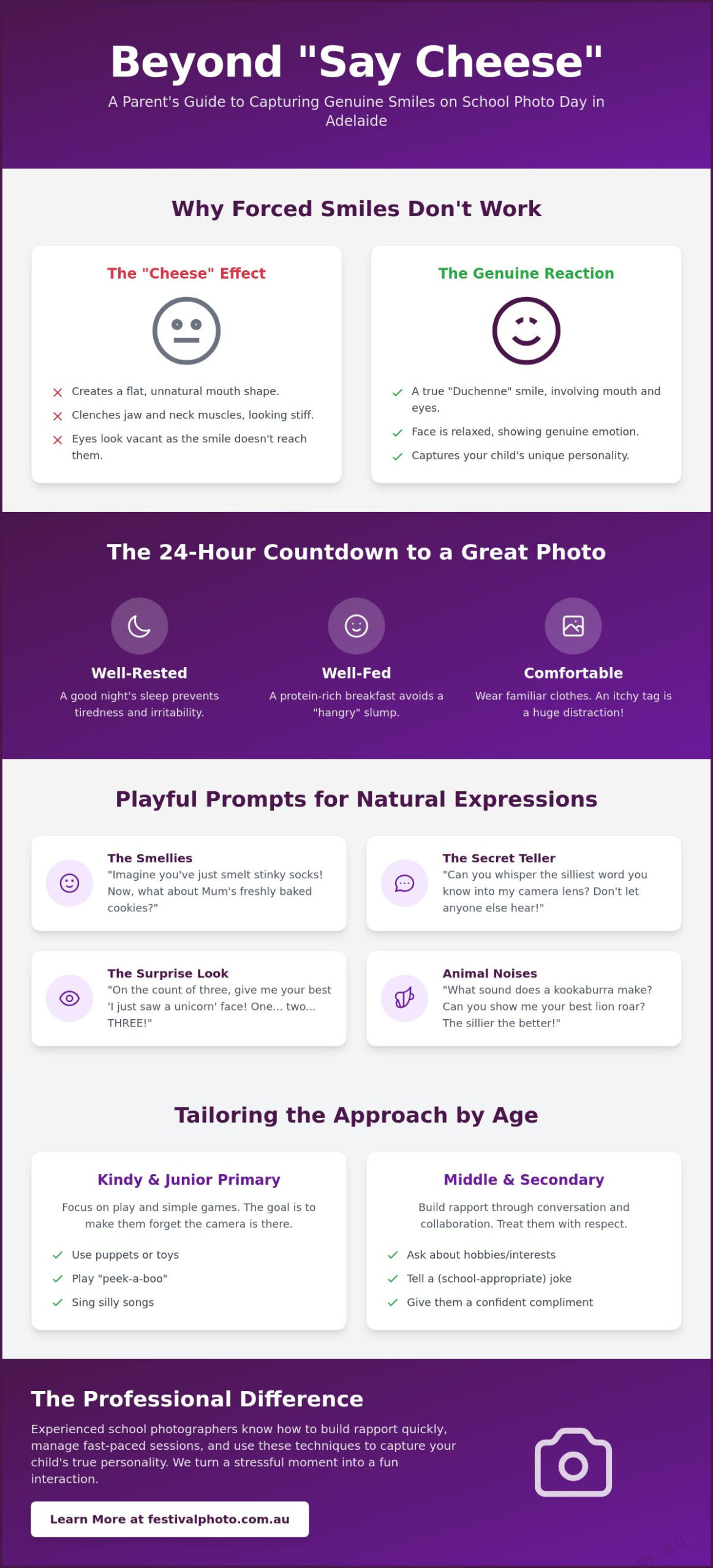
The technical reason “cheese” fails lies in the “ee” sound itself. It forces the mouth into a wide, unnatural shape that clenches the jaw and tightens the neck muscles. This is a far cry from a natural expression of joy. Understanding the history of portrait photography helps explain why we are so obsessed with the perfect grin today, even though early subjects remained stoic for several minutes at a time. In the modern era, we have moved toward capturing personality, but our methods for eliciting it are often stuck in the past. When a child is told to smile, it becomes a performance task. This triggers a subtle anxiety response, making them self-conscious about their face rather than relaxed in the moment.
The Anatomy of a Fake Smile
A true expression of happiness is known as a Duchenne smile. It is the only true expression of joy because it involves the involuntary contraction of the orbicularis oculi muscles around the eyes. Forced “social” smiles only engage the mouth, leaving the eyes looking vacant or “dead.” This creates the common “clenched jaw” look seen in many school photos. When kids try too hard to follow instructions, they often hold their breath or bite down, resulting in a stiff portrait that lacks the warmth of their actual personality.
The Pressure of the Lens
Professional photography equipment can be incredibly intimidating for a young child. Large lenses, bright studio lights, and the fast paced environment of a school photo day can cause even the most outgoing kid to freeze up. This pressure is often compounded by parental expectations. If a child feels they must “get it right” for an expensive photo package, they are less likely to relax. Old tricks like “looking at the birdie” are largely ineffective for modern, tech-savvy kids. Instead, we must shift the focus from the end result to the immediate experience, ensuring the child feels safe and engaged throughout the process. Learning how to get kids to smile for photos is ultimately about building a brief but meaningful rapport that allows their natural character to shine through the glass.
Preparation for Success: Setting the Scene Before Photo Day
A genuine smile is the final piece of a puzzle that begins long before the photographer arrives. If you want to master how to get kids to smile for photos, the preparation starts at home. A child who is tired, hungry, or physically uncomfortable will struggle to engage with even the most talented professional. By managing the environment and expectations in the 24 hours leading up to the shoot, you create a foundation where a natural expression can surface without being forced.
Adelaide’s unique climate plays a significant role in this preparation. On our warmer spring or summer days, hydration is vital for more than just health; it ensures skin looks clear and eyes remain bright. For hair, consider the local humidity. Using a light anti-frizz product can manage flyaways without making the hair look greasy or stiff. Most importantly, avoid making photo day a high-stakes event. If you treat it as a normal, enjoyable part of the school term, your child will likely mirror that calm energy during their individual portraits.
The 24-Hour Photo Day Countdown
Success is found in the routine. Ensure your child gets a solid night’s sleep and a protein-rich breakfast to avoid the mid-morning “slump” that often leads to irritability. Avoid debuting brand-new, stiff clothes on the day. An itchy tag or a tight collar is a constant distraction that prevents a child from relaxing. While infants have specific developmental milestones for smiling, school-aged children require a sense of physical ease to let their guard down. A “no stress” morning routine, where bags are packed and uniforms are ready the night before, sets a positive tone for the entire day.
Choosing the Right Outfit for Natural Movement
Comfort is the foundation of confidence. While we want our children to look their best, clothing that restricts movement often leads to stiff posing. When preparing for class group photos or sports team photos, check that the uniform or kit fits correctly. Consider these quick checks:
- Uniform Fit: Ensure collars aren’t too tight and jumpers aren’t overly bulky.
- Fabric Choice: Avoid “scratchy” wools or stiff synthetics for non-uniform days.
- Footwear: Even if feet aren’t in the shot, uncomfortable shoes affect a child’s posture and mood.
A quick check of your school’s specific requirements ensures everything is in place. This allows the student to focus on the fun of the experience rather than worrying about their appearance. By removing these small physical hurdles, you make the process of how to get kids to smile for photos much more natural and effective.
Age-Appropriate Engagement: Strategies for Every Milestone
A five-year-old attending their first day of school requires a vastly different approach than a Year 12 student preparing for their final graduation portraits. One size definitely doesn’t fit all. Understanding how to get kids to smile for photos means recognising these developmental shifts and adjusting the energy to match. While a toddler might respond to pure silliness, a teenager needs a sense of agency and mutual respect to feel comfortable enough to show their true self.
Building trust is the foundation of any successful session. For shy children, we often use “parallel play” or quiet observation before even raising the camera. This allows the child to grow accustomed to our presence without feeling like the immediate centre of attention. When the pressure is removed, the personality naturally emerges. Sibling photos are also a fantastic tool; the presence of a brother or sister often provides an instant safety net, turning a daunting solo task into a shared family moment. Exploring creative sibling photo ideas for school can help you plan poses that feel natural and capture the genuine bond between your children.
Kindy and Early Primary: The Power of Play
At the kindy level, engagement is all about distraction and delight. We often use puppets, gentle “wrong” names, or silly noises to break the ice. One of our most effective techniques is the “don’t you dare smile” game. By playfully challenging a stubborn toddler to keep a serious face, we almost always trigger a genuine, bubbling laugh. If a child is experiencing “stranger danger,” we take the time to chat with the teacher or parent first, showing the child that we are a trusted part of their community before starting any preparing for kindy photos session. For a comprehensive look at managing the morning routine and choosing the best outfits for your youngest, our Kindy Photos page has everything you need.
Upper Primary and Tweens: Finding the Balance
As children move into upper primary, they become more aware of the camera. The “silly” approach can sometimes feel patronising to a ten-year-old. Instead, we pivot to genuine conversation. Asking about their favourite sports team, a recent school project, or a hobby helps them forget the lens. This is also the “awkward” phase of missing teeth or new braces. We handle this with care, ensuring they know that these milestones are a perfect part of their story. Whether it’s for individual portraits or sports team photos, the goal is to make them feel confident in their own skin.
Year 12 and Beyond: Respect and Professionalism
For secondary students, the dynamic shifts toward a professional partnership. We treat these young adults with the same respect we would show a staff member during their portraits. By giving them agency over their pose and explaining the technical side of the lighting, we build a sense of confidence. This is particularly vital for graduation portraits or school formal photos. We provide subtle guidance rather than strict commands; this ensures the final image feels like a sophisticated representation of their achievement rather than a forced school requirement. When a student feels seen and respected, they don’t need to be told how to get kids to smile for photos; the expression happens naturally.
Proven Games and Prompts for Natural Expressions
Once the technical setup is perfect and the child feels at ease, the magic happens through interaction. Moving beyond the “Say Cheese” dilemma we discussed earlier, we use specific, playful prompts that trigger an emotional response rather than a physical instruction. Knowing how to get kids to smile for photos is often about being a bit of a larrikin and catching them off guard with something absurd. When a child is surprised by a silly question, their defensive “photo face” vanishes, replaced by the genuine warmth we aim to capture.
One of our most reliable techniques for sibling photo ideas for school is the “Secret Teller” prompt. We ask one child to whisper a silly secret into their brother’s or sister’s ear. It doesn’t matter what they actually say; the proximity and the “hush-hush” nature of the game almost always result in a genuine, shared giggle. For solo portraits, we might pivot to “The Smellies.” Asking a child who has the stinkiest feet in their family, or if their dad has smelly socks, breaks the formal atmosphere instantly. It’s a bit of “gross-out” humour that works wonders for primary-aged students in Adelaide.
Reverse Psychology Games
Sometimes the best way to get a smile is to strictly forbid it. We often initiate a “serious face” contest to see who can keep a straight face the longest. By telling a child they are absolutely NOT allowed to smile, we effectively remove the performance anxiety that comes with trying to look “perfect.” This shift in focus allows their natural spark to return to their eyes; eventually, the dam breaks into a beautiful, authentic grin. This technique is particularly effective for kids who tend to give a “plastic” smile when they are trying too hard to please the adults in the room.
Silly Scenarios and “The Wrong Way” Songs
Nonsense is a powerful tool in a professional photographer’s kit. We might ask a child if they had “baked beans and ice cream” for brekkie, or if they saw an Adelaide Crows player hiding in the school playground this morning. These local references help ground the experience in their own world. If we’re working with younger children, we might sing a popular song but get the lyrics hilariously wrong. Singing about a “Greeny” instead of “Bluey” usually earns a quick correction and a bright smile. For more active shots, we use movement-based prompts like “jump on three” or “give your friend a quick squeeze.” These actions create a physical release of tension, ensuring the final individual portraits capture a moment of true joy rather than a static pose.
If you’re ready to capture these genuine moments for your school or club, book your next photo day session with our expert team and see the professional difference in every smile.
The Professional Difference: How Festival City Captures the Real You
While parent-led prompts are helpful for a weekend snap, the environment of a busy Adelaide school photo day requires a different level of expertise. Our photographers are experts in how to get kids to smile for photos even when the schedule is tight and the volume of students is high. We manage this fast-paced setting by combining technical precision with a genuine passion for capturing the unique narrative of every child. By using professional-grade lighting and high-end equipment, we make every student feel like a star the moment they step in front of the lens.
A professional eye is trained to see the “in-between” moments that often go unnoticed. It might be the way a younger brother looks up at his older sister or the subtle sparkle in a student’s eyes just before they laugh. We place a high value on sibling school photos, as these images capture a family bond that evolves year by year. Our goal is to provide more than just a record of attendance; we want to deliver a portrait that parents recognise as the true version of their child.
Our Approach to School and Sports Photography
Creating a “safe space” at the camera station is our first priority. We train our team to engage with diverse personalities and specific needs, ensuring every student feels comfortable and respected. Whether we are capturing individual portraits or high-energy sports team photos, we adapt our energy to suit the individual. This tailored approach is why our graduation portraits Adelaide are so highly valued by families. We treat these milestone sessions with the significance they deserve, providing subtle guidance that empowers students to feel confident in their achievements.
Ordering Your Keepsakes with Confidence
Once the session is complete, the focus shifts to creating lasting heirlooms. We offer a comprehensive range of products designed to suit modern family needs. You can choose from the following options:
- Digital Image Files: Perfect for sharing with extended family or archiving for the future.
- Archival Prints: Professional-grade prints designed for longevity and superior colour reproduction.
- Composite Group Photos: A structured, tidy way to remember every classmate and teacher.
Choosing the right digital files and prints ensures your memories are preserved with the highest quality possible. Our structured ordering process is designed to be clear and direct, helping busy parents find exactly what they need without fuss. We understand that these photos are an investment in your family’s history, and we take that responsibility seriously. If you want to ensure your school or club benefits from our specialised expertise in how to get kids to smile for photos, we are ready to help. Contact Festival City Photography to book your school or club today and experience a seamless, professional photo day.
Capture Genuine Moments for Years to Come
Transforming a stiff school portrait into a cherished memory starts with a simple shift in focus. By moving away from forced commands and embracing age-appropriate play, you can finally master how to get kids to smile for photos in a way that feels natural and relaxed. Whether it’s ensuring they are well-fed and comfortable before photo day or using silly prompts like “The Secret Teller,” the goal is always to capture the authentic personality that makes your child unique.
Festival City Photography has been a family-owned Adelaide business since 1990. We are specialists in everything from kindy photos to university graduation portraits, ensuring every milestone is documented with technical precision and care. Our rapid-turnaround digital and print delivery means you won’t be waiting long to see those heartwarming results. Book your Adelaide school or sports photography with the experts at Festival City to ensure your next photo day is stress-free and full of genuine smiles. We look forward to helping you preserve these precious family chapters.
Frequently Asked Questions for Adelaide Parents
What should I do if my child is extremely shy on photo day?
Start by letting your child’s teacher know about their anxiety, as they can provide extra support during the transition to the camera station. Our photographers are trained to build quick rapport through observation and gentle conversation. We never rush a shy student; instead, we create a calm environment that allows them to feel secure before we begin capturing their individual portraits.
How do I handle a child with a “missing tooth” gap in their smile?
You should embrace the gap as a wonderful marker of their growth and development. Missing teeth are a classic part of the primary school experience and add a layer of authenticity to their school portraits. When considering how to get kids to smile for photos, remember that a genuine, toothless grin is far more precious than a forced, closed-mouth expression that looks unnatural.
Can I request a “serious” photo instead of a smiling one?
Absolutely, because our goal is to capture your child’s actual personality. While most parents look for a grin, some children have a naturally soulful or stoic expression that is more representative of who they are. We focus on capturing a relaxed, authentic face, whether that includes a wide smile or a quiet, thoughtful look that reflects their character at this specific age.
What are the best colours for kids to wear for professional portraits?
Solid, mid-tone colours like soft blues, greens, or earthy tones generally look best against professional backdrops. We recommend avoiding neon colours, as they can reflect onto the skin, and large logos which can distract from the face. If it is a non-uniform day, choose a colour that complements your child’s eyes to ensure their features remain the focal point of the portrait.
How long does a typical school photo session take per child?
Individual portraits usually take between one and two minutes per student. This timeframe allows our photographers to check their uniform, adjust the lighting, and use a few quick prompts to elicit a natural expression. We balance this efficiency with a high degree of care, ensuring the session feels like a positive highlight of their school day rather than a rushed or stressful task.
Should I let my child practice their smile in the mirror?
We generally advise against mirror practice as it often leads to a “practiced” or stiff expression. When kids rehearse a smile, they tend to focus on the shape of their mouth rather than the feeling of joy. Instead of rehearsing, talk to them about things that make them laugh. This helps them understand how to get kids to smile for photos by focusing on genuine emotion rather than a muscular pose.
What happens if my child is sick on the day of the school photos?
Most Adelaide schools organise a scheduled “catch-up” day for students who were absent during the main session. If your child is unwell, it is best to keep them home so they can recover and look their best for the rescheduled shoot. You should contact your school’s front office to confirm the specific date for these follow-up individual portraits and sibling photos.
Are digital files better than physical prints for school photos?
Both formats offer unique benefits for families. Digital Image Files provide a permanent backup and allow for easy sharing with relatives across Australia or overseas. However, professional-grade physical prints offer a tangible quality and colour accuracy that screens cannot replicate. Many parents choose a package that includes both, ensuring they have a modern backup and a beautiful heirloom for the lounge room wall.