
The school photo day has passed, a new student is settling in, and there’s still no portrait for their ID. For Adelaide schools, late enrolment student ID photo sessions Adelaide are easier to manage when portrait capture and card requirements are planned together, rather than handled as separate admin tasks.
Students may arrive at different times, replacement cards may be needed, and staff need a reliable way to keep records and photos aligned. A suitable portrait is part of the process, but the school’s requirements and card workflow determine which steps are needed.
This guide explains how to organise catch-up photography for late enrolments, what to consider when a student needs a replacement card, and how portrait capture connects with ID card production. Festival City Photography provides school portraits and student ID cards, helping Adelaide schools coordinate the photography component with their card requirements.
Key Takeaways
- Set up a catch-up portrait opportunity for students who enrol after the main school photo day.
- Map the school’s card requirements and portrait process before preparing a new or replacement student ID card.
- Compare a new portrait with an existing approved image, considering suitability, school rules and administrative effort.
- Use a clear sequence to identify eligible students, organise a practical catch-up session and confirm card details.
- Learn how late enrolment student ID photo sessions Adelaide can connect individual portraits with student ID card production.
Late-enrolment student ID photos in Adelaide: why a catch-up process matters
A student may join a school after its main portrait day, leaving staff to arrange an image for school records and an ID card. A late-enrolment ID photo session is a planned catch-up opportunity for students who missed the scheduled photography or need a new image for the school’s card process.
It helps to distinguish two requests that can sound alike. A newly enrolled student may need an initial portrait and card. A current student requesting a replacement after a card is lost or damaged may need a new card, but not necessarily a new portrait. If the school accepts the student’s existing image, that portrait may be reused. The school’s requirements determine which option applies.
Coordinating portraits promptly helps schools keep student images and identity details consistent across records and ID cards. A defined catch-up process also gives administrators a repeatable way to manage students who arrive after the usual photography schedule.
When does a student need a catch-up ID portrait?
A catch-up portrait may be needed when a student enrols after scheduled school photography, or when their original portrait was missed, is unsuitable or isn’t available for the school’s card process. For example, a student may have started after photo day, or their existing image may not meet the institution’s requirements for clarity or identification.
By contrast, replacing a lost or damaged card is a card request first. The school can decide whether an approved existing portrait is still suitable or whether the student should be photographed again. Keeping these requests separate avoids unnecessary portrait capture while allowing the school to update card images when its process requires it.
Which parts of the ID process does the school manage?
The school or institution sets the identity details required on a card, its photo standards and the purposes the card serves. It also determines whether a student needs a new portrait or can use an existing approved image. These decisions give a photography provider the specifications needed to support portrait capture and student ID card production.
Student cards can serve different purposes across institutions. The Campus card overview describes the range of functions associated with campus identification, but a school’s specific card capabilities depend on its chosen technology and requirements. Don’t assume a card has smart-card functions or encoded features based on its appearance alone.
For schools, bringing portrait needs and card requirements into one workflow can make late arrivals easier to manage. Festival City Photography provides individual portraits and student ID cards as part of its education photography services in Adelaide and South Australia. Administrators can use the school’s established requirements to identify who needs a new photo and how it fits into the card process.
What to expect from student ID photo sessions and replacement card printing
A straightforward workflow links three decisions: what the card must show, which portrait will be used and how the school’s required details are prepared for the card. Keeping these stages clear helps administrators avoid rework, particularly when a late enrolment or replacement request arrives alongside routine school tasks.
Institutions set the required card format and identity details. The photography provider supports the portrait and student ID card components, while the school supplies or approves the specifications that guide the work. For Adelaide schools, late enrolment student ID photo sessions Adelaide can be planned around these requirements, keeping portrait capture and card preparation connected while making their separate responsibilities clear.
How does a portrait become part of a student ID card?
The portrait helps staff identify a student by matching a recognisable image with the information required by the institution. Image capture or selection is one stage; preparing the card is another. Festival City Photography provides student portraits and student ID cards, while the school’s process determines how the image and approved details come together. This doesn’t imply any particular software, security feature or encoded technology.
What details should the school settle before production?
Before production begins, the school should establish the card dimensions, layout, branding and required student information. It should also set the portrait requirements and image format used in its process. Clear specifications help keep cards consistent, whether the school is arranging a new portrait or using an image it has already approved.
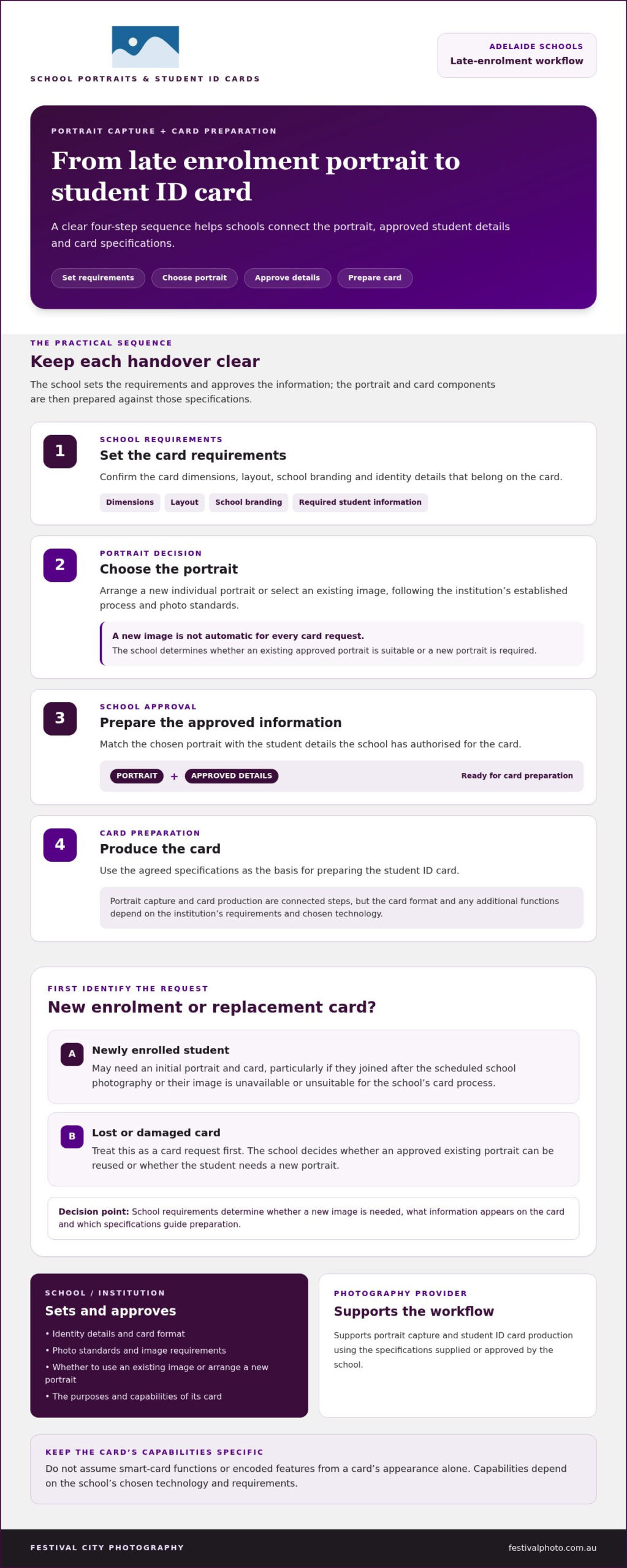
A practical sequence keeps the handover organised:
- Set the card requirements. Confirm the layout, school branding and identity details that belong on the card.
- Decide on the portrait. Arrange a new individual portrait or select an existing image according to the institution’s established process.
- Prepare the approved information. Match the chosen portrait with the student details the school has authorised for the card.
- Produce the card. Use the agreed specifications as the basis for preparing the student ID card.
Photography and card production are connected, but one doesn’t determine the other. A well-composed portrait can support clear identification, while the card’s format and any additional functions depend on the institution’s requirements and chosen technology. Keep those decisions with the school and include its approved specifications in the production workflow.
For broader planning, the school photography Adelaide buyer’s guide can help schools consider how portrait requirements fit within their wider photography plans. Festival City Photography provides individual portraits and student ID cards for educational clients in Adelaide and South Australia. Schools can include school portrait and ID card photography in their planning for a coordinated portrait and card process.
Replacement student ID cards: compare a new portrait with an existing image
A replacement card request doesn’t automatically mean a new photo is needed. The right choice depends on the institution’s image rules, whether an approved portrait is available and suitable, and the student’s circumstances. For schools coordinating late enrolment student ID photo sessions Adelaide, separating portrait recapture from card replacement helps avoid unnecessary steps while respecting the school’s identification process.
Use this comparison as a starting point. The school or institution makes the final decision about whether an existing image can be reused or another approach is required.
| Option | Image suitability and student circumstances | Rules and administration |
|---|---|---|
| New portrait | Useful when the original image is missing, unsuitable for the card layout or no longer meets the institution’s portrait requirements. It may also suit a student whose circumstances call for a fresh image under school procedures. | Requires arranging portrait capture and adding the approved image to the card workflow. The institution’s requirements guide the decision. |
| Existing approved portrait | May be suitable if the image is available, clear and appropriate for the card’s layout and the student’s current identification needs. | Reuse is subject to institutional rules. Administrators need to locate the correct file and ensure it is the image approved for that student and card. |
| Institution-directed alternative | May apply when the usual image options don’t fit the student’s circumstances or the institution’s procedure. | The school determines the appropriate next step and any information needed to process the replacement request. |
When might a replacement need a new student portrait?
A new portrait may be appropriate if the original was never captured, can’t be located or doesn’t meet the school’s established requirements for identification or card presentation. The school may also want a standardised image to maintain consistency across student cards. These are reasons to consider recapture, not automatic rules. The institution’s card and identity procedures determine whether a new photo is necessary.
When could an existing portrait be suitable?
An existing image may work if the institution permits reuse, the file is available and the portrait remains suitable for the card’s layout and identification purpose. Administrators can consider whether the image is clear, recognisable and consistent with the school’s approach to student portraits. An older image shouldn’t be assumed valid for every student or replacement card; approval rests with the institution.
To make the decision manageable, administrators can identify why the card is being replaced, check the relevant image rules and establish whether an approved portrait is accessible. If it is suitable, the school can follow its process for reusing it. If it isn’t, a new individual portrait can be arranged as part of the card workflow. Recording the decision helps staff handle similar requests consistently, without treating every lost or damaged card as a photography request.
How Adelaide schools can organise late-enrolment ID photo sessions
A simple plan helps school staff coordinate portraits without disrupting the usual timetable. Start with a current record of students who need a photo or card, then agree on requirements, session arrangements and responsibilities before inviting students. Where practical, grouping late arrivals into one catch-up session can make coordination easier for administrators and students.
For late enrolment student ID photo sessions Adelaide schools can use a consistent process that fits the school calendar, venue arrangements and privacy procedures. Keep student information within the school’s established systems and share only the details needed to coordinate portraits and card preparation.
A practical catch-up session checklist for school administrators
Before setting a date, confirm who needs a new portrait and who has a card request that may follow a different process. Then organise the session around the school’s approved specifications and the staff responsible for student records.
- Compile the student list. Identify students needing a first portrait, a recapture or a replacement card, and record the relevant request in the school’s usual system.
- Confirm the requirements. Settle the portrait specifications, card layout and student information required. Check these details internally so the session and subsequent card preparation follow the same instructions.
- Choose a practical time and location. Fit the session around the school calendar, student availability and a suitable space. Consider grouping students into an allocated catch-up session where that works for the school community.
- Share clear instructions. Tell students and relevant staff when and where to attend, what details to have ready and how the school expects them to prepare for the portrait.
- Reconcile the records. After capture, match each portrait to the correct student using the school’s procedures, then confirm the required card information before it moves to production.
One staff member can coordinate the list and session details, while the school’s nominated administrator retains responsibility for institutional requirements and student information. A clear division of responsibilities helps the portrait session run smoothly and reduces the risk of mismatched details during card preparation.
What should students have ready on the day?
Students should follow the instructions issued by their school. These may cover their allocated arrival time, the identity details the school needs and any institution-specific identification requirements. Clothing should also follow the school’s portrait guidelines, particularly if the image is expected to align with other student ID portraits.
Arriving at the allocated time helps the school keep the session orderly. If a student is unsure about card details, required documents or what to do after the portrait, they should speak with the school’s nominated administrator. The photographer supports portrait capture; the institution directs its card and identity procedures.
Festival City Photography provides individual portraits and student ID cards for education clients. Arrange school portraits and student ID cards as part of a coordinated catch-up process for your school.
Festival City Photography for Adelaide student ID portraits and cards
Late arrivals and replacement requests are easier to manage when portrait photography is treated as part of a school’s wider student ID process. Festival City Photography is a South Australian education photography specialist, providing individual portraits and student ID cards for educational clients in Adelaide and across the state. Schools can coordinate student images with their own card requirements as part of their photography planning.
For schools arranging late enrolment student ID photo sessions Adelaide, a clear division of responsibilities matters. The institution sets its identity procedures, required card details and image guidelines. Photography supports the portrait side of the process, while student ID card production brings the approved portrait and school-provided information together. This coordination helps administrators plan for late enrolments without assuming every card request needs a new photo.
A school-focused approach to portraits and student ID cards
School photography involves coordinating with an education community and working within its established routines. Late-enrolment portraits may need to fit school timetables and the institution’s process for identifying students and preparing cards. Aligning requirements ahead of a session helps staff decide who needs a portrait, what image guidance applies and how card details will be handled.
Festival City Photography is second-generation family-owned and operated, and was founded around 1990. Its work in South Australian school photography includes individual portraits and student ID cards, connecting the photography and card components while the institution retains control of its identity rules and card specifications.
Plan the next step for late-enrolment students
Administrators can begin by outlining the school’s requirements: which students need a first portrait, which requests relate to replacement cards, and what image and card details the institution has approved. They can then coordinate those needs with the school calendar and communicate clear instructions to students and families. Keeping the student list and card information within the school’s usual administrative process supports accurate coordination.
Families should follow their school’s directions for enrolment, portrait arrangements and card administration. The school can explain what the student needs to bring or prepare, and direct questions about institutional card procedures to its nominated administrator. This keeps photography arrangements distinct from decisions the school makes about identity details or card use.
For a school planning individual portraits alongside student ID cards, a defined catch-up process can make late arrivals easier to include. Explore Festival City Photography’s education services to plan photography that fits your school’s student portrait and card needs.
Make your next catch-up session easier to plan
Late arrivals are part of a school year’s changing rhythm. A repeatable process helps staff respond without rebuilding the workflow every time a student needs a portrait or replacement card. Keep a current checklist of school requirements, assign a staff member to coordinate the student list and note what worked after each session. This review can make future late enrolment student ID photo sessions Adelaide schools organise clearer for administrators, students and families.
For the next step, bring together the school’s portrait needs and card requirements, then plan a catch-up arrangement that fits the community and calendar. Families can follow the school’s directions, while administrators coordinate the photography and institutional details through the appropriate channels.
Explore Festival City Photography’s education services to plan a well-organised student portrait process for your Adelaide school.
Frequently Asked Questions
Can a late-enrolling student use a photo taken on a phone for an ID card?
Only if the school accepts it and the image meets its requirements. A phone photo might be clear enough but still be unsuitable if the background, framing, lighting or file format doesn’t match the institution’s process. Before submitting one, families should follow the school’s photo instructions and use the specified method. If the school requires a consistent portrait taken through its catch-up process, a phone image may not be appropriate.
Does a replacement student ID card always need a new photo?
No. A replacement card may be prepared with an existing image if the institution allows reuse and the approved file can be accessed. For example, a misplaced card may need replacing while the student’s current portrait remains suitable. A new photo may be needed if the image can’t be found or no longer meets the school’s requirements. The school decides which option applies to each request.
What information should a student have ready for a replacement ID card?
Students should follow the school’s instructions, as required details vary by institution. The school may ask them to confirm identifying information, such as their name or student number, and explain whether the card is lost, damaged or needs another kind of replacement. Accurate details help staff match the request to the correct student record. Students shouldn’t send personal information through an unapproved channel or assume every card uses the same fields.
How can schools arrange ID photos for students who enrol after photo day?
Schools can maintain an enrolment-based catch-up register so newly arrived students aren’t missed after the main portrait day. Once staff have identified who needs an image, they can set a suitable session and share clear instructions with students and families. For late enrolment student ID photo sessions Adelaide schools can coordinate portrait requirements with the institution’s existing card process, while keeping responsibility for student records and card rules with the school.
What happens if a student loses an ID card before receiving a replacement?
The student should tell the school or institution promptly and follow its instructions while the replacement is being arranged. The school can explain whether there’s an interim way to verify the student’s identity or access services, based on its own procedures. Students shouldn’t assume a photo of the lost card or another document will be accepted. If the card may have been found by someone else, report that as part of the loss notification.
Are replacement student smart cards the same as ordinary photo ID cards?
Not necessarily. A photo ID card displays information used to visually identify its holder. A smart card may also be designed to work with electronic systems, but its capabilities depend on the institution’s specified technology and how the card is configured. A replacement photo card shouldn’t be assumed to include electronic functions. The school or institution determines what type of card it uses and what steps apply when replacing one.