
In 2026, a school photography contract is no longer just about who takes the best portraits; it’s a critical data security agreement that can either protect or compromise your school’s reputation. You’re likely exhausted by the technical jargon surrounding data sovereignty and the annual headache of a disrupted timetable. It’s frustrating when photo day feels like a hurdle rather than a highlight for your staff and students. To navigate these challenges, you need a robust school photography contract checklist Australia that ensures your provider acts as a seamless, reliable extension of your own team. We understand that you want excellence without the admin burden.
This guide provides a structured roadmap to help you master the complexities of procurement while ensuring total compliance with the Privacy Act 1988 and the Australian Privacy Principles. We will show you how to vet vendors for data security, manage parent pricing expectations, and build a partnership rooted in community trust. By the end of this article, you’ll have the tools to guarantee a low-admin photo day that keeps your school running smoothly and your parents satisfied with the results.
Key Takeaways
- Learn why the shift to digital image files and strict data sovereignty laws makes a 2026 contract review essential for protecting student privacy.
- Use our structured school photography contract checklist Australia to verify technical capabilities and ensure all providers meet mandatory WWCC and insurance benchmarks.
- Master a five-stage roadmap for your next RFP, allowing you to identify service gaps and select a partner that operates as a low-friction extension of your school.
- Identify why local Australian hosting and robust encryption are critical for securing parent ordering portals and maintaining community trust.
- Explore the logistical advantages of partnering with a local Adelaide specialist to manage rapid reschedules for sports portraits and special events.
Why Reviewing Your School Photography Contract is Essential in 2026
The traditional model of school photography has undergone a massive transformation. While physical prints remain a cherished keepsake, 2026 has seen a definitive shift toward high-demand digital image files. This transition isn’t just about convenience. It’s about how schools manage their digital assets and protect student identities. When you use a school photography contract checklist Australia, the first priority must be data sovereignty. With the Australian Privacy Principles (APPs) tightening, ensuring that student data is hosted locally rather than on overseas servers is a non-negotiable requirement for modern administrators.
Beyond security, your contract should reflect the 2026 standard for inclusive and diverse portraiture. This means moving beyond “one size fits all” lighting and poses to ensure every student is represented with dignity and artistic merit. Understanding Photography and the law in an Australian context is vital here, as it governs how these sensitive images are captured, stored, and eventually archived. A modern agreement should clearly outline these responsibilities to protect the school’s reputation and its students.
Meeting 2026 Parental Expectations
Today’s parents live on their smartphones. They expect a mobile-first ordering experience and the ability to access instant digital downloads as soon as proofs are ready. The days of rigid, pre-set packages are over. Families now demand flexible “build-your-own” options that allow them to mix sibling photos with individual portraits. Professional retouching has also evolved. The modern era requires a subtle, natural approach that maintains the authenticity of the child while ensuring a polished final result. If your current provider can’t offer this level of digital agility, your contract is already outdated.
Institutional Efficiency and Admin Savings
A well-structured photography agreement can save your office staff over 20 hours of admin time per year. Modern workflows allow for automatic integration with School Management Systems (SMS), meaning student IDs are generated seamlessly without manual data entry. By moving to online-only ordering portals, you completely remove the “money handling” burden from classroom teachers. This streamlined approach extends to your staff portraits too, ensuring school directories and security badges are updated rapidly with minimal fuss. It’s about making the photographer a seamless extension of your administration team, rather than a yearly logistical hurdle to overcome.
Key Selection Criteria for Australian School Photography Tenders
Selecting the right provider requires a move beyond just looking at sample prints. You need an objective evaluation scorecard to compare technical capabilities and safety standards. A comprehensive school photography contract checklist Australia helps you weigh these factors equally. It ensures that the creative flair of the images is backed by the operational rigour required in a modern educational setting. When you assess a tender, you’re looking for a partner that can handle the sheer volume of a large student cohort without sacrificing the narrative quality of individual portraits.
Compliance and Safety Non-Negotiables
This emphasis on professional presentation often extends to school branding and event signage; to see how specialists like Print It ZA manage high-impact visual requirements in their latest guide for the retail sector, learn more about modern display standards.
Safety is the foundation of any institutional partnership. You must verify that every staff member attending your site holds a current Working with Children Check (WWCC). It’s not enough to have a company policy; you need to see the proof. Robust child protection policies should be standard. Additionally, the industry standard for public liability insurance in Australia is A$20 million. This level of coverage protects the school and the community during large-scale events or ceremonies.
Security isn’t just physical. A recent UNSW report on student data risks highlights how easily children’s information can be compromised through third-party vendors. Your tender should demand clear answers on how images and personal data are stored. Your school photography contract checklist Australia must include specific questions about data encryption and breach notification protocols to align with the latest privacy regulations.
Product Quality and Versatility
Technical capability varies wildly between providers. Look for consistency in lighting across an entire year level. A quality provider uses sophisticated composite group technology to ensure every student looks their best, even in large class photos. This versatility is crucial when managing everything from kindy photos to graduation portraits Adelaide. High-end equipment and a professional eye make a tangible difference in the final product.
Parents increasingly value the flexibility of digital image files for school photos. Your chosen partner should demonstrate a rapid-turnaround workflow for events like school formals or awards nights. This allows families to share memories almost instantly. If you are looking for a provider that balances these technical skills with a community-focused approach, partnering with a local specialist often provides the most reliable and responsive service model.
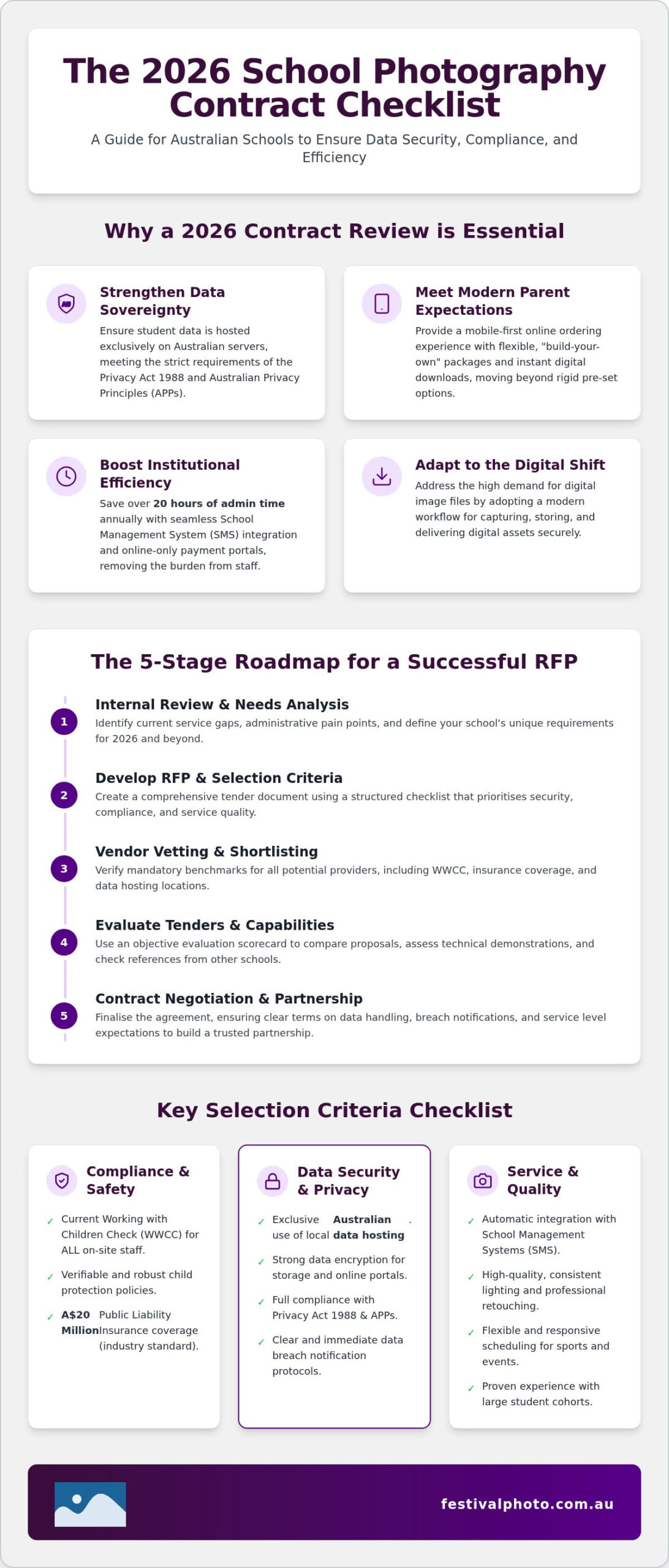
The 5-Stage Roadmap for a Successful Photography RFP
A successful tender process isn’t just about finding a photographer; it’s about securing a service partner who understands the rhythm of your school. To achieve this, administrators should follow a structured five-stage roadmap. This process ensures every box on your school photography contract checklist Australia is ticked before a single shutter clicks. By treating procurement as a strategic partnership rather than a transaction, you protect your school from the common pitfalls of poor communication and technical failure.
Stage 1 & 2: Audit and Drafting
The first step is a candid audit of your current service. Identify the “pain points” that caused the most stress for your office staff or parents last year. Perhaps the photo day disrupted the timetable too heavily, or parent complaints about package pricing were high. Use these insights to set clear Key Performance Indicators (KPIs) for 2026. Your Request for Proposal (RFP) must include essential clauses regarding data sovereignty, rapid-turnaround delivery, and mandatory Working with Children Checks. This document acts as your shield, ensuring any bidding provider meets your specific institutional standards from the outset.
Stage 3 & 4: Shortlisting and Evaluation
When you reach the shortlisting stage, it’s vital to look past the highest commission offer. A provider that promises excessive returns may be compromising on equipment quality or data security. Evaluate technical capability by requesting sample school photography Adelaide portfolios. These should demonstrate consistent lighting and professional composition across various educational tiers. A site visit to the provider’s facility is equally important. It allows you to evaluate their team culture and the digital workflow they use to manage student data safely. You want to see an organised, inspired team that feels like a natural extension of your school.
Stage 5: Final Negotiation and Onboarding
The final stage involves refining the contract to ensure all administrative burdens are shifted to the provider. This includes ensuring they handle all parent queries directly and provide a seamless integration with your school information systems. A successful onboarding process sets the tone for a long-term relationship built on reliability and community trust. It ensures that when photo day arrives, your only job is to welcome the team and let them capture the narrative of your school year.
Evaluating Technical Capability and Data Security Compliance
A modern school photography contract checklist Australia must prioritise technical rigour alongside artistic merit. While the aesthetic quality of a class photo is vital, the digital infrastructure protecting that image is what truly ensures long-term peace of mind. In 2026, the technical capability of a provider is defined by their ability to manage sensitive student data with absolute precision. This involves moving beyond basic password protection to high-level encryption standards for both parent ordering portals and long-term image storage.
Data sovereignty has become a non-negotiable requirement for Australian educational institutions. You must verify that student information is hosted locally on Australian servers. This ensures that the data remains subject to the Privacy Act 1988 (Cth) rather than being vulnerable to foreign jurisdictions. Additionally, as AI-assisted student indexing becomes the industry standard for efficiency, you need to understand how these tools interact with student privacy. A reliable partner will use AI to match names to faces rapidly without retaining biometric data longer than necessary for the production workflow.
The 2026 Data Security Checklist
When reviewing a potential provider, use these specific benchmarks to assess their compliance:
- Data Residency: Confirm that all student personal information and images are stored onshore in Australia.
- Regulatory Alignment: Ensure the provider has a documented policy for compliance with the Privacy Act 1988 and the Australian Privacy Principles.
- Data Retention: Ask for clear protocols regarding the destruction of student data once a student graduates or a contract concludes.
- Disaster Recovery: Verify that the provider has redundant backup systems to protect your school’s visual legacy from hardware failure or cyber incidents.
Digital Workflow and Delivery
Efficiency in 2026 is measured by how well a photographer’s system “talks” to your own. Seamless integration with school management systems like Compass, Daymap, or SIMS allows for the rapid generation of student ID cards and staff portraits. This reduces the manual entry burden on your office team and ensures that school directories are updated within days, not weeks. This same level of security and speed applies to milestone events. For example, our school formal photography packages Adelaide are delivered via secure, encrypted galleries that allow parents to access digital files immediately while maintaining strict privacy controls. If you want to ensure your school meets these high technical standards, contact us to review your digital workflow requirements today.
Partnering with an Adelaide Specialist for Seamless Service
When finalising your school photography contract checklist Australia, the physical location of your provider is often the deciding factor in operational success. Many schools overlook the logistical friction that occurs when partnering with interstate firms. A local Adelaide specialist offers a level of responsiveness that large, national franchises simply cannot match. This “Adelaide Advantage” translates to lower admin stress, as your photography partner becomes a familiar face on campus rather than a distant contractor. Proximity allows for face-to-face briefings with your administration team, ensuring every nuance of your school’s culture is captured accurately.
South Australian schools face unique environmental challenges that require local agility. For example, an unexpected February heatwave can make outdoor group portraits uncomfortable or even unsafe for students. A local partner can pivot rapidly, rescheduling for a cooler day or moving the entire operation to a pre-vetted indoor location with minimal notice. This flexibility is impossible for providers who must fly teams in from Sydney or Melbourne. By choosing a local expert, you ensure that the unpredictability of the Adelaide climate never compromises the quality of your school’s visual record.
Local Agility for Sports and Events
Sports schedules are notoriously fluid. Whether it’s a rain-delayed cricket match or a last-minute change to the athletics carnival, you need a photographer who can adapt. We specialise in managing the complex logistics of sports team photos Adelaide, providing local support for reschedules that keeps your physical education department happy. Because we’ve been Adelaide-based since 1990, we likely already know your campus layout. This familiarity means we set up efficiently without needing constant direction from your groundskeepers or office staff. Our team provides rapid response coverage for awards nights and milestone celebrations, ensuring no achievement goes unrecorded.
The Festival City Commitment
As a second-generation family-owned business, we view every school we serve as a long-term community partner. We aren’t just taking photos; we’re preserving your school’s legacy. This deep-rooted sense of accountability means we care about the small details, from the neatness of a student’s tie to the specific way your school prefers its composite group photos arranged. We don’t believe in rigid, corporate packages. Instead, we customise our services to suit the specific socioeconomic and cultural requirements of your community. It’s a relationship built on years of consistent delivery and mutual respect. If you’re ready to move beyond the admin headaches of previous years, organise a consultation for your 2026 tender today and experience the difference that local dedication makes.
Securing Your School’s Visual Legacy for 2026
Reviewing your photography arrangements is about more than just finding a skilled camera operator. It’s about establishing a secure, low-friction partnership that respects student privacy and supports your administration team. By using a structured school photography contract checklist Australia, you ensure that technical capability, data sovereignty, and mandatory safety checks are all verified before the first photo day of the year.
As an Adelaide family-owned business since 1990, we understand the specific needs of South Australian schools. Whether you require comprehensive coverage from ELC through to Year 12 or rapid digital delivery for milestone events, our local team is here to provide reliable, on-the-ground support. We pride ourselves on being a seamless extension of your school, handling everything from sports reschedules to direct parent queries with professional care.
Don’t let another year pass with outdated contracts or administrative headaches. Download our 2026 School Photography RFP Template to streamline your procurement process and ensure your community receives the quality and security they deserve. We look forward to helping you capture the narrative of your school year with confidence.
Frequently Asked Questions
What is the typical timeline for a school photography tender process in Australia?
A standard tender process should begin at least six months before your current contract expires. For most Australian schools, this means starting in Term 2 or early Term 3 to ensure a smooth transition for the following school year. This timeline allows your committee enough time to conduct site visits, review technical portfolios, and ensure the new provider integrates with your school management systems without a last-minute rush.
Do we have to accept the lowest price in a school photography tender?
No, schools are not obligated to select the cheapest quote during a tender. Procurement guidelines in Australia prioritise value for money, which balances cost against service quality, technical reliability, and data security. Choosing a provider based solely on price often leads to hidden administrative burdens or poor parent support. It’s better to use a school photography contract checklist Australia to score bidders on their long-term dependability and community trust.
What are the mandatory privacy requirements for school photographers in 2026?
In 2026, photographers must comply with the Privacy Act 1988 and the Australian Privacy Principles. These laws govern how student personal information is collected, stored, and shared. Mandatory requirements include having a clear privacy policy, obtaining parental consent for image use, and ensuring all on-site staff hold a current Working with Children Check (WWCC). Your contract should explicitly state these obligations to ensure the school remains fully compliant with federal regulations.
How do I ensure a new photography provider won’t disrupt our school schedule?
You can guarantee a smooth photo day by requesting a detailed logistical plan during the RFP stage. A professional provider will offer a structured schedule that accounts for recess, lunch, and specialist classes. They should use rapid-turnaround digital workflows and automated student indexing to move cohorts through the studio quickly. Checking references from schools of a similar size will also confirm if the team can handle high-volume days without disrupting the learning environment.
Can we include school formal and sports photography in the same tender?
Yes, bundling services like sports team photos, graduation portraits, and school formal coverage into one tender is highly efficient. This all-encompassing model reduces the number of vendors your office needs to manage and often results in better value for parents through unified ordering portals. It also ensures a consistent visual style across all school publications, from the annual yearbook to the latest sports department newsletter or student ID cards.
What should be included in a school photography technical scorecard?
A technical scorecard should evaluate lighting consistency, image resolution, and the provider’s digital infrastructure. You should specifically look for automated integration with school management systems like Compass or Daymap. Scoring should also account for the security of parent ordering portals and the speed of digital file delivery. This objective approach ensures you select a partner capable of meeting the high technical standards expected in a modern Australian educational setting.
How often should a school review its photography contract?
Most Australian schools review their photography agreements every three to five years. While some contracts run for a single year to allow for maximum flexibility, a three-year term is the industry standard for larger institutions. This duration provides enough stability to build a strong relationship with the photography team while allowing for regular market testing to ensure your school still receives the best technology and data security features available.
What is data sovereignty and why does it matter for my students?
Data sovereignty refers to the requirement that student information and images are hosted on servers located physically within Australia. This is critical because it ensures that sensitive data is protected by Australian law rather than being subject to foreign jurisdictions. When student photos are stored onshore, the school maintains better control over privacy and security, which is essential for building and maintaining long-term community trust with parents and guardians.