
A calm whole-school photo day starts with a plan for how people will move, before anyone decides where they’ll stand. For whole school panoramic photo logistics Adelaide schools need to coordinate student groups, staff, timing and the practical realities of their site. A clear sequence helps the session fit around school routines instead of leaving decisions until the day.
Queues, missed lessons, accessibility and changing weather are all worth considering early. Careful preparation gives staff clear responsibilities and a workable schedule, keeping the focus on students and the photograph.
This guide explains how to assess a location, plan group movement, agree on roles with the school contact and photography team, and prepare for weather or layout changes. Festival City Photography is a second-generation South Australian family-owned business with over 30 years’ experience in school and event photography, including class group photos. Use the steps below to build a plan around your timetable, site and photography requirements.
Key Takeaways
- Plan whole school panoramic photo logistics Adelaide around your school’s timetable, site and participant groups.
- Set a clear sequence for confirming participants, briefing staff, assembling groups and returning them to class.
- Compare indoor and outdoor locations for space, access, light, background and ease of movement.
- Use an ownership-based checklist to record the date, location, group order, meeting point and communication method.
- A concise brief for Festival City Photography and the school contact helps align the session with your school’s requirements.
What a whole-school panoramic photo involves – and what Adelaide schools need to plan
A whole-school panorama is a wide-format photograph planned to represent a large school community in one image. The aim is to bring students and, if included, staff together in a clear composition. “Panoramic” describes a broad view, but doesn’t specify how an image will be captured or composed. For background on the term, see What is panoramic photography?
A successful school panorama depends on an agreed plan for who will be photographed, where they’ll gather and how the session fits the school day. That’s the practical difference from class group photos, which are usually organised around individual classes. A whole-school photograph involves a wider group of participants, so it also calls for decisions about the site, group order and timetable.
A useful brief gives the school contact and photography team a shared reference point. Set out the photograph’s purpose, who should be included, the preferred location and a suitable date. Add relevant school requirements, such as access arrangements or areas to avoid. This gives the planning conversation a clear starting point while leaving room for the needs of each school site and schedule.
What should the school decide before choosing a photo date?
Nominate one school contact to coordinate decisions and day-of communication. This person can gather information from leadership and staff, share the agreed plan and direct questions to the right people. Before settling on a date, record who is expected to participate, including whether staff will be in the photograph. A participant list helps identify timetable or group-planning issues early.
Review the school calendar for commitments that could affect attendance or movement. Assemblies, excursions, special events and other scheduled activities may change which students or staff are on site, or limit access to a preferred space. Compare possible dates with those commitments, then include the preferred option in the brief.
Which Adelaide school location could work?
An outdoor area may provide room for the school community to gather, while a hall or another indoor space may offer shelter. Neither is automatically the better choice. Consider how participants will reach the location, whether the route supports safe movement and whether the space suits the needs of students and staff.
Assess conditions at the actual site. Check usable space, entry and exit routes, background, light and school access or safety requirements. Adelaide weather can affect an outdoor plan, so identify a suitable indoor alternative where possible. The best choice depends on the school’s site and conditions. Share relevant constraints with the photography team before finalising the plan.
For schools planning whole school panoramic photo logistics Adelaide, this early groundwork makes later decisions easier. A concise, accurate brief helps the school and photography team plan around the school community and its day-to-day needs.
How Adelaide schools can organise student and staff movement
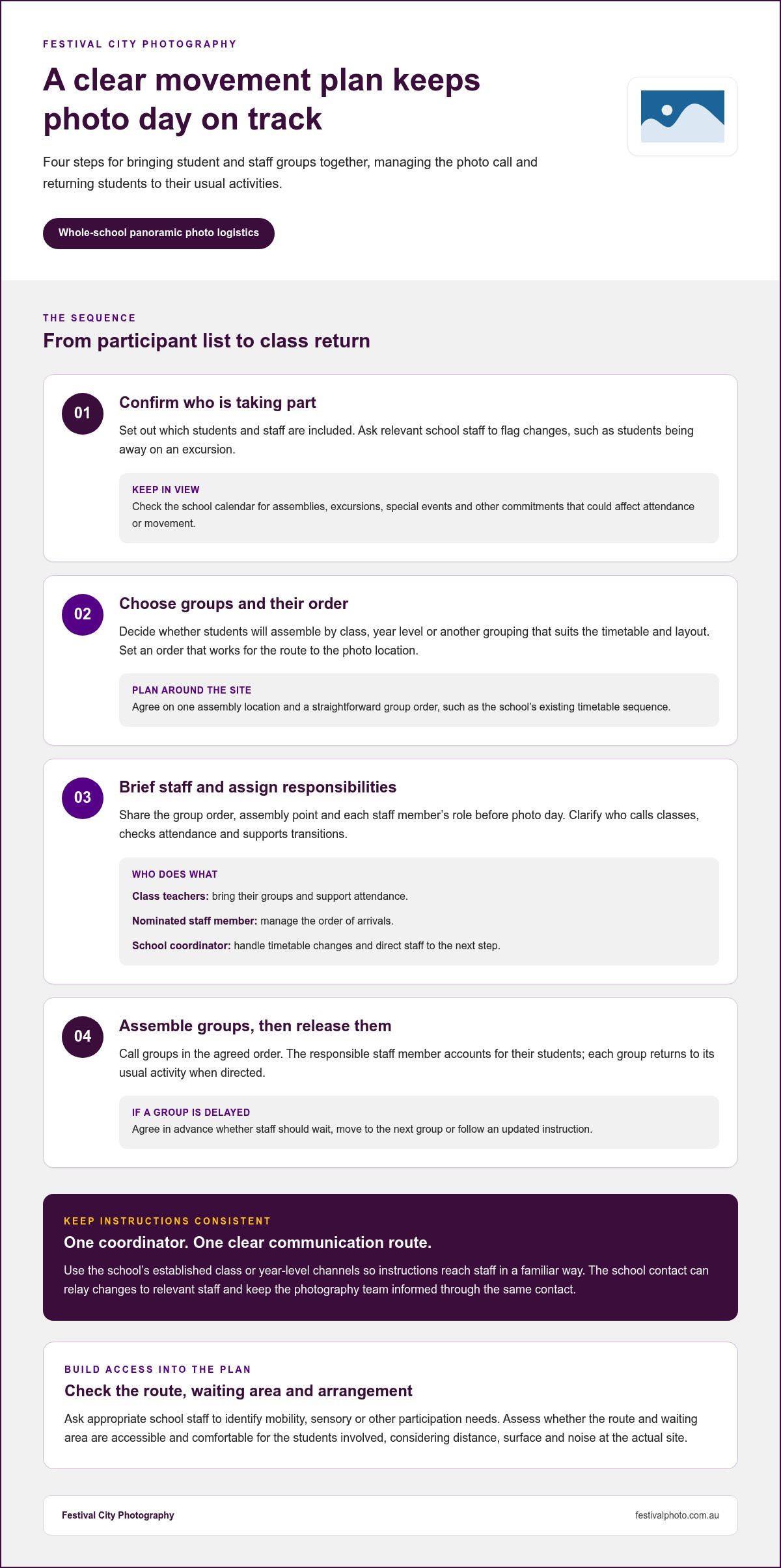
For whole school panoramic photo logistics Adelaide schools need a people-flow plan that fits their timetable and site. The aim is to move each group to the agreed location, include the right participants and return students to their usual activities without competing instructions. A simple sequence shared with staff in advance gives everyone a clear role.
A named school coordinator helps prevent crossed instructions by giving staff one point of contact for the photo call, updates and changes. The coordinator can work with the photography team and relevant staff to keep the plan consistent throughout the session.
- Confirm participants. Set out which students and staff are included. Ask relevant school staff to flag changes, such as students being away on an excursion.
- Nominate groups. Decide whether students will assemble by class, year level or another grouping that fits the timetable and layout. Choose a sequence that works for the route to the photo location.
- Brief staff. Share the group order, assembly point and each staff member’s role. Clarify who calls classes, checks attendance and supports transitions.
- Assemble and release. Call groups in the agreed order. Have the responsible staff member account for their students, then release each group back to its usual activity when directed.
How can staff keep the photo call orderly?
Use the school’s established class or year-level communication channels so instructions reach staff in a familiar way. Give everyone one assembly location and a straightforward group order, such as the school’s existing timetable sequence. The school contact can relay changes to relevant staff instead of sending competing updates through multiple channels. Keep the photography team informed through the same contact.
Assign duties before the day. Class teachers can bring their groups and support attendance, while a nominated staff member manages the order of arrivals. The coordinator can handle timetable changes and direct staff to the next step. Agree how the team will communicate if a group is delayed, including whether staff should wait, move to the next group or follow an updated instruction.
How should the plan account for access and participation?
Ask appropriate school staff to identify mobility, sensory or other participation needs during planning. They can help assess whether the route, waiting area and arrangement are accessible and comfortable for the students involved. Consider distance, surface and noise at the actual site. An inclusive plan can make adjustments without drawing unnecessary attention to individual students.
Keep alternative arrangements private and coordinate them directly with the school and relevant staff. Avoid discussing a student’s needs in group messages or in front of other participants. Share only the practical instructions staff need to support participation, and pass relevant arrangements to the photography team through the nominated contact.
Festival City Photography has over 30 years’ experience in school and event photography, including class group photos. Schools can discuss school photography planning with the team while preparing a clear, coordinated brief.
Outdoor or indoor panorama in Adelaide: compare location and weather plans
The choice between an outdoor and indoor location depends on the school’s site, participants and movement plan. Compare both options before confirming the arrangement rather than treating an indoor space as an afterthought. The Australian Bureau of Meteorology forecast can inform the decision, but it can’t guarantee conditions at the school or replace an agreed alternative.
Outdoor option
- Space: Walk the proposed area and assess whether it can accommodate the participants and their arrival.
- Access and movement: Check the route from classrooms and whether groups can gather and leave without creating pinch points or disrupting other activities.
- Light and background: Consider the direction of the sun and how light may change during the session. Check what will appear behind the group.
- Waiting conditions: Decide where students will wait and whether the arrangement is comfortable for the school community.
Indoor option
- Space: Assess whether the hall or other proposed area suits the participants and group arrangement.
- Access and movement: Check entrances, exits and the route between the assembly point and indoor location.
- Light and background: Review available light and the background, including school activities or fixtures that may be present.
- Waiting conditions: Plan how groups can assemble and move through the space while keeping access routes clear.
What should an outdoor location plan cover?
Visit the proposed space and consider the group order. Is the route clear for students and staff? Is there enough room for everyone to gather without blocking access elsewhere? Note the sun’s direction and whether it may change during the school day. Identify a practical waiting area so groups aren’t left standing in an active movement route.
Check the Australian Bureau of Meteorology forecast as the date approaches. Conditions can differ from a forecast, so agree in advance which school-approved indoor alternative will be used if the outdoor plan no longer suits. Avoid setting an arbitrary weather threshold. The school’s decision should reflect its site, participants and conditions on the day.
When is an indoor alternative useful?
An indoor option is useful when outdoor conditions or access make the original plan impractical, provided the alternative works for the school community. Identify it early and assess its space, background, lighting and access against the same participant and movement needs as the outdoor location.
Agree who will make the location decision and how it will be communicated to staff and the photography team. The school contact can relay the change through the established channel, including any updates to the meeting point or group route. This makes the changeover part of the plan rather than a rushed decision after students have assembled.
For whole school panoramic photo logistics Adelaide, comparing locations in advance helps the school choose a practical primary site and a considered alternative, with access, movement and participant needs central to the decision.
A school-ready checklist for whole-school panoramic photo day
A checklist turns planning into clear actions. Use the template below as a starting point, then adapt it to your school’s timetable, site and communication routines. Record decisions in one shared run sheet so staff and the photography team are working from the same information.
What should be confirmed before photo day?
Confirm the date, site access, participant list and any school commitments that could affect the plan. Share the group sequence, assembly point and staff responsibilities with the relevant people. Keep participation or accessibility arrangements private, and communicate them directly to the staff who need to support them.
- School contact: [ ] Name the coordinator and day-of contact method. [ ] Confirm the date, location, site access and who can communicate changes.
- Staff: [ ] Share the group order, meeting point and class-call responsibilities. [ ] Note who will support attendance and transitions.
- Participants: [ ] Confirm which student groups and staff are included. [ ] Communicate relevant participation arrangements privately through the school.
- Photography team: [ ] Provide the agreed location, group sequence, school access instructions and nominated contact’s details.
What should the day-of run sheet include?
Keep the run sheet easy to scan during a busy school day. List each group in order, who calls them and where they assemble. Include the agreed photo location, indoor alternative and process for deciding whether to change locations. Leave room for site-specific instructions without assuming a standard session duration.
- School contact: [ ] Record the communication method, change decision-maker and how updates will reach staff.
- Staff: [ ] List each group, the staff member responsible for calling it and any handover between locations.
- Participants: [ ] Record the meeting point and any school-approved instructions they need before assembling.
- Photography team: [ ] Note the agreed location, alternative site and relevant access instructions.
- Contingency: [ ] State who decides whether to use the alternative, when the decision will be communicated and which route groups should take.
Leave space for site-specific notes, such as an access route that must remain clear or a school activity that affects one area. If plans change, the school contact can update the run sheet and share the relevant information through the agreed channel. This avoids circulating unnecessary details while ensuring each person knows what to do next.
For whole school panoramic photo logistics Adelaide, assigning an owner to each task makes the checklist useful as well as comprehensive. Festival City Photography has over 30 years’ experience in school and event photography, including class group photos. Plan your school photography session with Festival City Photography using a clear brief and nominated school contact.
Plan a whole-school photo with Festival City Photography
The groundwork in this guide gives your school a practical starting point for planning: a preferred date, a considered location, a participant plan and a clear way to communicate changes. Festival City Photography is a second-generation, South Australian family-owned and operated business with over 30 years’ experience in school and event photography, including class group photos. The plan can be shaped around your site and priorities.
A concise brief keeps planning focused. Set out what the school hopes to achieve and the practical arrangements needed to support the session. Share relevant constraints early, then use the nominated school contact to keep decisions and updates consistent.
What information helps start a school photography discussion?
Prepare the school’s location, preferred timing, intended photograph and the student or staff groups involved. Include relevant site constraints, access needs and the school-approved alternative if outdoor conditions make the preferred location unsuitable. Identify the staff member who will coordinate decisions and day-of communication. This gives the discussion a useful foundation without making assumptions about the school’s layout or timetable.
Keep the focus on what matters to your community: who should be represented, how the session can fit around school commitments and which practical details need attention. For broader information about school photography services, the School Photography Adelaide buyer’s guide can help put the planning conversation in context.
How can schools continue planning after the initial discussion?
Turn agreed decisions into a run sheet for the school team. Record the confirmed date and location, group order, meeting point, staff responsibilities and communication method. Note who can approve a change and how that update will reach the people affected. A teacher-focused school photo day schedule guide can also help staff prepare for their part in the day.
Share only the details each person needs to carry out their role, and keep individual participation arrangements private. If plans change, the nominated contact can update relevant staff and the photography team through the agreed channel. This point of coordination helps keep instructions aligned without adding extra layers of communication.
For whole school panoramic photo logistics Adelaide, a clear brief and a focused planning conversation can help translate your school’s priorities into a workable approach. Festival City Photography brings over 30 years’ experience to school and event photography. Discuss your school’s photography requirements with Festival City Photography.
Take the next step towards a well-planned photo day
A school photo can become a lasting record of its community. Turn your preferred approach into a brief your team can use: note what matters most to the school, identify decisions still to be made and nominate the person who’ll keep communication moving.
With whole school panoramic photo logistics Adelaide, a thoughtful conversation can connect those priorities with the practical needs of your site and school day. Festival City Photography is a second-generation South Australian family-owned and operated business with over 30 years’ experience in school and event photography, including class group photos.
Talk with Festival City Photography about your school’s photo plans and take the first step towards a session shaped around your school community.
Frequently Asked Questions
What is a whole-school panoramic photo?
It’s a wide-format photograph planned to represent a school community together in one image. The school decides who is represented and what the photograph is intended to mark, such as a community milestone or shared school moment. For whole school panoramic photo logistics Adelaide, clarify the purpose early so decisions about participants and setting support the same outcome. The final composition depends on the agreed photography approach and site.
How do you organise students for a whole-school panoramic photo?
Organise students into groups staff can identify and call easily, such as existing classes or year levels. Use the school’s usual roll or attendance process to check that each group is together before it moves. For example, a staff member can remain with a class until it is called, then help it return to its scheduled activity. This keeps supervision connected to familiar school routines.
Can a whole-school panoramic photo be taken indoors?
Yes, an indoor location can work if the school’s space suits the participants and arrangement. A hall may be useful, but assess its usable area, entrances, background and any scheduled activities that could affect access. Consider how groups can wait without blocking doorways or disrupting other users. The school and photography team can discuss the proposed site during planning.
What happens if it rains on the planned photo day?
If rain makes the outdoor location unsuitable, the school can use its agreed indoor alternative or decide on another suitable arrangement. Check the forecast as the date approaches, but make the decision based on conditions and the school’s site, not the forecast alone. The nominated contact should communicate the decision and any revised meeting point through the school’s agreed channel, so staff aren’t left acting on different instructions.
How can a school make a group photo accessible for students?
Ask relevant school staff to identify access needs before deciding on the route and arrangement. Consider step-free access where required, distance to the location, waiting conditions and whether noise or crowding may affect participation. Plan adjustments with the student’s school team and share personal details only with staff who need them. This helps students take part comfortably without making individual arrangements a public focus.
Can staff be included in a whole-school panoramic photo?
Yes, the school can include staff if that suits the purpose of the photograph. Decide which staff groups are expected to take part, then consider how their availability fits with student supervision and scheduled duties. For example, plan how classes will remain supervised while staff join the photograph. Communicate the agreed expectation in advance so participants know whether they’re included and where to assemble.
Who should coordinate a whole-school photo at an Adelaide school?
A school-appointed contact, such as an administrator or staff member familiar with the timetable and site, is well placed to coordinate decisions. They can act as the main link between school staff and the photography team, while assigning class calls and supervision to relevant teachers. Choose someone who can share updates through established school channels and knows who can approve changes to the plan.