
Choosing a Barossa Valley regional school portrait provider means looking beyond the photographs to how well the planning fits the school day. Festival City Photography is an Adelaide-based South Australian school photography business, offering services such as individual portraits, class groups, student ID cards and school event coverage. For any school comparing portrait options, a clear brief makes it easier to assess what is needed and how photo day should run.
Schools want polished portraits without adding pressure to teachers and administration staff. Before making decisions, map out the timetable, campus requirements and family portrait options. A well-prepared brief helps identify practical details early, from which groups need photographs to how students will move between classrooms and the photo area.
This guide explains how to assess portrait quality, compare service scope and plan around the school timetable. It also covers family deliverables, including physical prints and digital image files. Festival City Photography is a second-generation, family-owned South Australian business founded circa 1990, with experience in school photography and a range of education services. Use the guidance below to define your requirements and choose images that become part of each student’s story.
Key Takeaways
- Assess a Barossa Valley regional school portrait provider by how well its planning fits your school’s timetable and community needs.
- Match portrait types to their purpose, from individual and sibling portraits to class groups and staff portraits.
- Use a practical scorecard to compare scheduling, communication, image options, service scope and the workload involved for school staff.
- Reduce photo-day surprises by setting requirements, arranging the schedule, briefing families and preparing the site in advance.
- Festival City Photography is an Adelaide-based, second-generation family business with experience in school photography.
Why a Barossa Valley school needs a portrait provider built around its community
A regional school needs a photo day that is predictable, well organised and considerate of classroom time. Students need to be called in an orderly way, staff need to know what is expected, and the timetable needs to keep moving. A clear plan reduces avoidable interruptions and gives the school a practical basis for coordinating the day.
Start with the school’s own circumstances. Student numbers, year-level arrangements, campus layout and the time available between bells all affect how portraits can fit around lessons. Record site access, suitable photography spaces and scheduling constraints in the brief. These details help make planning specific to the school rather than relying on a generic photo-day schedule.
School portraits also have a life beyond photo day. Families may value individual and sibling portraits, while class photographs preserve a record of students learning together. Staff portraits can support school communications, and group images become part of the community’s shared history. The Barossa Valley has its own distinct communities and local identity, so consider how school images can reflect the people and connections that matter to families.
What schools should expect from a portrait partnership
A strong partnership starts with coordinated communication and a school-defined brief. Set out which portraits are needed, who is involved, how the school day is structured and what families should be able to receive. This gives everyone a shared reference point, clarifies responsibilities and reduces last-minute uncertainty. It also helps the school weigh image quality alongside organisation and the usefulness of family choices, rather than judging photographs in isolation.
A successful school portrait day produces quality images through a clear, orderly process that fits the timetable and keeps disruption to a minimum.
Why Barossa Valley context belongs in the brief
Local context is practical, not decorative. Separate buildings, shared spaces, access points and bell times can all shape where and when each group is photographed. Barossa Valley communities have their own school and family needs, so explain what will make the day workable on your campus.
- Note the campus layout and the most suitable photography spaces.
- Map the available time around bells, lessons and other school commitments.
- Identify the portraits needed for students, staff and school records.
- Consider what families will find useful, such as individual, sibling or class portraits.
These details help a school assess whether a proposed approach aligns with its requirements. A well-defined brief gives the school a sound starting point for discussing portrait needs and the images its community wants to keep. Adelaide schools can use the same practical approach when organising photography with a local provider.
Match school photos to students, staff and milestones
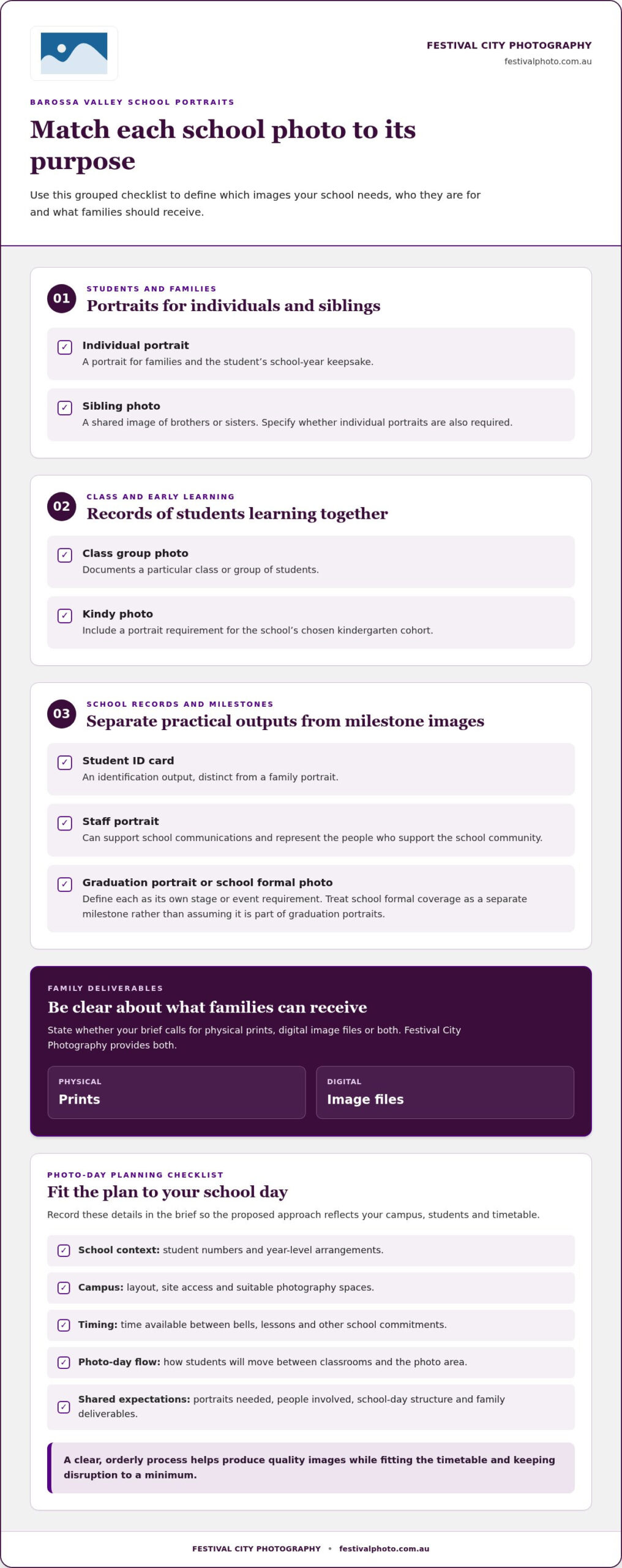
A useful portrait brief starts with the people and purpose behind each image. Individual portraits give families a record of each student, while class groups capture a year level or class as a shared moment. Sibling photos bring school-age brothers and sisters together. Staff portraits meet a different need: representing the people who support the school community.
Matching the image type to its purpose makes the brief more useful than simply requesting “school photos”. Use this comparison to identify what belongs in your school’s requirements:
| School need | Portrait option | Purpose to define |
|---|---|---|
| Individual student record | Individual portrait | A portrait for families and the student’s school-year keepsake. |
| Siblings at the same school | Sibling photo | A shared image of brothers or sisters, alongside any individual portraits required. |
| Class or year-level record | Class group photo | A photograph that documents a particular class or group of students. |
| Early learning | Kindy photo | A portrait requirement for the school’s chosen kindergarten cohort. |
| School administration | Student ID card | An identification output, distinct from a family portrait. |
| Staff and milestones | Staff portrait, graduation portrait or school formal photo | Images for staff representation or a specific stage and event in school life. |
Choose portrait options by school stage and purpose
Not every school needs the same combination. A school with a kindergarten cohort may include kindy photos as well as individual portraits; a graduating year may need graduation portraits. Class groups document students together, while sibling portraits give families another way to mark the school years. Treat school formal coverage as its own milestone requirement rather than folding it into graduation portraits by default. The Barossa Valley demographics can provide broader community context, but each school’s year groups and priorities should guide its choices.
Clarify family and school deliverables before photo day
State whether the brief calls for physical prints, digital image files or both. Festival City Photography provides both, so schools can specify the formats relevant to families and their own requirements. Be specific about student ID cards and composite group photos: these are distinct outputs, not alternatives to individual portraits or standard class groups. Clear wording helps prevent different expectations from being bundled together.
For a broader overview of selection considerations, the School Photography Adelaide buyer’s guide complements this requirements-based approach. Schools considering a Barossa Valley regional school portrait provider can use a simple test: does each requested image have a clear audience and purpose? To see how these school portrait needs fit within a wider education photography service, explore school portrait services.
Compare regional school portrait providers with a practical decision framework
A polished portfolio is only one part of a school photography decision. The stronger comparison is how a provider’s planning, communication and image options fit the school’s actual requirements. Score each area against the same brief, and look for examples or clear explanations rather than relying on broad claims such as “easy” or “seamless”.
Use this scorecard during discussions. Rate each criterion against your school’s priorities, then note what evidence supports the rating. A simple scale, such as low, adequate or strong, is enough to highlight gaps without making the decision more complicated than it needs to be.
- Scheduling: Does the proposed approach account for bell times, year levels, staff availability and the school’s preferred photo-day window?
- Communication: Are planning responsibilities and the information families need explained clearly?
- Image quality: Do sample portraits look consistent and considered? Review lighting, composition and how subjects are presented. The student photography best practices guide offers useful prompts for assessing these visual basics.
- Image outputs: Are physical prints, digital image files or both described clearly in the school’s requirements?
- Service range: Can the provider address the school’s stated portrait and event needs, including relevant student, staff or milestone images?
- School workload: Does the proposed workflow clarify what staff need to do before, during and after photo day?
Regional suitability depends on planning as much as location: a clear schedule and dependable communication help make logistics a manageable part of the brief. Rather than treating location as a proxy for quality, include practical coordination in the comparison. Consider how timing, site details and communication will be handled, and whether the process allows staff to focus on their usual responsibilities.
Assess organisation, communication and school workload
Before comparing proposals, write down what staff can realistically coordinate and what information families need. Look for a workflow that assigns responsibilities plainly, sets out the sequence for the day and avoids unnecessary follow-up by school staff. Clear communication is useful evidence; vague assurances alone do not show how a plan fits a real timetable.
Assess image options and ongoing school needs
Compare the proposed scope with the school’s confirmed requirements, not an assumed package. A school needing student portraits, staff images and a formal or awards-night record has different priorities from one seeking class groups alone. Define expected print and digital deliverables in the brief, then consider whether the provider’s range can support recurring year-level portraits and future milestones consistently.
Festival City Photography is a second-generation, family-owned South Australian school photography business founded circa 1990. Its services include portraits, groups, student ID cards and school events. Schools comparing options can review Festival City Photography alongside their written requirements.
Plan a Barossa Valley school portrait day with fewer surprises
A practical plan gives staff, students and families a shared picture of what will happen and when. For a Barossa Valley school, the steps below help organise the day around its own campus and timetable. Schools in Adelaide can use the same preparation approach when planning with a local photography provider.
Set the school brief and photo-day schedule
Start with a written list of year levels, portrait categories, staff requirements and intended deliverables. Identify a school contact and set out how planning updates will be shared. Then map the sessions against bells, class movements, breaks and other commitments. This helps reveal clashes early and gives staff a clear way to sequence groups around the school day.
- Define requirements. Record the portraits and outputs needed, such as individual student portraits, class groups, staff portraits, student ID cards or milestone images. Note which year levels and staff groups are involved.
- Set the schedule. Allocate sessions around lessons, breaks and campus commitments. Grouping year levels can help coordinate student movement; place staff and any required group portraits into the plan as distinct sessions.
- Brief families. Share the photo-day timing, portrait options and relevant school instructions in clear language. Provide key details directly so families know what to expect.
- Prepare the site. Choose an available room or area and consider lighting, access and space for students to wait or move through. Check that the route between classrooms and the photo area fits the campus layout.
- Review outputs. After photo day, compare the images and deliverables with the school’s agreed requirements. Decide in advance how to record absences and communicate any follow-up arrangements, so staff understand the next step.
Prepare students, staff and families
Preparation is a shared task. Staff can help students understand where to go and when, while families benefit from timely information about portrait choices and school expectations. Before the day, check that the photo area is accessible and ready for use. A simple movement plan, such as calling one class at a time through an agreed route, can help keep transitions orderly.
Keep the schedule realistic. If the campus has multiple buildings, shared rooms or tightly timed lessons, account for those constraints rather than relying on best-case movement between sessions. A named school contact and agreed communication steps give staff a clear way to manage changes without making every teacher responsible for coordinating the day.
Use this sequence to prepare a concise school brief and make planning discussions more focused. Explore Festival City Photography’s school services to learn about its education photography options.
Partner with Festival City Photography for school portraits across South Australia
A school portrait partnership works best when the photography options fit the school’s actual brief. Festival City Photography is a second-generation, family-owned South Australian photography business, founded circa 1990. Its education photography covers a range of student, staff and school milestone needs, helping decision-makers consider related requirements together rather than treating every image as a separate project.
For schools assessing a Barossa Valley regional school portrait provider, the practical next step is to set out the portraits the school needs, its timetable priorities and the image formats families and the school require. A clear scope keeps the conversation focused on how the work should fit the school community and makes it easier to compare suitable photography services.
Bring school portrait requirements together
The school’s brief might combine individual portraits for students, sibling photos for families, class groups that record a year level, and staff portraits for school use. Other requirements can relate to a particular stage or occasion, such as kindy photos, graduation portraits, school formal coverage or awards nights. Listing each need separately helps the school see what is essential and what serves a distinct audience or milestone.
Festival City Photography provides physical prints and digital image files. The school can state which formats it wants considered without assuming that particular deliverables come in a set package. A clear description also helps distinguish keepsakes for families from outputs needed for school administration. For more on digital options, the digital image files for school photos guide offers context for considering how families might use their images.
- For students: identify individual portraits and any kindy or graduation requirements.
- For families: include sibling photos where relevant, and define preferred print or digital formats.
- For school records: specify class groups, staff portraits and student ID cards as separate needs.
- For milestones: list formal, graduation or awards-night coverage according to the school calendar.
Turn the school’s brief into a clear next step
Bring the portrait scope together with the schedule priorities developed by the school: year levels, staff involvement, campus constraints and the way students will move through the day. Then state the deliverables families and the administration need. This gives the photography discussion a useful foundation and makes it easier to consider how a broad service range may suit the school’s requirements.
Festival City Photography’s family-owned experience and school-focused range offer a starting point for that discussion. Explore Festival City Photography’s school portrait services to learn about its education photography options.
Make your next school photo day a considered choice
Before choosing a Barossa Valley regional school portrait provider, bring the decision back to what will serve your school community well: a clear shared brief, realistic expectations and images families will value. Use the brief as a practical reference for school leadership and staff, so decisions about portrait scope and family deliverables stay aligned as planning moves forward.
It is also useful to think beyond one photo day. A consistent approach to school portraits can help build a visual record that grows with students, from their early years through later milestones. The right choice should feel workable for your school and meaningful to the people in its community.
Festival City Photography brings school portrait services together for South Australian schools, with an Adelaide focus. To discuss your school’s portrait requirements, explore Festival City Photography’s school portrait services.
Frequently Asked Questions
How far ahead should a Barossa Valley school plan portrait day?
Start planning as soon as your school calendar and likely portrait requirements are available; there is no single lead time that suits every campus. A school choosing a Barossa Valley regional school portrait provider can use early planning to coordinate a date around assessments, excursions, assemblies and term events. It also gives staff time to prepare family information and share practical campus access details during scheduling discussions.
What should students wear for school portraits?
Follow the school’s uniform and dress expectations, and let families know these before photo day. Clean, tidy clothing that students feel comfortable in is a practical choice; check that collars sit neatly and clothing is suitable for the school setting. If the school has a uniform policy, explain whether it applies to all portraits or only formal school images, so families are not left guessing.
Can a school portrait day take place indoors?
Yes, an indoor space can be suitable if it gives the photographer room to work and students a clear way to enter and leave. A school might use an available hall or classroom, provided the area can be kept reasonably uncluttered and interruptions are manageable. Before the day, consider room access, lighting, nearby lessons and whether the space can be reserved for the planned sessions.
What happens if a student is absent on school photo day?
The school should decide how absences will be recorded and communicated before photo day. Staff can note which students missed their scheduled session and direct families to the school’s agreed follow-up process. Avoid promising a particular re-sit or alternative arrangement unless it has been organised. Clear instructions help families understand what to do, while giving administration staff a consistent way to handle enquiries.
How should schools manage photo permissions and student image privacy?
Follow the school’s photography and filming policy and its established consent process. Make sure families receive clear information about what will be photographed, why images are being collected and how they may be used. Keep any consent records and relevant instructions accessible to the staff coordinating photo day, and ensure the photographer receives the school’s requirements before sessions begin. Policies can differ between schools, so use your own school’s procedures.
Can one school photography provider cover different school milestones?
Yes. A school may bring student portraits, class groups, staff images and milestone photography together through one school photography provider. Festival City Photography is an Adelaide-based South Australian specialist offering education photography from kindy portraits through graduation, as well as school formal coverage and awards nights. Compare the services against the actual milestones in the school calendar rather than assuming every event needs the same format.
What should a school include in its portrait photography brief?
Include the year levels and groups involved, the portrait types required, preferred dates and any timetable constraints. State whether the school needs physical prints, digital image files or both, and note any student ID or group-photo requirements separately. Add the best school contact, campus access information, family communication plans and how absences will be handled. Naming a staff member who can approve schedule changes also helps keep decisions clear on the day.