
For school groundskeeper and admin staff ID cards in Adelaide, the school usually arranges collection and sets which identity documents it accepts. There is no single collection point or document list for every school.
Have photo identification ready, such as a current driver’s licence or passport, but follow the school’s instructions rather than assuming either document will be accepted. Confirm where to collect the card and what to bring so pickup fits smoothly around the school day.
This guide explains how to find the collection point, prepare to prove your identity and check the school’s pickup instructions. It also covers how professional staff portraits can support clear, consistent identification across a school team.
Key Takeaways
- Use the school’s pickup instructions to establish where staff cards are collected and what identity documents to bring.
- Decide which details groundskeeper and administration staff need on their cards before settling on a card format.
- Allow for turnaround to depend on factors such as photo readiness, design approval and the number of cards being produced.
- Plan photos and visual branding around a clear, consistent look that suits the school community.
What information should school staff ID cards in South Australia include?
A staff ID card is a school-issued credential that identifies an employee. For South Australian schools, its details should help colleagues recognise the person and their role. The school chooses the information and format to suit its site. Keep the card clear, current and easy to read.
A staff photograph should make the cardholder easy to recognise. Use a recent, well-lit head-and-shoulders portrait with the face clearly visible, and place the employee’s full name beside it. This helps staff and visitors match the card to the person presenting it.
- School name: identifies the institution issuing the card, such as the school’s full name.
- Staff member’s name: shows who holds the card, using the name colleagues recognise.
- Job title: describes the person’s role, such as groundskeeper or administration officer.
- Photograph: provides a visual reference for recognising the cardholder around the school.
- School contact detail: gives a relevant internal contact route, such as the administration office.
A job title briefly describes the employee’s school role. Choose wording that explains responsibilities without crowding the card. “Groundskeeper” identifies outdoor site duties, while “Administration Officer” indicates an office-based role. For staff with several duties, use the title the school applies consistently.
An employee identifier is an internal reference chosen by the school. It can distinguish staff with similar names, but the school should decide whether it is useful. An expiry date marks when a card should be reviewed or replaced. Include one only if the school uses expiry dates in its card process.
Before production, bring each staff member’s approved name, role and photograph together in one list. Check spelling against school records, then confirm the school name and any contact details. For example, “Jordan Lee, Groundskeeper” alongside the school name and portrait gives reviewers a clear reference and helps prevent mismatched names, roles or photos.
The school can decide whether its card format needs access-control chips, barcodes or QR codes. These features are not necessary simply to identify staff and their roles.
What types of ID cards are suitable for school groundskeepers and administrative staff?
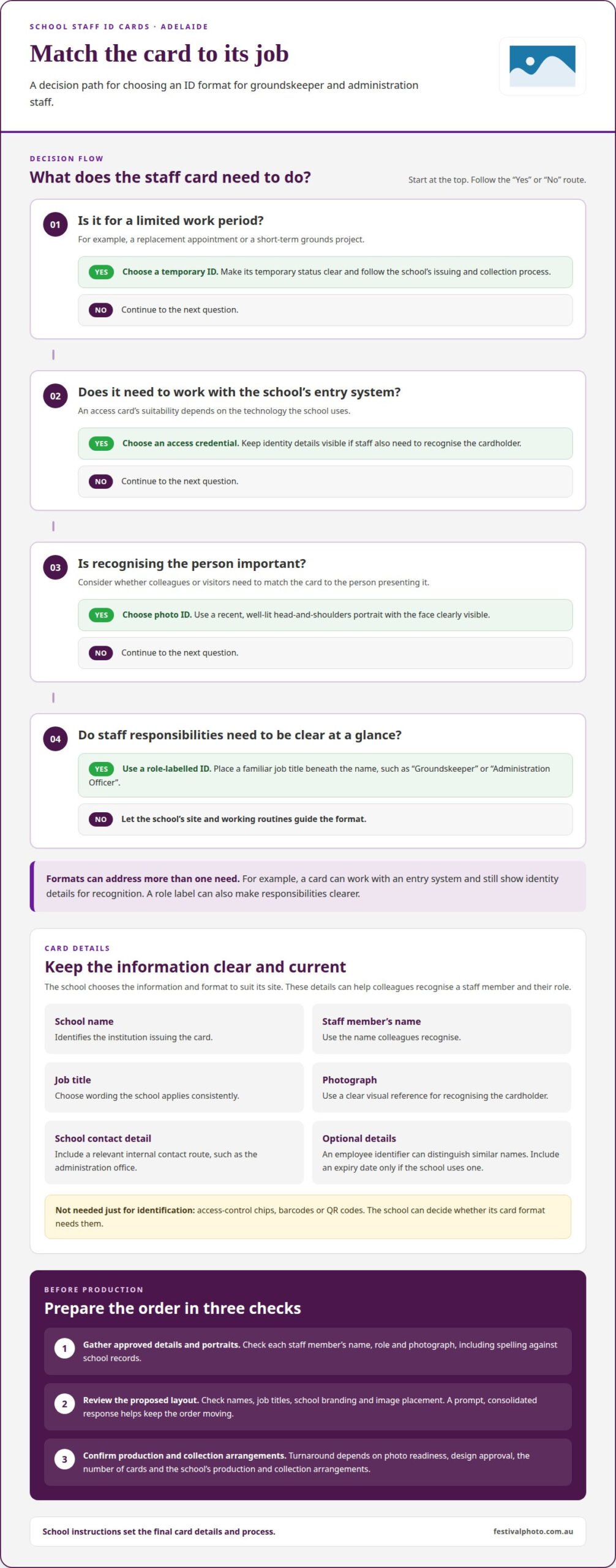
A photo ID card identifies an employee by image and name. It can help groundskeepers and administration staff remain recognisable around the school. For school groundskeeper and admin staff ID cards in Adelaide, choose a layout that makes the portrait and essential details easy to see. The photograph helps colleagues connect each person with their role.
A role-labelled card displays the employee’s job title, helping distinguish a groundskeeper from an administration officer at a glance. Place the title beneath the name and use wording familiar from school staff records, such as “Groundskeeper” or “Administration Officer”.
An access card works with a school’s entry system, so its suitability depends on the technology the school uses. Keep identity details visible if staff also need the card for recognition. A credential designed only for entry may not clearly identify its holder to colleagues or visitors.
A temporary staff card identifies someone for a limited work period, such as a replacement appointment or short-term grounds project. Make its temporary status clear and follow the school’s process for issuing and collecting it. This helps distinguish it from a permanent employee credential.
- Photo ID: useful when recognising the cardholder matters.
- Role-labelled ID: useful when staff responsibilities need to be clear.
- Access credential: useful where the school operates an entry system.
- Temporary ID: useful for short-term staffing arrangements.
Start by identifying the card’s main purpose: staff identification, site access or both. Then consider where groundskeepers and office staff work, and who needs to recognise them. For school groundskeeper and admin staff ID cards in Adelaide, a visible role label can help identify a groundskeeper moving between school buildings. An administration officer’s name may need to stand out for office visitors.
The portrait also shapes how readily colleagues recognise each cardholder. A consistent staff portrait can provide a clear image for an ID layout. Match the card type to the school’s working routines, then use the same approach for staff with comparable roles.
What are typical turnaround times for school staff ID card printing in Adelaide?
Turnaround time covers the period from preparing an ID card order to receiving the finished cards. For an Adelaide school, it depends on when staff details, photographs and artwork are ready, as well as the production and collection arrangements. There is no standard timeframe for every school order.
Preparation involves gathering staff information and images. A complete list helps avoid delays caused by missing names or role details. An order for a groundskeeper and an administration staff member, for example, needs the approved details and photograph for each person. Changes after preparation may require another review.
Proof approval is the school’s review of the proposed card layout before production. It gives staff a chance to catch errors in names, job titles, school branding or image placement. A prompt, consolidated response helps keep the order moving; separate rounds of corrections can delay printing.
Photo readiness means having a usable image for everyone included in the order. A clear portrait that fits the agreed layout can move into design. If someone needs a new portrait, allow for that photography in the schedule. Coordinating portraits for grounds and office teams together can simplify preparation.
Collection is the final handover of completed cards to the school or staff. Allow for the school’s distribution process, such as sorting cards by department before handout. For a planned staff changeover, work back from the date the cards are needed: complete the staff list, prepare photographs, approve the proof, then organise collection.
To estimate the schedule, identify the first unfinished step and who needs to make the next decision. A school waiting for portraits has a different timeline from one ready to approve artwork. Keeping names, images and feedback together helps avoid rework at each stage.
What photo, design, and branding requirements apply to South Australian school staff ID cards
A staff ID portrait identifies the cardholder. Choose a recent image with the face clearly visible and evenly lit. A plain background keeps attention on the person. Use a consistent portrait style for groundskeepers and administration staff.
Photo consistency means using similar framing and visual treatment across staff images. Align head position and crop across portraits, and avoid strong shadows, busy backgrounds or filters that alter someone’s appearance. The printed image should still look like the staff member.
Card layout is how information and visual elements are arranged. Place the photograph, name and role where readers can find them quickly. Keep the school name prominent and use a clear typeface for details. “Groundskeeper,” for example, should be legible beside the staff member’s name.
- Portrait: use a clear, recognisable image with consistent framing.
- Typography: choose readable lettering for names and job titles.
- Colour: use school colours while keeping text easy to distinguish.
- Logo: use the approved school artwork at a clear size.
Contrast is the difference between text and its background. Dark lettering on a light area, for example, can make names easier to read. Review the design at the card’s final size, not just on screen, and check that the portrait, name, role and school logo remain clear together.
Artwork includes the approved images and design files used for printing. Before production, compare the proof with the school’s brand guidance. Check spelling, logo placement, colour treatment and image crops. Gather feedback in one review so any adjustments are clear and consistent.
For a coordinated approach, plan staff ID card photography around the school’s chosen portrait style and branding.
Formal identification is separate from card design: in South Australia, a Consumer and Business Services (CBS) photo licence or registration card is worth 100 identification points. Applicants for an occupational licence must also show 100 points.
Festival City Photography: Sibling Photos
Festival City Photography offers Sibling Photos for school communities planning photography alongside staff ID arrangements. These portraits bring siblings together in one image as a keepsake for families. They are a separate school photography option, not part of collecting staff ID cards.
Consider Sibling Photos when a school is arranging photography for students and families as well as updating staff portraits. Coordinating the timing can help families understand what photography is included in the school programme. The school can share the arrangements through its usual communications.
For school photography planning, visit festivalphoto.com.au or contact Festival City Photography.
Make staff identification part of your school’s planning
Make staff identification part of regular school planning, rather than waiting until a role changes or a new team member arrives. A simple process for updating staff details and portraits helps keep school records and printed materials aligned. Assigning a coordinator also gives colleagues a clear point of contact.
Planning school groundskeeper and admin staff ID cards in Adelaide can fit alongside other school photography arrangements. Festival City Photography offers Individual Portraits and Class Group Photos, as well as Sibling Photos for school communities. These services can support a considered approach to staff and student photography throughout the school year.
For a practical next step, contact Festival City Photography to discuss your school photography plans. A clear plan can help your school move forward with confidence.
Frequently Asked Questions
Where can Adelaide schools order staff ID cards for groundskeepers and administration staff?
Adelaide schools can arrange Staff Portraits and Student ID Cards with Festival City Photography. Staff portraits provide images for school identification materials, while the school coordinates its preferred card format and pickup process. To get started, prepare a staff list separating groundskeeping and administration roles, then arrange the required portraits through the school’s photography programme.