
What if a scholarship portrait could recognise a student’s achievement without making an award their whole story? For Adelaide schools, thoughtful independent school scholarship student portraits Adelaide can feel polished and welcoming while still allowing each student’s personality to come through.
Students may feel self-conscious in front of a camera, especially when a portrait marks a significant achievement. A considerate experience can help them feel at ease and keep the focus on who they are, as well as what they’ve accomplished.
This guide explains how schools can plan portraits that feel personal, respectful and straightforward for students and families. It covers how to shape the portrait experience, coordinate it with school photography and give students clear expectations before the session.
Festival City Photography is a second-generation South Australian family-owned and operated business with over 30 years’ experience in school and event photography. We provide individual portraits and school event photography for Adelaide school communities, with a professional, friendly approach to recognising students.
Key Takeaways
- An individual portrait can recognise a scholarship achievement while showing the student as more than an award.
- Plan independent school scholarship student portraits Adelaide around the student’s comfort, the school setting and the image’s intended use.
- Choose between an individual portrait, class group image or school event photograph based on the story the school wants to tell.
- Use a simple preparation sequence to align the school, family and photography team before the session.
- Individual portraits and school event photography can fit into a school’s wider photography plans.
What scholarship student portraits can mean for Adelaide independent schools
A scholarship portrait is an individual photograph that recognises a student’s place and contribution within school life. It can mark an achievement while showing the person behind it: their expression, confidence and individuality. For schools considering independent school scholarship student portraits Adelaide, that distinction matters. The portrait can acknowledge a milestone without suggesting that one award defines a student’s identity or future.
Scholarships recognise different forms of achievement and opportunity. For a general introduction to their purpose and types, see What is a Scholarship? A portrait has a different role from the scholarship process itself. It doesn’t assess a student or explain selection criteria. Instead, when it feels appropriate to the student and school, it offers a visual way to recognise them within the school community.
How portraits can recognise a student’s achievement
An individual portrait gives the school a focused image of one student. Depending on its intended use, it might accompany an internal recognition, appear in school communications or mark an occasion. Let the purpose guide the approach: a warm, composed portrait can recognise achievement without making the award the only detail people notice.
Recognition doesn’t require a separate session for every scholarship recipient. A school might include portraits in an existing photography plan or recognise selected achievements in another suitable way. The key question is whether the image will feel respectful and meaningful, rather than treating a portrait as an automatic requirement attached to an award.
Why Adelaide school context matters
Independent schools have their own communities, traditions and ways of recognising student achievement. A portrait planned for an Adelaide school should make sense within that setting, whether it’s intended for a school publication, a family keepsake or another purpose. Deciding who will see the image and how it will be used helps staff and families make clear choices about the portrait.
Clear context also helps students know what to expect. Explain why the portrait is being taken, where it may appear and who will be involved. Families can share relevant preferences, while the photography team can plan around the school’s arrangements and the student’s comfort.
Scholarship portraits should sit alongside, not replace, the wider story of a student’s school life. They aren’t application materials or a record of test performance, and they serve a different purpose from a class group photograph, which represents students together. An individual portrait focuses on one student; the right format depends on what the school wants to recognise. The guidance below shows how to plan that experience with care.
Planning independent school scholarship portraits in Adelaide around the student
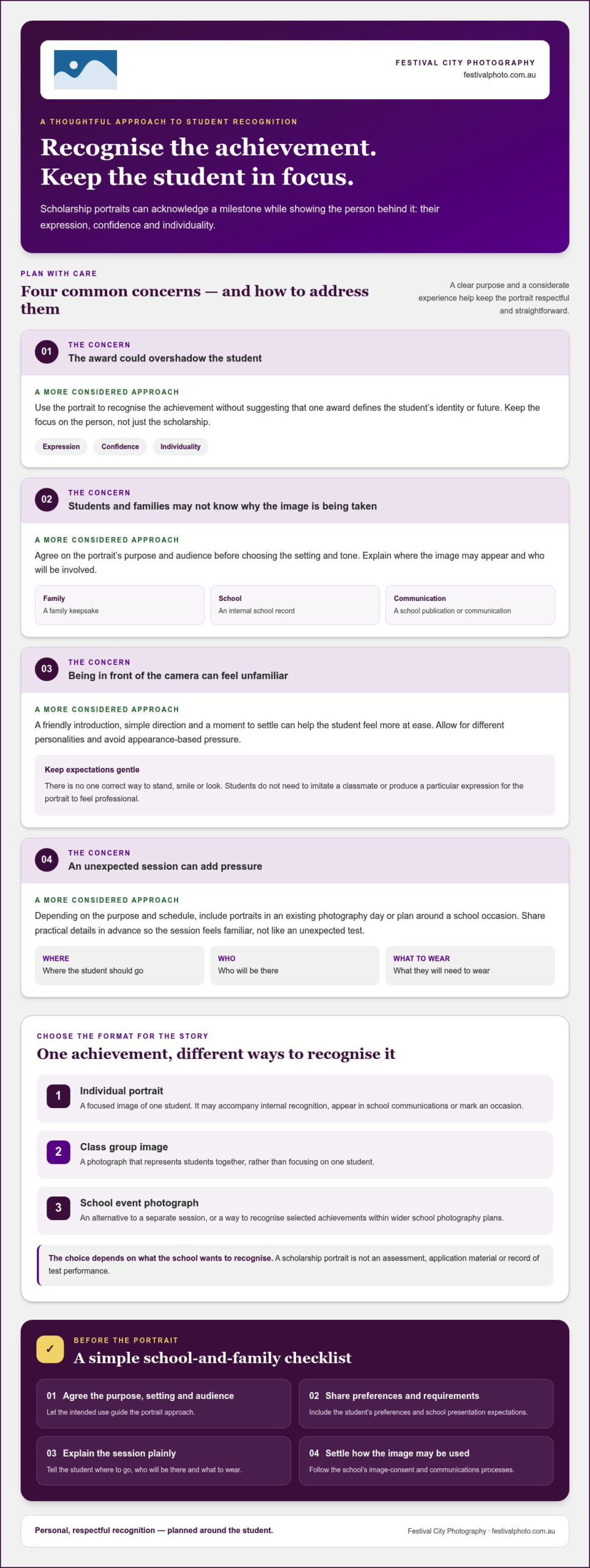
Good planning begins with the student, not the camera. Before arranging independent school scholarship student portraits in Adelaide, agree on why the image is being taken, where it may appear and what will help the student feel comfortable. A clear purpose makes it easier to choose a suitable setting and explain the session without adding pressure.
Connect the arrangements to the school environment. A portrait might fit into an existing photography day or be planned around a school occasion, depending on the purpose and schedule. Share practical details in advance: where the student should go, who will be there and what they’ll need to wear. Straightforward information makes the session feel familiar, not like an unexpected test.
What schools and families can decide before the portrait
Start with the image’s purpose and audience. Is it for the family, an internal school record or a school communication? Then consider the student’s preferences and any presentation expectations for that use. Give the photography team the same clear brief, covering the setting and tone. Keep instructions simple, particularly for younger students or anyone unfamiliar with portrait photography.
A useful pre-session checklist is: agree the purpose, setting and audience; share the student’s preferences and school presentation requirements; explain the session in plain language; and settle how the image may be used. Schools should follow their own image-consent and communications processes. Agreeing on intended use from the outset helps families understand what they’re consenting to.
Helping students feel comfortable in front of the camera
A friendly introduction can make the session feel less unfamiliar. The photographer can explain what will happen, offer simple direction and give the student a moment to settle. Calm, respectful communication allows for different personalities: some students may feel at ease straight away, while others need time to become comfortable.
Keep the focus on expression and presence, not appearance-based pressure. Avoid suggesting there’s one correct way to stand, smile or look. Students don’t need to imitate a classmate or produce a particular expression for the portrait to feel professional. Clear, gentle guidance can support a natural result while respecting each student’s comfort.
These decisions also help the school fit recognition portraits into its wider photography plans. Festival City Photography provides school individual portraits alongside school event photography, with an approach shaped around the school’s needs and the student’s experience.
Choosing a portrait approach for Adelaide scholarship students
The best format depends on what the school wants the photograph to communicate. A portrait centred on one student serves a different purpose from an image of their class or a photograph made during a school occasion. For independent school scholarship student portraits Adelaide, match the format to the recognition story, audience and setting. No single approach suits every student or school.
Individual portrait or class group photograph?
An individual portrait gives one student the focus, which can suit a personal recognition story. A class group photograph documents a cohort and its shared place in school life. If the school wants to acknowledge a particular student, an individual portrait may communicate that clearly. If it wants to record a wider group, a class image may be more fitting. The choice is about purpose, not which format is better.
| Format | Audience | Setting | Likely use |
|---|---|---|---|
| Individual portrait | Student, family or school community | Planned portrait setting | Personal recognition |
| Class group image | Classmates, families and school | School group setting | Shared documentation |
| School event photograph | Event attendees and school community | Relevant school occasion | Recording a milestone in context |
Use the comparison as a starting point, then consider where the image will appear and what the student is comfortable with. An individual portrait can sit alongside a class photograph rather than replace it, especially when the school wants to recognise one student and also document their wider cohort. Schools planning several types of photography can refer to this guide to school photography in Adelaide.
When a school event portrait may fit
A school event can provide a meaningful backdrop when recognition is connected to a milestone or gathering. The setting may place the student’s achievement within school life rather than present it in isolation. Consider whether an event photograph suits the occasion and intended use, or whether a planned individual portrait would give the student clearer focus.
Festival City Photography provides School Events photography, as well as individual portraits and class group photographs. These formats can help schools connect recognition with existing photography needs. The school can decide which image best represents the moment and explain that purpose to families and the photography team. A clear understanding of the event’s context helps keep the image relevant.
For example, a school might choose an individual portrait for a student-focused recognition notice, a class group image for a cohort record, or an event photograph when a milestone is best understood as part of a shared occasion. Let the audience and intended use guide the decision. A clear brief also keeps the student’s identity central, rather than relying on the award alone to tell the story.
Preparing students and schools for scholarship portraits
A considered plan helps a scholarship portrait feel like a school moment, not another test for the student to pass. For independent school scholarship student portraits Adelaide, schools can prepare by aligning the session’s purpose, practical arrangements and intended image use. A short, shared brief gives staff, families and the photography team a common understanding before the student steps in front of the camera.
A simple preparation sequence for school teams
Use these steps to shape a portrait plan around the student and the school’s existing photography arrangements:
- Agree the purpose and audience. Decide what the portrait is meant to recognise and who is expected to see it. This helps the school choose a suitable setting and explain the session to the student and family.
- Share practical details. Tell the student and family when and where the portrait will take place, who will be present and any school presentation guidance. Give them enough notice to plan without adding unnecessary complexity.
- Prepare the student. Explain what the session will involve in reassuring, age-appropriate language. Encourage the student to follow the school’s stated requirements, while making clear they don’t need to perform or copy someone else’s pose.
- Review intended image use. Make sure the school and family understand the planned audience and use before the photograph is taken. Follow the school’s image-consent and communications processes, and share relevant restrictions with the photography team.
If portraits sit alongside other school photography, coordinate the plan with those arrangements. A clear schedule and consistent communication help avoid confusion about where the student should be and what to expect, while respecting the school’s timetable.
Helping students know what to expect
Students may feel more at ease when they know the basic shape of the experience. A simple explanation could be: “You’ll have an individual school portrait taken in this location. The photographer will guide you, and the school plans to use the image for this purpose.” Adapt the wording to the student’s age and the actual arrangements. Avoid language that makes the session sound like an assessment or suggests there’s one correct expression.
During the portrait, respectful direction and a calm pace give the student room to settle. School staff can share presentation guidance in advance, such as uniform expectations or other requirements for the planned use. Families can also pass on preferences that may help the team approach the student thoughtfully.
Image use is part of preparation, not an afterthought. Schools can explain whether an image is intended for internal communication, family access or another agreed purpose, then manage permission through their established processes. For practical information about viewing and using school photographs, see this guide to digital image files for school photos.
When purpose, timing and communication are aligned, the portrait can fit more smoothly into school life. Festival City Photography provides school portraits as part of a thoughtful approach to student recognition.
Festival City Photography for independent school student portraits in Adelaide
Scholarship recognition calls for photography that respects both the occasion and the student. Festival City Photography provides individual portraits and school event photography for Adelaide schools, helping them consider how an image fits within the wider school community and photography plan. Our professional, friendly approach recognises achievement while keeping the student’s personality in view.
A local school photography partner with long experience
Festival City Photography is a second-generation South Australian family-owned and operated business with over 30 years’ experience in school and event photography. We work with South Australian schools and their communities. Our school photography experience includes work with Cabra Dominican College, Sacred Heart College and Loreto College.
For schools planning independent school scholarship student portraits in Adelaide, an individual portrait gives a student focused recognition, while school event photography can place a milestone within the occasion where it belongs. The right approach depends on the school’s purpose, setting and intended image use. A separate session isn’t automatically necessary for every scholarship recipient.
Good planning is collaborative. School staff can outline the reason for the portrait, the setting and any presentation requirements. Families can share relevant preferences, and students can be told what to expect in straightforward, reassuring language. With a clear brief, the photography team can work with the school’s arrangements and keep the student’s experience central.
“Let us put you in the picture” reflects this shared approach: school photography helps a community remember its people and milestones. A thoughtful portrait can honour an achievement without making the award the whole story. It can sit alongside class group photographs and event coverage as one considered part of a school’s photographic record.
Discussing a school portrait project
School teams can start by setting out the portrait’s purpose, who it is for, how the student should be prepared and how the image is intended to be used. This gives everyone a practical foundation for discussing the student experience and how individual portraits may fit with existing school photography or an event. Keep the brief focused on the recognition and the student, rather than assuming a particular format in advance.
To discuss your school portrait plans, contact Festival City Photography. You can also reach the team on 1300 360 241 or at jess@festivalphoto.com.au. Share your school’s requirements and the image’s intended purpose to start a practical conversation about an approach that suits your Adelaide community.
Make recognition meaningful for each student
A scholarship portrait can become a positive part of a student’s school story when recognition feels thoughtful rather than automatic. For schools considering independent school scholarship student portraits Adelaide, start by deciding what would make the experience worthwhile for the student and community. A clear purpose can guide the conversation while leaving room for each student to feel seen as an individual.
Consider who will view the image, how it will fit into the school’s communications and what would help the student feel comfortable taking part. These decisions can turn a small photography choice into a considered act of recognition, shaped around the people it represents.
Festival City Photography’s school and event photography experience includes work with Cabra Dominican College, Sacred Heart College and Loreto College. As a second-generation South Australian family-owned business with over 30 years’ experience in school and event photography, we can discuss how individual portraits may fit your school’s needs.
Talk with Festival City Photography about student portraits and take the next step towards recognition that feels welcoming, considered and true to your school community.
Frequently Asked Questions
Is a scholarship student portrait different from a school portrait?
Usually, the format can be much like an individual school portrait; the difference is its purpose. A school may use the image to recognise a scholarship student, rather than as part of routine student records or a general photo programme. It isn’t an application image or evidence of test performance. The school can decide how it fits with wider photography plans, recognition activities and the student’s preferences.
Can a school use an individual portrait to recognise a scholarship student?
Yes. An individual portrait can give the school a focused image for recognising a student, depending on its plans and intended use. For example, staff might consider an image for an internal recognition notice, while the school decides the audience and arrangement. Before photography, explain the purpose to the student and family, including where the image may be used, so everyone understands the context.
How should Adelaide independent schools prepare students for scholarship portraits?
Explain why the portrait is being taken and give the student practical details, such as where to go and what the school expects them to wear. A short, reassuring explanation can help the session feel distinct from an exam or assessment. Share presentation guidance with families in advance, and coordinate the portrait with existing photography plans so the student knows how it fits into their school day.
What should a school consider before arranging scholarship student portraits?
First decide what the image needs to communicate, who will see it and where the portrait will be made. An individual image may suit personal recognition, while a class group or event photograph can better represent a shared occasion. Adelaide schools planning independent school scholarship student portraits should also share relevant presentation and image-use requirements with students and families, without assuming every scholarship follows the same process.
Can scholarship portraits be included in school event photography?
Yes, school event photography can suit a recognition moment when the occasion and intended image use align. A school might want to record a student milestone within a relevant gathering rather than plan a separate portrait setting. Festival City Photography provides School Events photography. The school can decide how the image fits its plans and agree on its purpose and audience before photography takes place.
Who can Adelaide schools contact about student portraits?
Adelaide schools can speak with Festival City Photography, a South Australian family-owned and operated business with over 30 years’ experience in school and event photography. School teams can discuss the portrait’s purpose, the student experience and relevant school arrangements. For customer support, phone 1300 360 241 or email jess@festivalphoto.com.au.