
What if the most frantic day on your school calendar could actually be the most organised? For many administrators, managing the school photography tender process Australia requires often feels like a mountain of technical jargon, particularly when you’re trying to untangle data sovereignty rules and complex package structures. It’s exhausting to compare different providers when their offerings don’t line up; it leaves you worried about hidden costs for families or a photo day that disrupts the entire term’s flow.
We believe that your photography partner should act as a seamless extension of your school’s own team. This 2026 guide provides a structured roadmap to help you master procurement while prioritising quality, community trust, and absolute compliance with Australian privacy laws. You’ll learn how to move past the confusion of “apples with apples” comparisons to find a provider that offers transparent pricing and rapid, reliable support. We’ll preview the essential steps to ensure your next photo day is defined by professional excellence and zero administrative headaches.
Key Takeaways
- Learn how to transition from a simple price check to a strategic service review that embraces modern digital workflows and rapid delivery.
- Navigate the school photography tender process Australia requires by using our five-stage roadmap to audit your needs and draft a comprehensive RFP.
- Ensure total compliance with Australian privacy laws by prioritising data sovereignty and secure, encrypted parent ordering portals.
- Identify technical benchmarks for lighting and retouching alongside mandatory safety requirements like current Working with Children Checks.
- See why a local Adelaide partner provides the agility needed for last-minute sports reschedules and consistent quality from kindy through to graduation.
Why Reviewing Your School Photography Contract is Essential in 2026
Many schools treat their photography agreement as a set-and-forget arrangement that rolls over every few years. However, the school photography tender process Australia requires in 2026 has evolved into a strategic review of service quality and technical security. It’s no longer just a price check. A formal Request for Proposal (RFP) allows administrators to evaluate how a provider handles the delicate balance of creative output and administrative precision. If you haven’t reviewed your contract in the last three years, your school is likely operating on legacy systems that don’t meet modern standards.
2026 marks a pivotal year for contract reviews because of tightening Australian data sovereignty laws. If your current provider uses offshore cloud storage for student portraits, your school might be at risk. Modern tenders must prioritise providers who guarantee Australian-based servers and robust encryption. This isn’t just about taking a nice photo; it’s about protecting student identities in an increasingly digital world. We’ve seen a massive shift toward “immediate gratification” portals where parents expect to view and order portraits shortly after they’re taken. A provider who still relies on manual proofs and long turnaround times will likely generate more complaints for your front office than smiles.
Securing a partner through the school photography tender process Australia expects ensures your school remains compliant and competitive. It’s an opportunity to find a seamless extension of your own team. You need a partner who understands the rhythm of the school year and the technical precision required for specialised institutional work, matching the professional excellence seen at full-service studios like The Photography Co.
Meeting 2026 Parental Expectations
Today’s families demand flexibility. They want high-resolution digital image files delivered directly to their devices alongside traditional prints for the mantlepiece. Ordering systems must be mobile-friendly and intuitive, removing the need for parents to hunt for lost paper forms or spare cash. Including creative sibling photo ideas for school within the standard package also adds immense value, ensuring families feel their specific needs are met without unnecessary stress or complex separate bookings.
Institutional Efficiency and Admin Savings
A successful tender can significantly reduce the burden on your administrative staff. By choosing a partner who automates parent communication and integrates photography data directly with your school management system, you streamline the production of student ID cards and staff portraits. Consolidating various needs, such as awards nights, sports team photos, and school formal photography, under one reliable contract ensures a consistent aesthetic and a single, accountable point of contact for the entire year. For major ceremonies that require high-end production beyond photography, engaging a specialist like NextGen AV ensures your audio-visual requirements are handled with the same professional precision.
Key Selection Criteria for Australian School Photography Tenders
Selecting a partner during the school photography tender process Australia requires a focus on rigorous technical and safety benchmarks. While price is always a factor, the hidden costs of a poorly executed photo day, such as reshoots or administrative errors, can far outweigh any initial savings. A high-quality provider must demonstrate technical consistency across their entire portfolio. This includes uniform lighting setups that ensure every student looks their best and equipment redundancy plans that prevent technical failures from derailing a tightly scheduled school day.
Technical benchmarks also extend to the post-production phase. You should look for retouching standards that enhance the image while maintaining a natural appearance. Consistency is key; the portrait taken at 9:00 am should match the quality of the one taken at 3:00 pm. When evaluating potential partners, ask for local referee lists. Speaking with other Adelaide administrators can provide honest insights into a provider’s punctuality, their ability to manage large groups, and their overall reliability under pressure.
Compliance and Safety Non-Negotiables
Safety is the cornerstone of any institutional contract. All on-site personnel must hold current Working with Children Checks (WWCC), and schools should verify these details before any equipment is unloaded. It’s also vital to check public liability insurance and specific health and safety protocols for managing students in high-traffic areas like the gym or quad. For those looking at state-level requirements, the NSW Department of Education provides a clear framework for Tendering for our business, which serves as an excellent benchmark for compliance standards across the country.
Product Quality and Versatility
A versatile provider simplifies your life by handling everything from kindy photos to sophisticated graduation portraits Adelaide students will cherish for years. You should evaluate the durability of student ID cards and the clarity of print for security purposes. High-end retouching should be standard, ensuring a professional finish without looking artificial. Look for a partner who can provide specialised staff portraits and leadership group photos that reflect the school’s unique identity.
The reliability of a local partner cannot be overstated. An Adelaide-based specialist with a proven track record offers peace of mind that a national chain often cannot match. Having local experts means you get rapid support for last-minute sports team photo reschedules or urgent student ID replacements. With over 35 years of experience in South Australian schools, we understand that building a multi-year relationship is about more than just one day of shooting. If you’re looking for a provider that feels like a natural extension of your team, consider how Festival City Photography supports local schools with tailored service models.
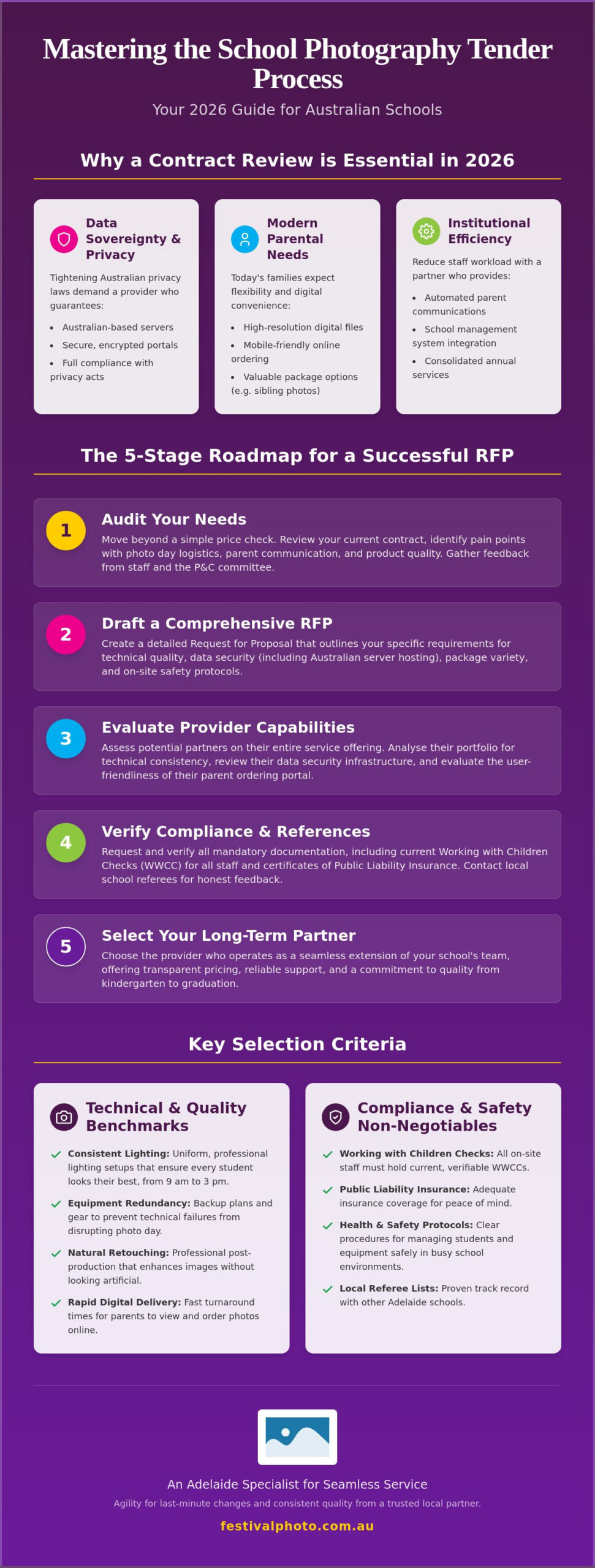
The 5-Stage Roadmap for a Successful Photography RFP
Executing a seamless school photography tender process Australia needs requires a clear, chronological strategy. It’s not enough to simply ask for quotes; you must build a framework that identifies the best cultural and technical fit for your campus. This roadmap moves from internal reflection to final contract execution, ensuring every stakeholder from the front office to the parent body feels heard. By following a structured path, you avoid the common pitfall of selecting a provider based on price alone, only to discover service gaps halfway through the school year.
Your procurement strategy should mirror the principles found in the NSW Government Procurement Policy Framework, prioritising value for money, ethics, and fairness. While state policies provide the foundation, your school’s unique rhythm dictates the specifics. The goal is to move beyond a transactional relationship and secure a partner who operates as a dedicated extension of your administrative team. This involves shortlisting providers with local Adelaide expertise who understand the South Australian educational landscape and can offer rapid, on-the-ground support when schedules shift unexpectedly.
The final stages of the roadmap focus on evaluation and awarding. Don’t rely on digital brochures alone. Request physical samples to check print clarity and durability, and insist on a live demonstration of parent ordering portals. Testing these systems ensures the user experience is intuitive and secure. Once a provider is selected, finalising service level agreements (SLAs) for 2026 provides a clear benchmark for accountability, covering everything from arrival times on photo day to the delivery window for final products.
Stage 1: Conducting a Needs Analysis
Success begins with an honest internal audit. Survey your parents and staff to pinpoint exactly where previous photo days have caused friction. Are the poses too rigid? Is the ordering system clunky? You must also audit your event calendar to ensure coverage for sports team photos and formals is included. A critical requirement in 2026 is defining the expected turnaround for digital image files for school photos, as families now expect rapid access to their memories.
Stage 2: Writing a Precise Request for Proposal
A vague RFP leads to vague results. Be specific about your enrolment numbers and preferred photo day dates to allow providers to accurately assess their capacity. Detail your technical requirements for student ID data imports to ensure compatibility with your school management system. Most importantly, demand a transparent school photography price list. This should be a comprehensive document with no hidden “admin fees” or “processing charges” that could surprise families later in the year.
Evaluating Technical Capability and Data Security Compliance
Technical capability in the modern school photography tender process Australia requires is no longer just about the megapixels in a camera. It’s about the robustness of the digital infrastructure supporting your students’ data. Administrators must verify that every portrait and personal record is stored on Australian-based servers to maintain data sovereignty. This ensures that sensitive information remains under the jurisdiction of Australian law, protecting the school from the complexities of international data handling. Encryption is equally vital; parent ordering portals and digital downloads must use high-level security protocols to prevent unauthorised access.
Compliance with the Privacy Act 1988 and the specific children’s privacy codes updated for 2026 is a non-negotiable benchmark. A provider’s technical stack should include a clear disaster recovery plan to protect your school’s visual legacy. If a server fails or a cyber incident occurs, you need the assurance that years of historical portraits aren’t lost forever. We’ve seen that the most reliable partners are those who treat data security with the same technical precision they apply to their creative output, acting as a seamless extension of your school’s IT and administrative departments.
The 2026 Data Security Checklist
- Does the provider have a documented data breach response plan that meets current Australian mandatory notification requirements?
- Are images and student data automatically deleted after a set period following the conclusion of the contract?
- Data sovereignty for Australian schools in 2026 means that all student personal information and photographic images are legally subject to Australian laws because they are stored and processed exclusively on physical servers located within Australia.
Scoring the Shortlist
When you reach the final evaluation stage, using a weighted scoring system helps you compare providers objectively. We recommend a balance of 40% for Service and Quality, 30% for Security and Compliance, and 30% for Value and Cost. This weighting ensures that while budget is respected, the safety of your students and the excellence of the final product remain the primary drivers. Visiting a provider’s local centre or studio is a brilliant way to verify their scale and technical capability before signing.
Choosing a local school photography Adelaide partner significantly reduces logistical risks. Local providers can offer more agile support and a deeper understanding of South Australian educational standards. If you’re ready to partner with an expert who prioritises security and local accountability, contact Festival City Photography to discuss our 2026 compliance standards.
Partnering with an Adelaide Specialist for Seamless Service
The final stage of the school photography tender process Australia administrators manage involves looking beyond the technical specifications to evaluate the human element of the partnership. While national providers offer scale, they often lack the “boots on the ground” agility essential for the unpredictable nature of the school year. A local Adelaide specialist understands that a sudden weather shift or a change in the sports calendar requires immediate action, not a series of emails to an interstate head office. Having a partner who can physically be on-site to troubleshoot or reschedule at short notice provides a level of security that remote providers simply cannot match.
Building a multi-year relationship with a second-generation family business fosters a deep sense of community trust. We understand the specific traditions and milestones that define South Australian schools, from the unique atmosphere of a local sports day to the prestige of a Year 12 formal. This local knowledge allows us to act as a seamless extension of your team, ensuring that every event, from kindy portraits to graduation ceremonies, is captured with the technical precision and narrative passion it deserves. By streamlining your entire event coverage under one local contract, you reduce administrative friction and ensure a consistent aesthetic for your school’s visual history.
The Festival City Photography Commitment
Since 1990, we’ve dedicated ourselves to serving the Adelaide community with a service-oriented mindset. We believe that consistency is the foundation of a successful partnership, which is why we provide a dedicated account manager for every school we serve. This ensures you have a single, accountable point of contact who understands your school’s specific requirements year after year. Our comprehensive model also allows for the seamless integration of professional sports team photos Adelaide families value, alongside staff portraits and student ID production, all handled with the same high degree of accountability.
Next Steps for Your 2026 Tender
Mastering your procurement process requires a proactive approach. We recommend starting your tender cycle at least six months before your current contract expires to allow ample time for evaluation and site visits. This timeframe ensures you can thoroughly test digital portals and view physical samples without the pressure of an impending photo day. Our Adelaide team is ready to provide a comprehensive sample pack and conduct a site visit to discuss how we can tailor our services to your campus.
If you’re ready to move away from the frustration of generic providers and toward a reliable, community-focused partnership, we invite you to reach out. Contact Festival City Photography for a confidential discussion about your school’s 2026 requirements and discover how a local expert can simplify your administrative workload while delivering excellence for your families.
Securing Your School’s Visual Legacy for 2026 and Beyond
Securing a photography partner is about more than just booking a date in the diary; it’s about protecting your school’s reputation and student data. By following a structured roadmap, you ensure that technical excellence and Australian data sovereignty remain at the forefront of your procurement. We’ve explored how a strategic RFP allows you to move beyond simple price checks to find a partner who understands the unique rhythm of your campus. Whether it’s individual portraits or composite group photos, consistency is the key to a successful long-term relationship.
Mastering the school photography tender process Australia requires doesn’t have to be an overwhelming administrative burden. With 35+ years of experience in South Australian schools, Festival City Photography provides the local reliability and technical precision you need. Our systems are fully compliant with 2026 Australian privacy standards, ensuring your student images are stored securely on local servers. We pride ourselves on being a seamless extension of your team, providing “boots on the ground” support from kindy through to graduation.
Discuss your 2026 school photography tender with our Adelaide experts today. Let’s work together to make your next photo day the most organised and successful one yet.
Frequently Asked Questions
How long does a typical school photography tender process take in Australia?
A comprehensive tender process generally spans three to six months from the initial internal audit to the final contract execution. This duration allows administrators enough time to survey the school community, draft a precise RFP, and thoroughly evaluate physical samples and digital portals. Starting the process early ensures your school isn’t forced into a rushed decision as the new academic year approaches.
What are the mandatory data privacy requirements for school photographers in 2026?
Mandatory requirements in 2026 prioritise data sovereignty, which dictates that all student images and personal records must be stored on physical servers located within Australia. Providers must also maintain a documented data breach response plan and ensure all on-site personnel hold current Working with Children Checks (WWCC). These standards are essential for compliance with the latest 2026 updates to the Privacy Act 1988.
Can we include sports team photos and event coverage in the same tender?
Yes, consolidating sports team photos and special event coverage into the school photography tender process Australia requires is highly recommended for administrative efficiency. Bundling these services under one reliable provider ensures a consistent aesthetic across all school records and simplifies your point of contact. It also allows the school to negotiate a comprehensive service model that covers everything from kindy portraits to the Year 12 formal.
What is the standard contract length for school photography in South Australia?
The standard contract length for South Australian schools typically ranges between three and five years. This timeframe provides the stability needed to build a multi-year relationship and allows the photography team to become a seamless extension of the school’s operations. Periodic reviews every few years ensure that the school continues to benefit from the latest technical advancements in digital delivery and data security.
How do we evaluate the quality of digital image files versus physical prints?
Quality evaluation should involve a side-by-side assessment of high-resolution digital image files and professional physical prints. Request physical samples to check colour accuracy, paper weight, and print durability for items like student ID cards. For digital files, test the provider’s parent portal to ensure images are easily accessible, properly retouched, and compatible with your existing school management systems.
Does the school need to provide staff to help on photo day?
Professional photography teams aim to minimise the burden on school staff by managing the majority of the logistics themselves. While the school provides a basic schedule and a suitable space like the gym or hall, the photographers handle the student flow and technical setup. An organised provider acts independently, allowing your front office to focus on daily tasks while the photo day runs smoothly in the background.
What happens if a student misses the scheduled photo day?
Reliable providers always schedule a dedicated catch-up day for students who are absent during the primary visit. This ensures that every child is included in the class group photos and that the school’s database for student IDs remains complete. You should verify that a “mop-up” session is included in the service agreement during the tender stage to avoid gaps in your visual records.
How are sibling photos usually handled during the tender process?
Sibling photos are typically managed through dedicated time slots before or after school hours to avoid disrupting the main portrait schedule. Most schools prefer a system where parents can book these sessions directly through an online portal, which removes the administrative workload from the front office. It’s important to specify that you require an intuitive booking system for sibling portraits within your tender requirements.