
A junior soccer club photo day runs more smoothly when each team has a dedicated time slot, rather than everyone arriving at once. A junior soccer club team photo scheduling template for Adelaide should set out each squad’s arrival time, individual portrait session and team photo, while fitting around the club’s existing training or competition timetable.
Families need clear timings, and clubs need to keep photo day moving without disrupting the wider schedule. A practical run sheet gives coaches, players and parents a shared plan, helping the photographer move from one team to the next in an organised way.
This guide explains how to choose a suitable photo day, coordinate several teams and share useful details with families. It also covers what to prepare for team photos and individual player portraits, so the day runs smoothly from the first arrival to the final squad photograph.
Key Takeaways
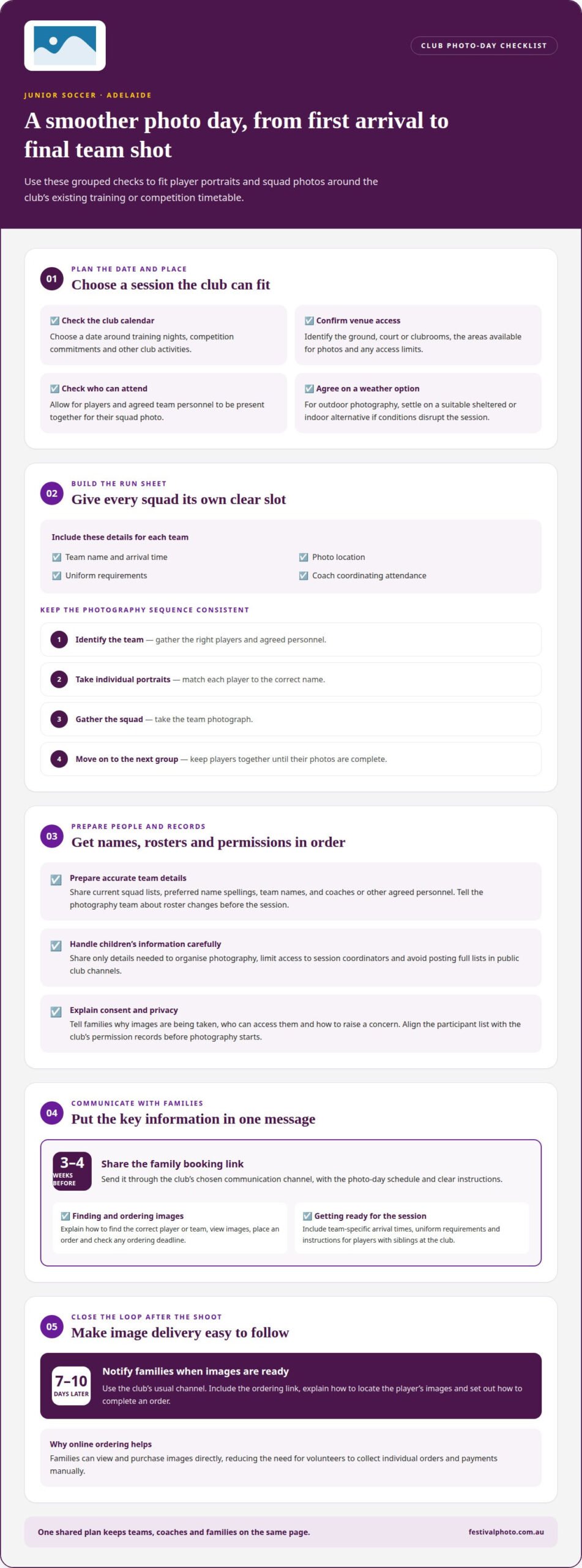
- Share the family booking link three to four weeks before photo day, with clear timings and information about viewing and ordering images.
- Prepare team and player details in advance, including agreed personnel to be photographed and the club’s uniform requirements.
- Choose a date that works with the club’s training or competition timetable and venue, then allow each participating team its own photography slot.
- Use online ordering to reduce the need for volunteers to collect individual orders and payments manually.
How a professional photo provider communicates schedules to participants and families
A clear schedule tells every family where to be and what happens next. The provider prepares one club-wide timetable, then shares team-specific arrival times through the club’s chosen communication channels. Each entry should name the team, arrival time, location, uniform requirements and the coach coordinating attendance. For example, an Under-10s team might be asked to arrive before its allocated portrait and squad-photo session. Coaches can circulate the same details to families, reducing conflicting messages and late arrivals.
Families should receive the booking link 3-4 weeks before photo day. The message can explain how to open the link, find the correct player or team, place an order and review any ordering deadline. A short example helps: “Select your player’s team, then follow the prompts to view available images.” The provider can also include the photo-day schedule and instructions for players who have siblings at the club. Keeping the booking information in one message makes it easier for families to find later.
For children’s photos, Australian clubs should explain their consent and privacy process before the session. Tell families why images are being taken, who can access them and how to raise a concern. Before photography starts, the club and photographer can align the participant list with the club’s permission records. Clear instructions help coaches manage attendance without discussing a child’s circumstances in front of the wider team.
Online ordering gives families a direct way to view and purchase their images, reducing volunteers’ need to collect individual orders and payments manually. After the shoot, families can be notified when images are ready to view and order, usually around 7-10 days later. The message should identify the ordering link, explain how to locate the player’s images and set out the next step for completing an order. A single update sent through the club’s usual channel keeps delivery information easy to follow.
Team photos and individual player portraits
Adelaide clubs can use professional sports photographers to coordinate player portraits and team photographs in one session. For outdoor photos, agree on a rain plan and a venue with suitable space, room for players to assemble, and a sheltered or indoor alternative.
Confirming rosters and player names
Before photo day, the club can provide current squad lists, preferred name spellings, team names and details of coaches or other agreed personnel. The photographer uses these details to prepare the session order and match each player to the right portrait and squad photograph. Tell the photography team about roster changes before the session so the working list reflects who is expected.
Secure team and player lists
Team lists contain children’s personal information, so the club and provider should agree on a suitable way to share and handle them. Send only the details needed to organise photography, such as team, player name and agreed personnel. Keep access limited to people coordinating the session, and avoid posting full lists in public club channels. A named contact can pass roster updates directly to the photography team.
Junior team coordination
A consistent sequence helps younger players know what happens next: identify the team, take individual portraits, gather the squad for its team photograph, then move on to the next group. Coaches can help assemble players and agreed personnel. Share uniform requirements with families beforehand so each squad arrives in the expected kit. To keep the session moving, the team contact can keep players together until their photographs are complete.
Individual portraits and team images in one organised session create a useful record of the season. Consistency comes from using a similar pose, framing and background across players, while keeping names matched accurately to each image. Clubs arranging professional team and player photography can provide the photographer with squad details and any agreed presentation preferences before photo day.
Check player names and team information while individual portraits are being taken. Combining individual portraits with team photographs can create a more complete set of images while players are present in uniform.
Choosing and confirming a club photo-day date with your photo provider
Start with the club calendar and choose a date that gives participating teams a practical session window. Training nights can work well because players are already at the venue, provided photography fits around training and other club activities. A weekend or another day may suit better if the ground, court or clubrooms are available and teams can attend. The right choice depends on the club timetable, venue access and number of squads.
Share the proposed date and key scheduling constraints with the photography team. Include the venue, participating teams, training or competition commitments, and any access limits that affect where photographs can be taken. If several teams use the ground on the same evening, account for their arrival and departure times. Discussing these details early helps create a session plan that suits the club instead of squeezing teams into an unsuitable gap.
Before confirming, settle the practical details that determine whether the date will work:
- Venue: identify the ground, court or clubrooms and the areas available for photographs.
- Team timetable: note when each squad is already scheduled to train or play.
- Attendance: consider whether players and agreed team personnel can be present together.
- Weather option: decide how outdoor photography will move to a suitable alternative if conditions disrupt the session.
Once agreed, record the date, venue and session arrangements in one message for the provider and club contacts. This gives coaches a reliable reference when coordinating teams and helps prevent later calendar changes from going unnoticed. If a fixture or training change affects attendance, pass the update to the provider promptly so the session order can be adjusted. A confirmed date should work for the venue and participating teams, not merely appear free on the club calendar.
How a professional photo provider schedules a multi-team club photo day
A professional schedule gives each participating team a clear slot, sequence and arrival instruction. For Adelaide clubs, it should fit the season calendar and the venue’s existing activities.
What to look for in a professional team photo schedule for junior soccer clubs
A useful schedule names each team, its arrival time, photography sequence and meeting point. It shows when players move from individual portraits to the squad photograph, helping coaches keep everyone together. A junior soccer club team photo scheduling template Adelaide clubs can adapt might include each team’s coach, a uniform reminder and the next step after the session. Families can see when their player is expected, while the club can spot clashes with training or competition.
How a professional provider builds a multi-team photo-day schedule
The photography team can build the sequence around participating teams, venue access and the club timetable. Order teams around training times so players can be photographed while already at the ground. Schedule each squad’s portraits and team image before moving to the next group, and include coaches or other agreed personnel when requested. A junior soccer club team photo scheduling template Adelaide clubs adapt should capture these details in one run sheet.
How a professional provider allows time for each team
There is no single session length that works for every squad. The time required depends on the number of players present, whether portraits and a team image are planned, and how quickly the group assembles. The photographer can use these details to shape each slot and the transitions between teams. A smaller squad with everyone ready has different needs from a larger group with late arrivals. Allow each team a distinct slot for portraits, the squad image and movement to the next team.
For an organised season photo day, arrange professional team photography around your club’s teams, venue and timetable.
Festival City Photography: Sports Team Photos
Festival City Photography provides Sports Team Photos for clubs planning a coordinated photo day. Team images and Individual Portraits capture each squad together and each player separately, creating a record of the season. Share your preferred date, venue, participating teams and timetable to help shape the session around your club’s arrangements.
For clubs looking beyond squad photographs, Sibling Photos can bring players with brothers or sisters at the same club together. A Photobooth can add an interactive element to a club event. These options suit different occasions, so choose the combination that matches what the club wants its photography to capture.
To discuss Sports Team Photos for your club, contact Festival City Photography.
Make this season’s photo day part of the club story
Once the club has settled on its approach, turn the plan into images players and families will value beyond the season. A junior soccer club team photo scheduling template Adelaide clubs can adapt should reflect the club’s character, how its teams come together and the moments families want to keep.
Festival City Photography offers Sports Team Photos, Individual Portraits and Class Group Photos, giving clubs options for capturing squads and players. Sibling Photos can bring club-going brothers and sisters together in a shared image. Choose the option that suits the memories your club wants to create and the way photography fits into its season.
Start a conversation about your club’s photo-day plans and the images you have in mind. Contact Festival City Photography to discuss your next step, and give this season’s team memories a thoughtful beginning.
Frequently Asked Questions
What’s the best time of the season for junior soccer team photos in Adelaide?
Choose a time when teams can gather in their current uniforms without clashing with important fixtures or training. Some clubs prefer an early-season session, while others wait until squads have settled. First consider player availability, venue access and the club calendar. For Adelaide clubs, a date that works for participating teams matters more than a fixed point in the season.
How does a professional provider organise team lists and player arrival times for photo day?
A professional photographer uses the club’s team and player details to organise the photography sequence and assign arrival times. Group each team’s information together, noting its coach or other agreed personnel alongside the players. For example, the schedule can distinguish when a squad should report from when its portraits begin. This gives coaches a clear handover point and helps prevent several teams gathering at once.