
Poolside access is the deciding factor. Swimming squad club night photography in Adelaide can go ahead when the club and venue agree to photographer access and image-use arrangements. Swimming SA has 42 affiliated clubs across South Australia, so each squad’s setting and event plans can differ.
Club nights are about more than racing: they bring swimmers, coaches and families together around shared effort and team spirit. You’ll learn how photography can fit into a club night, what to consider when arranging coverage, and which Adelaide locations are served.
It also explores how event photography can capture swimming, surf, open-water swimming and triathlon, from team moments to individual sporting portraits.
Key Takeaways
- Arrange photographer access with the club and venue before planning coverage, and agree how images will be used.
- Build child-safety and privacy considerations into the event plan, including clear communication with families.
- Indoor pool lighting and fast-moving swimmers make exposure, focus and shooting position important to image quality.
- Help the booking process run smoothly by sharing the venue, event schedule and the moments the club wants captured.
- For squad keepsakes, sports team photos and individual portraits can preserve both the group spirit and each swimmer’s achievement.
Are photographers allowed at swimming squad club nights in Adelaide?
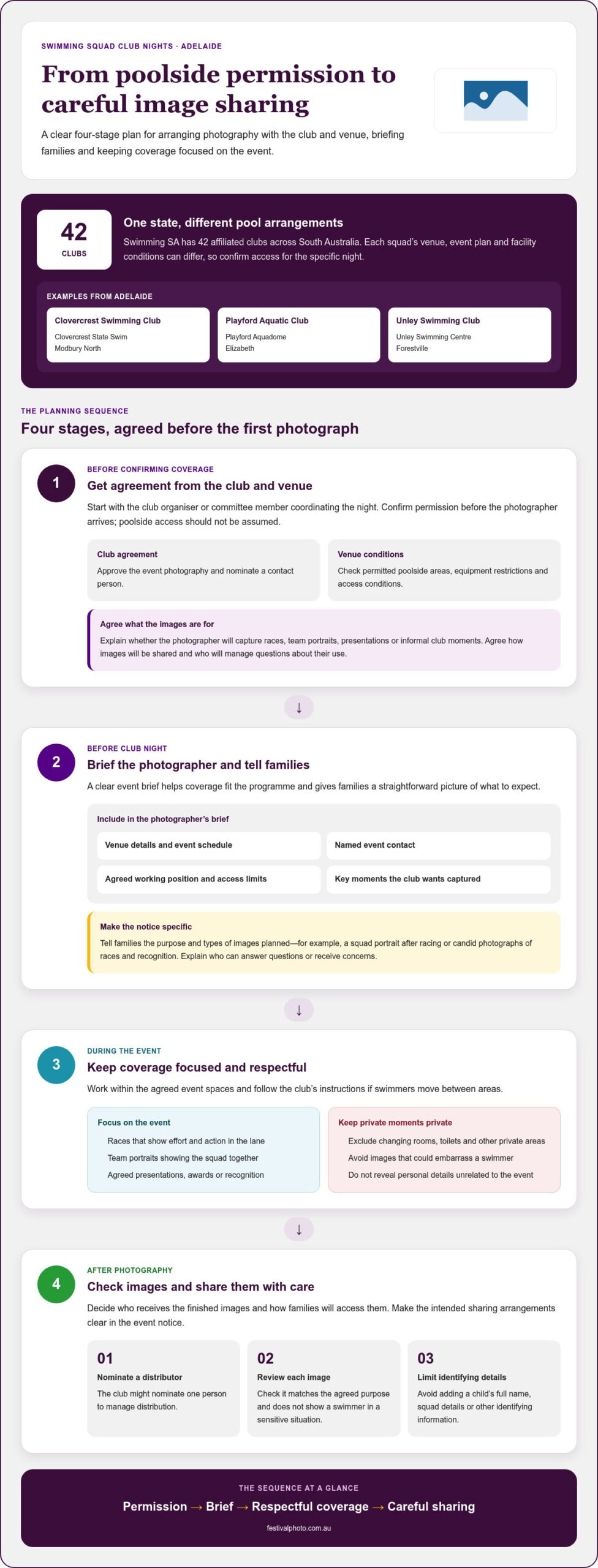
Photography at an Adelaide swimming squad club night needs to be arranged with the club and venue in advance. There is no single arrangement for every pool: the event plan, facility access conditions and intended use of the images all matter. Confirm permission before the photographer arrives, rather than assuming access at poolside.
Swimming SA has 42 affiliated clubs across South Australia, and squads train at different facilities. For example, Clovercrest Swimming Club trains at Clovercrest State Swim in Modbury North. Playford Aquatic Club uses Playford Aquadome in Elizabeth, while Unley Swimming Club trains at Unley Swimming Centre in Forestville. A club night at one venue may therefore involve different access arrangements from an event elsewhere.
Who needs to agree to photography?
Start with the club organiser or committee member coordinating the night. They can explain the event format, identify who manages the venue relationship and discuss photography with the facility. The venue’s conditions will determine where the photographer can stand and work without disrupting swimmers or staff.
Before confirming coverage, agree on practical details with both parties:
- Ask the club to approve the event photography and nominate a contact person.
- Ask the venue about permitted poolside areas, equipment restrictions and any access conditions.
- Explain whether the photographer will capture races, team portraits, presentations or informal club moments.
- Agree how images will be shared and who will manage questions about their use.
These steps distinguish an organised club booking from a visitor taking photographs independently. A parent’s camera at a public event and a photographer commissioned by a squad are different situations. The club can explain the purpose and arrangements to families, while the venue sets expectations for its facility.
What should the club plan before the night?
Give the photographer a clear schedule, venue details and a named event contact. Identify key moments, such as a relay, squad photograph or presentation, so coverage fits the programme. At Clovercrest State Swim or Playford Aquadome, the available working position may differ, so agree on it with the venue.
Make sure swimmers and families understand the arrangements. The club can explain when photography is planned, what the images will record and how families can raise concerns. Be specific: tell families if the photographer will take a squad portrait after racing, rather than describing the plan only as general event coverage.
Clubs can also discuss photography while families assess a squad. People considering a South Australian swimming club can ask about its programmes, training times and support. Visiting before joining, meeting coaches and viewing the facilities can help families understand the setting and the club’s approach.
For swimming squad club night photography in Adelaide, arrange coverage through the club and secure the venue’s permission for the planned photography. Confirm the contact person, permitted position, schedule and image-use plan so the photographer has a clear brief and the night runs smoothly.
What photography and child-safety rules apply at Adelaide swimming events?
At an Adelaide swimming event, the club and venue should agree on photography conditions before it begins. The plan should explain who is photographing, what they’ll capture, where they may work and how images will be shared. These steps help protect swimmers’ privacy while documenting the event.
Set expectations before the event
Give families clear notice before club night, rather than relying on an announcement beside the pool. State the purpose of photography, the types of images planned and who will answer questions. For example, distinguish a squad portrait from candid photographs of swimmers racing or receiving recognition.
The club organiser can coordinate communication with families and venue staff. Give the photographer the same instructions, including any limits on poolside access or areas where photography isn’t permitted. A written event brief helps prevent misunderstandings if the schedule changes or several activities happen at once.
Agree on a straightforward way for families to raise concerns before photographs are taken. The organiser can pass relevant instructions to the photographer without drawing attention to a swimmer during the event. Make sure coaches and event volunteers know whom to approach with questions.
Keep photography focused and respectful
Use the event plan to guide the photographs. A race image can focus on the swimmer’s effort and the action in the lane. A team portrait can show the squad together, rather than singling out a child unexpectedly. Avoid images that could embarrass a swimmer or reveal personal details unrelated to the event.
Exclude changing rooms, toilets and other private areas from photography. Keep cameras directed towards agreed event spaces, such as the pool deck or presentation area. If swimmers move between spaces, follow the club’s instructions and avoid photographing private moments.
For a presentation, agree beforehand whether photographs will show a swimmer receiving an award, posing with a coach or joining the team group. Clear direction helps the photographer prepare and keeps coverage consistent with the event’s purpose.
Plan image sharing with care
Decide who will receive the finished images and how families can access them. For example, the club might nominate one person to manage distribution, rather than letting images circulate through multiple informal group chats. Describe the intended sharing arrangements plainly in the event notice.
Choose photographs carefully. Before sharing an image, check that it matches the agreed purpose and doesn’t show a swimmer in a sensitive situation. Avoid adding a child’s full name, squad details or other identifying information unless the club has specifically approved that use.
Keep the photographer’s brief practical: identify approved areas, key moments, individual restrictions and the person responsible for questions. At a club night with races and presentations, a clear brief helps the photographer work without interrupting coaches, swimmers or venue staff.
Clubs organising swimming, surf, open-water swimming or triathlon coverage can use the same clear approach: communicate the purpose, define access and manage image sharing thoughtfully. For event photography planning, organised event photography can sit alongside the club’s own child-safety procedures.
If shared images include results, keep captions limited to the event and verified placing, and follow the agreed distribution plan. A clear caption can record an achievement without adding unnecessary personal details.
Two Unley Swimming Club swimmers placed 6th and seventh in their respective 5 km events at the Australian Open Water Championships in Bunbury. Unley swimmer Emmy placed sixth in the 15-year female 5 km event at the Australian Open Water Championships in Bunbury, with a time of 1:04.44. Unley swimmer Jobe placed seventh in the 15-year male 5 km event at the Australian Open Water Championships in Bunbury, with a time of 59:33. Unley swimmer Sutton Miller won a national Bronze medal in the 16-year female 5 km open-water event. Unley swimmer Jobe Bevan won the 14-year boys 5 km event at the Victorian Open Water State Championships in 1:03:21.
What camera and lens settings work for indoor pool photography?
Indoor pool photography requires a balance between stopping swimmer movement and managing limited light. Start with a fast shutter speed, a wide aperture and a higher ISO setting. The right combination depends on the pool’s lighting, the swimmer’s pace and your distance from the camera. Take test frames before racing begins, then adjust after checking sharpness and exposure.
For a freestyle race, use continuous autofocus and track the swimmer as they approach. A fast shutter helps freeze a hand entering the water or a turn at the wall. If the swimmer looks blurred, increase shutter speed and compensate with a wider aperture or higher ISO. If the image is too dark, check exposure before slowing the shutter, which can add movement blur.
Choose exposure settings for the action
A wide aperture lets more light reach the sensor, which is useful indoors at venues such as Unley Swimming Centre. It also creates a shallower depth of field, making accurate focus important. For a single swimmer, keep the active focus area over the face or upper body. For a squad portrait, stop down the aperture so swimmers across the group remain in focus.
ISO controls how strongly the camera amplifies available light. Raise it when pool lighting requires a fast shutter and wide aperture, then check the result for visible noise. Cameras handle higher ISO settings differently, so test your own equipment under the venue’s lights. A slightly grainy, sharp action frame is often more useful than a clean image blurred by movement.
Pick a lens for distance and framing
A telephoto zoom helps you photograph swimmers across the pool without entering restricted areas. It also makes it easier to frame starts, turns and finishes from an approved position. A standard zoom suits team portraits and wider scenes, such as swimmers gathering behind the starting blocks. Choose a focal length that suits your working distance and available space.
Keep the lens hood on where practical. It can reduce stray light and help protect the front element from splashes. Poolside surfaces can be wet, so secure camera straps and avoid changing lenses where water could reach exposed equipment. Follow the facility’s access conditions when choosing where to shoot.
Control focus, colour and reflections
Use continuous autofocus for moving swimmers and choose a focus area that stays on the subject. For a relay exchange, track the incoming swimmer, then shift focus as the next swimmer launches. Burst shooting can capture several stages of the action, but review the frames later for the clearest expression and sharpest moment.
Indoor pool lights can create colour casts, especially across skin tones and white lane ropes. Set white balance for the venue lighting, or photograph in RAW so you can refine colour during editing. Watch for reflections from the water and bright pool lights. A slight change of angle can reduce glare across a swimmer’s face or goggles.
Before club night, test exposure from the position you’ll use for races and portraits. Review the histogram, check focus at full playback size and adjust one setting at a time. At an Adelaide pool, these tests help you respond to changing light and fast movement for clearer, more energetic photographs.
Capture a short sequence around a start, turn or finish, then select a frame with clear focus and useful timing. Review the images at the camera rather than relying only on the viewfinder, and adjust focus tracking or exposure if the swimmer is not crisp. Keep your position consistent with facility access conditions and avoid letting the camera distract you from nearby activity.
Tea Tree Gully Swimming Club Head Coach Lawrence Krauter has coached athletes in pool swimming, open-water swimming and triathlon through to national-level competition. The range of disciplines is a reminder to frame each event appropriately: keep the pool surroundings visible when they help explain the action, or tighten the composition when the swimmer is the main subject.
How can I book a photographer for an Adelaide swimming squad club night
Start with the club organiser, who can coordinate the event brief and venue arrangements. For swimming squad club night photography in Adelaide, identify key moments, confirm access and give the photographer a clear schedule. A race night at Unley Swimming Centre, for example, needs a different plan from a squad portrait session.
Prepare the event details
Before requesting a quote, gather the information that will shape the coverage. A concise brief helps the photographer understand the event, prepare suitable equipment and plan around the club’s programme.
- Venue: name the pool and provide its location, such as The Parks Recreation and Sports Centre in Angle Park.
- Programme: outline the order of races, presentations, team portraits or other planned moments.
- Coverage priorities: say whether the club wants action photographs, a squad portrait or both.
- Access arrangements: nominate the organiser coordinating with venue staff and explain any agreed working-area limits.
- Image use: describe how the club plans to share the photographs with swimmers and families.
Specific examples make the brief more useful. Instead of asking for general coverage, list moments such as swimmers behind the starting blocks, a relay finish and a team portrait after racing. If there’s a presentation, include it in the schedule so the photographer can be ready without interrupting proceedings.
Agree on the booking scope
Once the photographer has the event details, agree on the coverage before finalising the booking. Clarify which parts of the programme to photograph, the expected working position and who will manage questions on the night. Naming Waterworld Aquatic Centre in Ridgehaven helps everyone discuss the correct facility and event plan.
Ask for a quote based on the club’s actual requirements. The quote depends on factors such as event duration, location, coverage priorities and requested image deliverables. A clear brief connects these factors to the planned event, making it easier to compare like with like.
Also agree on how the club will receive and distribute the images. Identify who is responsible for sharing them and make the intended audience clear. If the club wants images for families as well as its own communications, explain both uses when arranging the booking.
Confirm the plan before event day
Before the event, send the photographer the final schedule and a contact name. Include any changes to race order, presentation timing or the agreed shooting position. If the club night is at Largs Bay Swim Centre, make sure the venue and photographer have the same location details.
Run through the plan with the event organiser to flag essential moments and access boundaries. A relay, squad portrait and awards presentation each call for different positioning. Have one person responsible for updates so the photographer receives clear instructions if the programme changes.
Ready to organise coverage for a club event? Start planning your event photography with the venue, schedule and image priorities to hand.
Festival City Photography: Sibling Photos
Festival City Photography offers Sibling Photos for families who want a shared portrait alongside their children’s swimming milestones. This suits families whose siblings belong to different squads or where only one child is competing at club night but the family would also like a photograph together. Race coverage records the action, while a sibling portrait captures a family connection.
For club keepsakes, Sports Team Photos bring squad members together, while Individual Portraits focus on each swimmer. The right format depends on whether families or the club want a personal memento, a team image or both. Share your photography needs with Festival City Photography at festivalphoto.com.au.
Plan the images your squad will value
Before the next club night, decide what the photographs should represent after the final race: a record of the season, a shared team memory or a portrait families can keep. For swimming squad club night photography in Adelaide, that purpose gives organisers a practical starting point for planning and choosing the moments that matter most.
Festival City Photography offers Sibling Photos, Individual Portraits and Class Group Photos. These options can suit families looking for a personal keepsake or clubs planning a formal group portrait beyond the action of a meet. A clear idea of the image you want makes the next conversation focused and practical.
Bring your club’s priorities and event details together, then contact Festival City Photography to discuss your club night.
Frequently Asked Questions
Which Adelaide swimming clubs or squads hold club nights?
Adelaide clubs to contact about schedules include STARplex Swim Club in Evanston Park, Tea Tree Gully Swimming Club in Ridgehaven, Western Aquatic Swimming Club at Largs Bay, and Marion Swimming Club at SA Aquatic and Leisure Centre in Oaklands Park. These are examples of clubs and training venues, not confirmation of a particular club night. Ask about squad programmes, training times and event schedules, then visit to meet coaches and see the facilities.
Who are Adelaide sports photographers specialising in swimming?
Festival City Photography provides sports photography for teams and individuals in Adelaide, including Sports Team Photos and Individual Sports Portraits. In your brief, say whether the priority is a squad portrait, individual swimmer portraits or action at a meet. This helps shape the coverage around the images your club wants to keep.