
A composite group photo can bring individual portraits together to tell the story of a whole centre. For an early learning centre composite group photo design Adelaide families can feel connected to, the brief matters: decide who the image represents, what it should convey and how the project can fit around children’s routines.
Planning starts with the centre’s community, not a layout. Consider how children and educators will be represented, what families should recognise in the finished keepsake and which practical details staff need to coordinate. A clear purpose helps create an image that feels considered rather than simply assembled.
This article covers the decisions behind composite group photos, how to plan around centre routines and what can help a keepsake feel personal. Festival City Photography is a second-generation, South Australian family-owned business with over 30 years’ experience in school and event photography, including composite group photos. Its education photography brings a local Adelaide perspective to planning a photo project for your centre.
Key Takeaways
- Start with the story you want the keepsake to tell about your centre and its community.
- Balance a unified overall look with details that help each child retain their individuality.
- Compare a composite with a traditional group portrait by considering the feel you want and how photography fits your centre’s routines.
- Use a clear planning sequence to organise the brief, staff coordination and family communication.
- Explore how early learning centre composite group photo design Adelaide can reflect your centre’s character with an experienced local photography partner.
Why an early learning centre composite group photo can matter to an Adelaide community
A centre photograph can do more than record who attended. It can reflect a particular group of children, the educators who support them and the relationships formed through everyday experiences. For Adelaide centre leaders considering an early learning centre composite group photo design families can value, begin by defining what the image should say about the community.
What does composite group photo design mean for an early learning centre?
A composite group photo brings individual portraits together to represent a group in one shared image. A traditional group photograph captures everyone together in a single picture. Each format creates a different kind of keepsake, so consider whether you want to bring individual portraits into one designed image or remember the group gathered at the same time.
Early learning is shaped by relationships, play and development, as the broad overview of Early Childhood Education helps illustrate. A composite can give families a way to remember the children who shared a stage of their early learning, along with the educators and centre community around them. It can represent a cohort, rather than simply collect names and portraits.
Why centre identity and belonging matter in a shared image
Some families may find a composite less personal than a group portrait. A useful way to address that concern is to give equal thought to the group and to each child’s place in it. The brief should make visibility and individuality priorities, while ensuring the overall image feels connected.
Centre identity can guide the project without requiring a particular layout or backdrop. Think about what families associate with your community: its welcoming atmosphere, relationships between children and educators, or the character of the learning environment. Use those details to describe the tone you want, and avoid visual choices that distract from the people being remembered.
Belonging also depends on representation. Children have different expressions and personalities, and a shared keepsake should make room for each of them. Before design decisions begin, define the cohort or group, the role educators have in the image and the feeling you want the finished photo to convey.
For families, the photograph may become a reminder of friendships, familiar educators and a place where their child spent an important part of growing up. For the centre, it can mark a chapter in the community’s story. Start with a practical question: what should children and families feel when they look back at this image?
What makes an early learning centre composite group photo design feel cohesive?
A cohesive composite needs to work as both a unified group image and a collection of individual portraits. The aim is not to make every child look identical. Instead, make sure each person has a clear place and the overall image feels connected. Consistency can come from a shared visual tone while preserving the differences that make each child recognisable.
A cohesive composite brings individual portraits together in a consistent visual approach while preserving each child’s distinct presence. This balance is central to early learning centre composite group photo design Adelaide centres may be considering: families should recognise their child, while the image as a whole reflects a shared community.
Balancing a shared centre story with each child’s individuality
First, decide who the image is intended to represent. Is it a particular cohort, children alongside educators, or the wider centre community? This decision keeps the brief grounded in real relationships, rather than treating the project as a set of portraits without a shared purpose.
Give everyone equal consideration. A child should not feel like an afterthought in an image intended to represent the group. Individuality comes through in each child’s expression and presence. State in the brief that both the collective story and each person’s place within it matter, without prescribing a layout or promising specific editing.
Choosing a design direction that feels right for the centre
Ask educators to describe the feeling they want families to associate with the keepsake. It might be welcoming, calm, lively or connected. Treat these as ways to describe the intended tone, not as fixed design options. A shared description gives the people involved a useful reference point for decisions.
Keep each visual choice tied to that intention. If the centre wants the image to feel warm and familiar, explain what that means to your community and consider whether proposed choices support it. This keeps the project connected to the centre’s identity instead of imposing a one-size-fits-all look.
Before the project begins, centre leaders can make the brief more useful by noting:
- Who belongs in the image: define the cohort and whether educators are part of the story.
- What the keepsake should convey: describe the community feeling families should recognise.
- What matters for each child: make visibility and individuality priorities alongside the overall look.
- What to avoid: flag visual choices that wouldn’t feel true to the centre’s identity.
These points give staff and the photography team a practical basis for discussing the project. They also prevent the brief from becoming a list of unrelated preferences. Consider each choice against the same question: does it support a unified image and respect the children represented?
Festival City Photography provides composite group photos for education clients, drawing on over 30 years’ experience in school and event photography. For a community-focused brief in Adelaide, explore Festival City Photography as your local photography partner.
Composite group photo or traditional group portrait: which suits your centre?
Neither format is automatically the better choice. A composite brings individual portraits together in one shared image, while a traditional group portrait captures people together in a single moment. Choose based on what the centre wants families to remember, the feeling it hopes to convey and how photography can fit around children’s routines.
A composite does not show everyone in one shared moment, which may feel less natural to some families. A traditional portrait records a group gathered together. Compare what each format communicates, then decide which kind of keepsake best reflects the centre’s priorities.
| Consideration | Composite group photo | Traditional group portrait |
|---|---|---|
| Purpose | Bring individual portraits together as one representation of a cohort or community. | Record children and educators together in a shared group photograph. |
| Desired feel | A designed keepsake that gives the group an overall visual identity. | A record of one occasion, with the feeling of people gathered at the same time. |
| Coordination | Consider how individual portraits fit the centre’s schedule and the project brief. | Coordinate the group for a shared photography moment within the centre’s routine. |
| Best guiding question | Do we want to represent the cohort through individual portraits brought together? | Do we want to remember this group as they appeared together in one moment? |
When a composite may suit the centre’s priorities
A composite can suit a centre that wants to bring individual portraits into one keepsake representing a cohort and its shared story. Each child’s portrait contributes to the whole. Consider whether that designed, collective feel matches what educators and families would value. The format alone does not determine who is included or how portraits fit into the centre’s schedule.
When a traditional group portrait may be the better fit
If the centre values the sense of a shared occasion, a traditional group portrait may feel more familiar. Children and educators are photographed together, recording the group as it came together for that moment. This can appeal to families who prefer a straightforward record of the cohort in one scene. Consider the centre’s priorities and how a group portrait can fit its routines.
To decide, invite educators to describe what they want the keepsake to communicate, then consider how families might respond to each format. A centre marking a cohort’s shared identity may lean towards a composite; one that wants to remember a particular group gathering may prefer a traditional portrait. Use these as discussion points, not fixed rules.
Festival City Photography provides composite group photos as part of its education photography for Adelaide centres. Choose the format that best reflects your community’s preferences, then shape the project around that purpose.
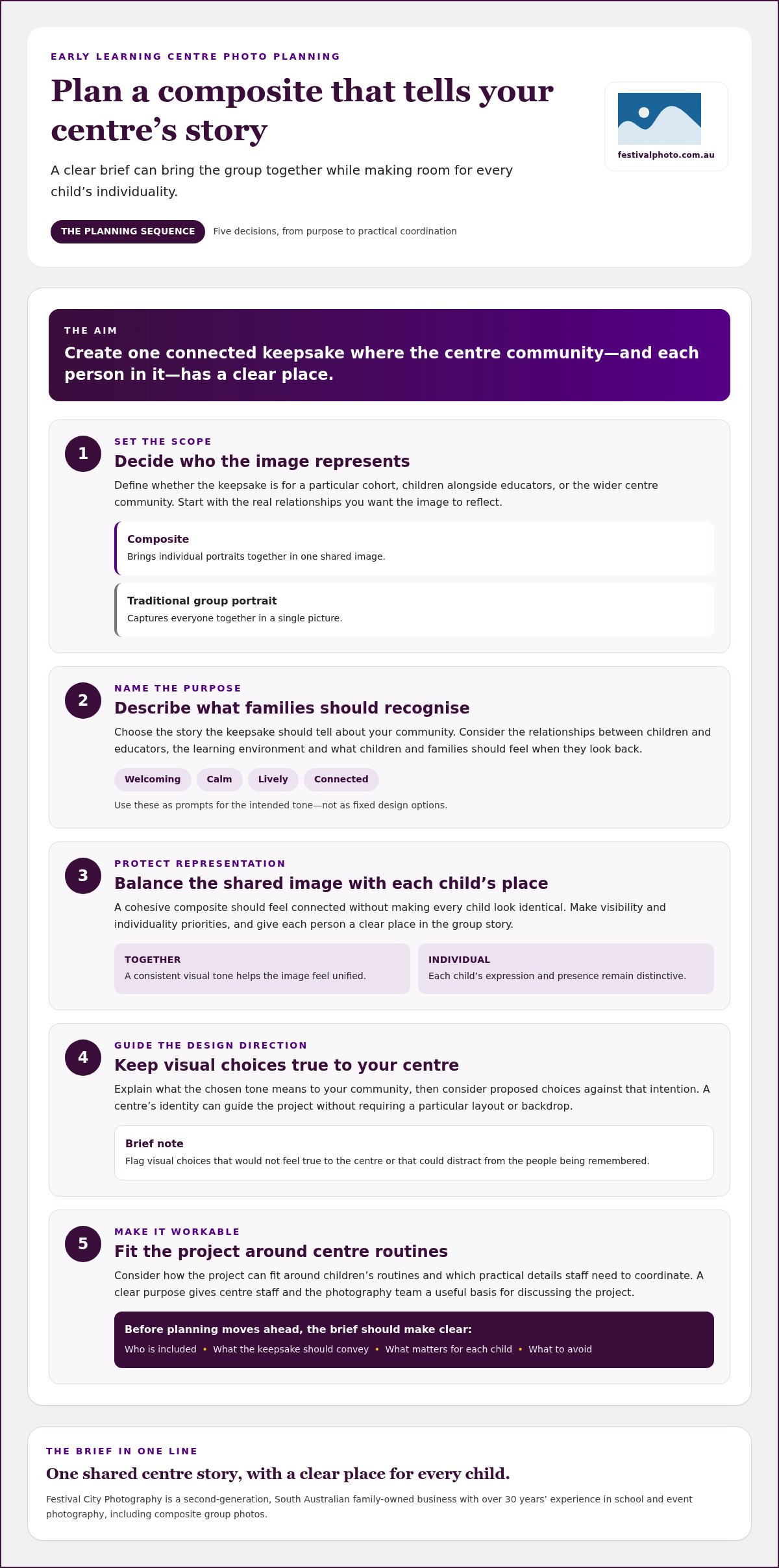
How to plan an Adelaide early learning centre composite photo project
A clear plan helps photography fit around children’s needs, staff responsibilities and the centre’s daily rhythm. Start with the purpose, then work through practical details in order. Define what the keepsake should represent, agree on a brief with educators, then coordinate the session and explain the process to families.
Create a clear brief and coordinate with educators
- Set the purpose. Decide who the image is for and what it should remember, such as a cohort’s time at the centre or the wider learning community. Agree on the overall feeling you want families to take away.
- Write the brief. Note who the photo project is intended to represent, the centre’s preferred tone and any practical considerations. For broader education photography context, refer to this school photography guide for Adelaide.
- Assign staff responsibilities. Choose a staff contact to coordinate information and identify which educators can help children feel settled. Share the plan with the relevant team members so everyone understands their role.
- Fit arrangements around routines. Consider children’s usual transitions, rest periods, meals and activities when organising the session. Plan around age-appropriate routines instead of expecting young children to follow a rigid timetable.
- Record attendance considerations. Note expected absences or changes staff know about, and include them in the project brief. This helps the team plan around the cohort without assuming how a child who is away will be represented.
Prepare families and explain how photographs can be ordered
Give families clear, centre-approved information before the project. Explain its purpose, who it represents, what families need to know about the photography arrangements and how ordering information will be shared. Keep the message straightforward and follow the centre’s image-consent and communication processes.
Be specific about the ordering information families will receive, including how to order and where to find instructions. If digital files are part of that information, the digital image files for school photos guide offers additional context. For school class photo orders, student packs are delivered to the student’s school.
A short family notice can explain when the project is taking place, who families can speak to at the centre and how updates will be shared. This gives families a clear point of reference. Keep the wording aligned with the centre’s approved process and avoid promising an outcome for an individual child.
With the purpose, staff plan and family communication in place, the centre can move forward with a shared understanding of the project. Plan your centre’s composite photo project with Festival City Photography, a South Australian education photography provider with over 30 years’ experience.
Plan your early learning centre composite group photo with Festival City Photography
A centre composite is a keepsake with a story behind it: the children, educators and community who shared a stage of early learning. Turning that idea into a clear project takes a thoughtful brief and a photography partner who understands education settings and the importance of working around each centre’s needs.
A local photography partner with education experience
Festival City Photography is a second-generation, South Australian family-owned and operated photography business serving education clients and the wider community. The team provides educational and event photography, including composite group photos, and brings over 30 years’ experience in school and event photography.
That local experience supports a project rooted in the centre community. A considered conversation helps staff define what the image means to them, who it should represent and how the project can fit their environment. Keep the centre’s priorities at the heart of the brief rather than starting with a standardised idea of the finished image.
Turn your centre’s idea into a photo brief
Before making an enquiry, centre staff can gather a few details to make the first discussion productive. Think about the image’s purpose, its intended audience and the qualities families associate with the centre. For example, the brief might focus on marking a cohort’s time together, recognising educators’ place in the community or creating a shared keepsake for children and families.
Outline practical considerations too: daily routines, staff coordination, family communication and attendance factors that may affect planning. These notes help shape a project around the setting and the children. As you develop your early learning centre composite group photo design Adelaide brief, clarity about the people and purpose can guide the conversation from the outset.
Festival City Photography’s education photography experience supports a practical, community-focused approach. Share what you hope the image will capture, along with the routines and considerations that matter to your centre. The brief does not need to settle every detail in advance; it should give the project a thoughtful starting point and help everyone work towards the same purpose.
To take the next step, plan a centre photo project with Festival City Photography. Bring your ideas, audience and centre context to the conversation, and start shaping a composite group photo that reflects the community it represents. Let us put you in the picture.
Give your centre’s story a place to grow
A keepsake can become part of how families remember a child’s time at the centre. Begin by considering what the image should mean to your community and what would make it feel like a genuine reflection of the people who belong there.
For an early learning centre composite group photo design Adelaide project, start with the centre’s own perspective. Bring together the ideas that matter to educators and families, then use them to guide a clear, considered brief. You do not need every detail settled before you begin. A strong sense of purpose gives the project a meaningful starting point.
Start planning your centre’s composite group photo with Festival City Photography. Share the story you hope to preserve and take the first step towards a keepsake shaped around your community. Your centre’s next chapter is worth remembering.
Frequently Asked Questions
What is an early learning centre composite group photo?
An early learning centre composite group photo is a designed image that brings individual portraits together to represent a centre group. Unlike a conventional group photograph, which records people together in one picture, a composite presents the group through combined portraits. For an Adelaide centre, it can serve as a keepsake of a cohort’s time together and give families a shared image connected with their child’s early learning community.
Can a composite group photo include a child who is absent on photo day?
Attendance is a practical consideration to include in the project brief. If a child is expected to be away, note this early so it can be included in planning. The agreed project approach will guide how the group is represented, so do not assume a portrait can be added later.
What should an early learning centre include in its composite photo brief?
For early learning centre composite group photo design Adelaide, a useful brief records the image’s purpose, intended audience and the centre identity it should reflect. Include staff coordination needs, daily routines, known attendance considerations and how families will receive project and ordering information. These details give everyone a shared reference for decisions. A straightforward written outline is enough to get the discussion started.
How can a composite group photo feel personal rather than artificial?
Start with the people and relationships that make the centre community distinctive, then give each child thoughtful consideration in the shared image. A composite has a different feel from a single photograph of everyone together, so it will not suit every family’s preference. Explain the intention in the brief and consider whether a designed group image reflects the kind of keepsake families would appreciate.
How do families order school class photos?
Families order school class photos online by selecting the school, entering the student’s last name, choosing the student or students, selecting a package and paying by PayPal or credit card. Orders are processed only after full payment is received. Student packs are delivered to the student’s school. Select the correct school and student details before choosing a package so the order is associated with the right student.
How long do digital photo download links remain available?
The download link expires in 7 days. High-resolution images arrive as a ZIP file containing the image and a text file with licensing terms. Use an unzip utility such as Win-RAR to extract the files. High-resolution and Facebook-low-resolution digital downloads are supplied without a watermark. Download and save the files before the link expires so they remain accessible on your device.
Are printed school photos supplied with a watermark?
No. Printed school photos are supplied without a watermark. Images displayed on the website are watermarked for viewing and ordering, while prints are produced in-house using Festival City Photography’s own professional photographic processing labs. They’re printed on high-quality “lustre” paper. Website images help customers view and order prints, digital files or souvenir photographic products.