
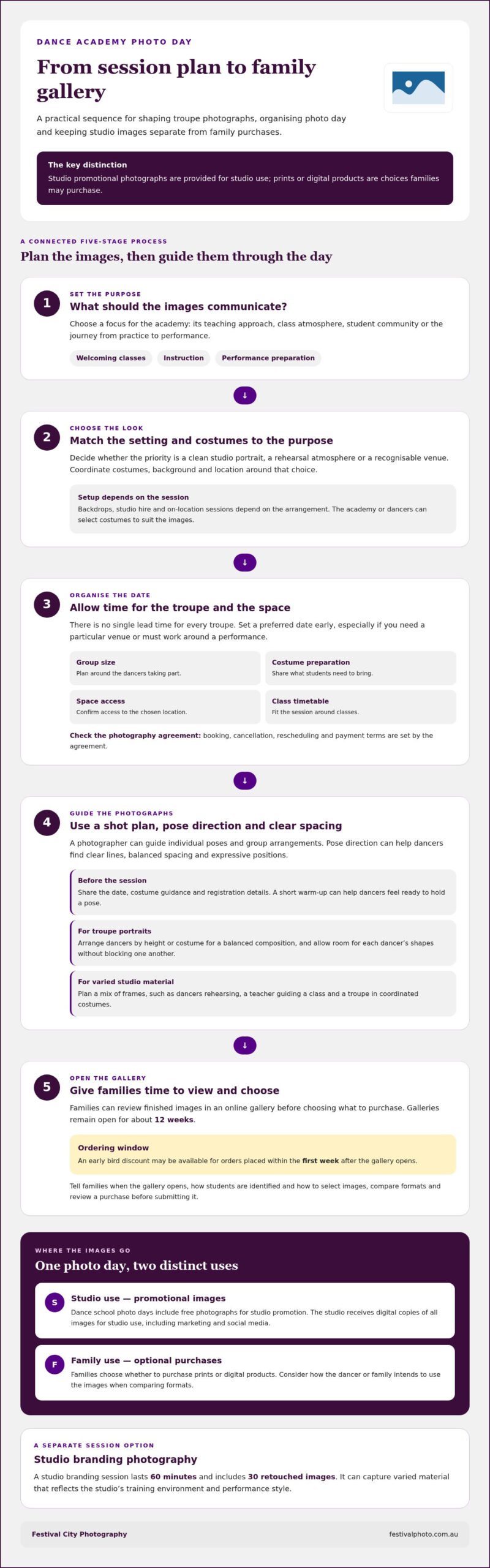
A studio photo day doesn’t have to mean the academy pays for every promotional image. Dance school photo days include free photographs for studio promotion, and studios receive digital copies of all images for studio use, including marketing and social media. For dance academy troupe photography packages in Adelaide, distinguish these studio-use images from the prints or digital products dancers’ families choose to purchase.
Before arranging a photo day, get clear on the costs, schedule and images you need. This guide covers practical planning for a dance troupe, including pose direction, image formats and the difference between studio-use photographs and family purchases. Use these details to shape a session around your dancers and understand how the resulting images can be used.
Key Takeaways
- Separate any school or centre expenses from the purchases families choose to make, then assess how the photo-day arrangement suits your budget.
- Plan the session around the troupe’s needs, including how posing guidance and group arrangements can help create polished, coordinated images.
- Use the online gallery’s roughly 12-week window to give families time to view images and make their selections.
- For competition teams, consider how a dress rehearsal can let the photographer move around the auditorium and capture dancers on stage.
- Compare printed keepsakes with digital files by considering how families and the studio intend to use the images.
Promotional photographs for dance studios
Promotional photographs give an Adelaide dance studio consistent images for its website, enrolment material and social channels. A planned session can show both the academy’s identity and the energy dancers bring to class.
Studio branding photography can create a considered set of images rather than a single group portrait. A studio branding session lasts 60 minutes and includes 30 retouched images. Use that time to capture a mix of frames, such as dancers rehearsing, a teacher guiding a class, and a troupe in coordinated costumes. These examples give a studio varied material for sharing its training environment and performance style.
Dance school photo days include free photographs for studio promotion. The studio receives digital copies of all images for studio use, including marketing and social media. This gives an academy material to show its classes, student community and performance work. These promotional images are separate from the photographs families may choose to purchase.
Photographs can document more than polished poses. A class group image shows students learning together; a rehearsal frame can capture a teacher demonstrating movement or dancers preparing for a performance. These images help an academy represent its community and give students a record of their progress from class practice to stage-ready presentation.
Photo day settings and session provisions
The academy or dancers can select costumes to suit the images. Backdrops, studio hire and on-location sessions depend on the setup. First decide whether the priority is a clean studio portrait, a rehearsal atmosphere or a recognisable venue. Then coordinate costumes, background and location around that purpose so each choice supports the studio’s visual identity.
Booking lead time for troupe photography
Set a preferred photo-day date as soon as the academy is ready, especially when the session needs a particular venue or must fit around a performance. There is no single lead time that suits every troupe. The date, group size, costume preparation, access to the space and class timetable all affect scheduling. Choose a date early and allow time to organise students and session details.
Before confirming a session, decide which parts of the academy’s identity the images should communicate: its teaching approach, class atmosphere or connection between practice and performance. A simple shot plan helps the photographer and studio staff use the available time purposefully, while leaving room for natural moments that show movement and interaction. A consistent visual direction also makes it easier to select images that work with existing promotional material.
Match the session to the intended use of the photographs. The academy might want to present a welcoming class environment, highlight instruction or show dancers preparing to perform. Decide who will coordinate students, costumes and the space, so the session has a clear focus. Afterwards, selecting images that follow the same visual direction can help the studio maintain a coherent presence across its website, enrolment material and social channels.
Do you handle posing?
Yes. A photographer can guide dancers through individual poses and group arrangements, helping them find clear lines, balanced spacing and expressive positions. Families can review the finished images through an online gallery before choosing what to purchase.
Booking, cancellation, rescheduling and payment terms are set by the photography agreement. Review how the date is secured, what happens if the session changes and when payment is due, so the dance academy can plan around clear arrangements.
Pose guidance can help students who feel unsure in front of the camera. A photographer may demonstrate a position, adjust a dancer’s angle or suggest where to place hands and feet. For troupe images, spacing matters: dancers need room to show their shapes without blocking one another. A teacher can help identify poses that reflect the group’s training and performance style.
Before photo day, share the session plan and remind students which costume or uniform to bring. A short warm-up can help dancers feel ready to hold a pose. For group photographs, arranging students by height or costume can create a balanced composition. Individual portraits allow more scope for a dancer’s preferred movement or character.
After the session, families can view images in an online gallery. Dance school photography galleries remain open for about 12 weeks, giving families time to look through the photographs and decide what they’d like to order. An early bird discount may be available for orders placed within the first week after the gallery opens.
Online registration and ordering work best when every family has clear instructions. Explain how students are identified in the gallery and outline the ordering steps, so families can find the right dancer’s images, compare formats and complete a purchase. Clear communication also helps prevent confusion when siblings attend the same academy.
- Before the session: Share the date, costume guidance and registration details.
- After the session: Tell families when the gallery opens and how long it remains available.
- At ordering: Explain how to select images and review the purchase before submitting it.
For families choosing a keepsake, digital image files provide an option to consider alongside printed photographs. The gallery gives parents a practical way to view a dancer’s portraits and troupe images before making that choice.
Competition teams and dance troupes
Competition photography should show both the troupe’s identity and the movement that defines its performance style. Planning the image mix helps an academy create team memories and useful studio communications.
Team and troupe photography
A troupe portrait brings dancers together in a frame that reflects their formation, costumes and shared style. Individual portraits show each performer more closely, while action images capture movement and expression. For example, a competition team might want a coordinated group pose alongside images of a characteristic leap or turn. A clear shot list helps organise these different outcomes.
Performance timing shapes the session. A dress rehearsal allows the photographer to move around the auditorium and capture photographs of everyone on stage. This can show formations from different angles, rather than relying on one fixed viewpoint. The academy can identify key moments in the running order, such as a full-troupe sequence or a featured group section, so the photographer knows which parts matter most.
Preparation makes the images more cohesive. Before the session, group students by routine, costume or team, then confirm who needs individual portraits. A simple schedule helps dancers move between group and solo photographs without disrupting rehearsal. Have costumes ready before the troupe takes its place, and ask the teacher to guide students into positions that match the choreography.
Consider the intended use of each image. A wide troupe photograph can suit a season record or academy display, while a tighter arrangement may highlight a smaller competition team. Action frames show movement; a still pose can make costume details and formation easier to see. A mix of image types gives families and the academy more ways to remember the performance.
Academy and troupe package providers
Photography sessions can be organised around a school’s needs, with families selecting images after the shoot. Package structures may differ in their mix of group photographs, individual portraits, prints and digital files. The right format depends on the troupe’s purpose, whether that is competition keepsakes, academy promotion or a season record. Set those priorities first to make package comparisons useful.
For an Adelaide academy, consider how the session fits the rehearsal schedule, costume changes and available photography space. A troupe with several routines may need images organised by team or performance, while a smaller group may prioritise individual portraits and one shared photograph. A written running order, named team groups and a nominated school contact help keep the session organised and make image selection clearer afterwards.
Printed and digital photography packages
Printed photographs and digital files serve different needs, so compare them by intended use, not appearance alone. A family might choose a printed portrait for display at home and a digital image for sharing with relatives. A printed troupe photograph can become a keepsake from a particular performance season, while digital files offer another way to view and store those memories.
Separate family purchases from studio-use images. Dance school photo days include free photographs for studio promotion, and studios receive digital copies of all images for studio use, including marketing and social media. These promotional images are distinct from products families select through a gallery. Explain the difference so families understand which photographs support the academy’s communications and which purchases are optional.
For families, the main choice is how they want to keep or use each image. A printed portrait can go in a frame or with other school-year memories. A digital file can be stored on a device and shared with family members. A troupe photograph may suit either format, while an individual pose could make a more personal keepsake for one dancer.
Before orders open, describe the available formats clearly. Explain how families can find the right student, view the images and choose a print or digital option. If they want several images, comparing package contents can help them select a format for their needs. Keep instructions straightforward, particularly for parents ordering for more than one child.
- For home display: Consider a printed portrait or troupe photograph.
- For sharing: Consider a digital file that can be viewed on a device.
- For studio promotion: Keep studio-use images separate from family purchases.
Printed and digital options can preserve different parts of a child’s dance experience. A class portrait records who trained together, while a performance image captures a moment on stage. Families may value one format for display and another for sharing. The choice is personal, so clear descriptions of each format matter more than presenting one as right for everyone.
Decide how studio images will be used before photo day. For example, an academy preparing enrolment material may prioritise images for its marketing, while families choose individual purchases separately. Keeping these uses distinct makes the arrangements easier to understand and helps each photograph serve its intended purpose.
Which Adelaide photography studios offer packages for dance academies and troupes?
Adelaide dance academies can look for photography studios that organise sessions for schools, performance groups and families. Compare the specific images covered, such as troupe portraits, individual dancer images and performance photographs. A competition team preparing a season keepsake may need a different image mix from an academy promoting its classes.
Start by listing the photographs the academy needs. A troupe might want a coordinated team portrait, individual dancer images and photographs showing movement during rehearsal. If the school has several competition groups, note each team and routine before planning. A clear scope helps the academy compare package structures against its practical requirements.
Next, consider how the session fits the academy’s timetable. A rehearsal-based shoot needs access to the performance space and a running order that identifies key routines. A portrait session needs a suitable setting and a plan for organising costumes and groups. Arranging dancers by team in advance, for example, can keep transitions between troupe photographs and individual portraits orderly.
When comparing packages, distinguish family purchases from images intended for studio use. Families may want prints or digital files, while an academy may need images for its own communications. Clarify how the gallery is organised, how families locate each dancer and how promotional photographs can be used by the studio. This helps everyone understand which images are personal keepsakes and which support the academy’s marketing.
- Image types: List the group, individual and performance photographs required.
- Session plan: Match the schedule to costumes, routines and venue access.
- Image use: Separate family orders from photographs used by the academy.
- Ordering process: Understand how families view images and make selections.
For Adelaide schools, the most useful package fits the troupe’s purpose and keeps photo day manageable. An academy focused on class memories may prioritise a group portrait, while a competition troupe may want team images and performance movement. Write down the desired outcomes before discussing the session, so the package reflects the academy’s needs.
To discuss photography for an academy or troupe, get in touch about your photo day.
Some photography arrangements include studio fundraising income through commissions on package sales and a studio rental fee. Compare these terms alongside the session and image requirements when planning a photo day.
Festival City Photography: Sibling Photos
Festival City Photography offers Sibling Photos for families who want portraits together, alongside Individual Portraits and Class Group Photos. These school photography options can help dance academy families capture a shared milestone or a student’s wider school community. Sports Team Photos are another option for students involved in team activities.
Choose the image that fits the moment: a sibling portrait for family memories, an individual portrait for one student or a class group photo to mark the year. These offerings are different from troupe performance photography, so choose according to the photograph your family or school needs.
Contact Festival City Photography to discuss school photography for your Adelaide academy.
Plan the next photo opportunity
As you plan dance academy troupe photography packages in Adelaide, start with the story you want each image to tell. A clear brief helps shape a session around your dancers, families and upcoming milestones, with the desired images front of mind.
For school photography beyond the troupe, Festival City Photography offers Sibling Photos, Individual Portraits and Class Group Photos. These options help families mark sibling connections, celebrate a student’s school experience or preserve a class memory.
Choose the photo opportunity that best suits your next school milestone, then take the next step at a pace that works for your academy. Contact Festival City Photography to discuss its school photography offerings. A thoughtful plan can help create images your school community will value.
Frequently Asked Questions
Are there any costs to the school/centre?
Who pays depends on how the photo day is arranged. A school-led commission may involve costs agreed for the session, while families can make separate purchases. Before setting a date, map out who covers the photographer, venue access and any studio-use requirements. This gives administrators a clearer view of the school’s role and helps families understand which purchases are optional.
Do your photographers have working with children?
A package description alone doesn’t establish a photographer’s Working With Children Check status. For an Adelaide academy, include child-safety credentials and supervision arrangements in the photo-day plan. Set out who will supervise students, how dancers will move between session areas and which adults can be present. Clear expectations help the school organise a structured session and define responsibilities before students arrive.
Which styles do you cover?
Dance photography can include posed portraits, coordinated group compositions and images that capture movement. A solo portrait might focus on a dancer’s expression and costume, while a troupe arrangement can emphasise formation and shared identity. Action-style photographs convey the energy of a routine. Choose styles according to whether the images are for family keepsakes, academy promotion or a performance record.
What do Adelaide dance troupe photography packages include?
Don’t assume what a package includes from its name alone. A useful outline identifies the session type, the images families can choose, available print or digital formats and how ordering works. For example, an academy might specify troupe portraits for every competition group, then decide whether individual images are also needed. These details make inclusions easier to understand.
Can packages include individual portraits, group photos, team photos, and action shots?
Yes, a package can be planned around a mix of individual, group and team images, with action photographs included in the requested shot list. The academy can identify which dancers need portraits, which groups should appear together and which routines offer useful movement moments. Share the preferred image mix before the session so the schedule allows time for each distinct setup.