
The strongest school photography tender isn’t necessarily the one with the most impressive sample images. A South Australian school photography tender comparison of larger providers versus local studios is most useful when it weighs data consistency, reporting, photo-day services and administration support together. The right fit is the provider whose approach best matches the school’s practical needs across those areas.
It is understandable to focus first on image quality: school photographs become keepsakes for students and families. But a well-run photography program also depends on accurate records, clear reporting and organised photo days, with as little extra administration for school staff as possible.
This article shows how to compare examples across those working details, not just the finished photographs. You’ll see what consistent data and useful reporting look like, how to assess photo-day arrangements and which administration tasks matter when comparing a large-scale provider with a local studio like Festival City Photography. The result is a clearer basis for evaluating tenders and choosing an approach that supports both the school and its community.
Key Takeaways
- Compare photo-day logistics and administration support alongside image quality to understand the workload each approach creates for school staff.
- Match the procurement process to the school’s requirements, and assess tender opportunities by their published scope and closing dates.
- Compare any commission, rebate or fundraising return by how it is calculated and what conditions apply, not just by the headline offer.
- Consider how portraits, including sibling photos, can create meaningful keepsakes for students and their families.
School photo-day services and administration support
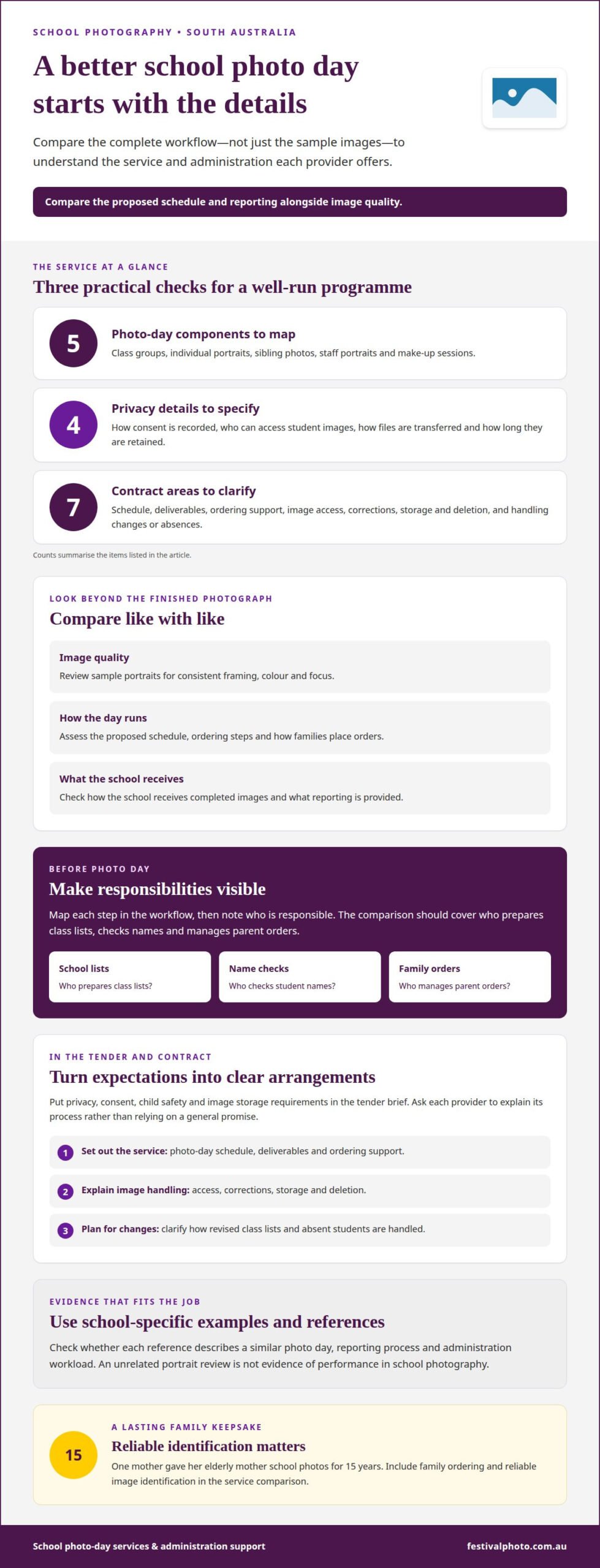
Image quality, delivery schedules and ordering systems vary by provider, so compare like with like. Review sample portraits for consistent framing, colour and focus, then assess the stated schedule and ordering steps. Note how families place orders and how the school receives completed images.
For privacy, consent, child safety and image storage, put each requirement in the tender brief. Specify how consent is recorded, who can access student images, how files are transferred and how long they are retained. School policies and applicable obligations guide these arrangements. Ask each provider to explain its process, rather than relying on a general promise.
Compare South Australian school photography studios using school-specific examples and references in their tender submissions. Assess whether each reference describes a similar photo day, reporting process and administration workload. An unrelated portrait review is not evidence of performance in school photography.
Example: One mother gave her elderly mother school photos for 15 years. The situation shows how a school photograph can become a lasting family keepsake. The practical step is to include family ordering and reliable image identification in the service comparison, so photographs remain useful beyond photo day.
What are the current South Australian school photography tender requirements and procurement rules?
For a South Australian school, start with the procurement policy and approval pathway that apply to it. Requirements vary with the school’s governance and purchasing arrangements, so one tender template may not suit every school. Let the policy guide the process, approvals, record-keeping and any required competition between suppliers.
Build the brief around comparable deliverables. Specify whether the school needs individual portraits, class photographs, staff images or a combination. Set out photo-day arrangements, ordering, image delivery, administration responsibilities and the information expected in progress reports. This gives every bidder the same scope to respond to.
Set a documented evaluation plan before submissions arrive. The school might assess image samples, scheduling, administration processes, data handling and the completeness of each response. Weight the criteria clearly in line with school policy. Record the reasons for scores and the approval decision so the outcome can be explained consistently.
Make the contract reflect the brief. Set out the agreed services, deliverables, responsibilities, timing, image access, storage arrangements and how changes will be managed. If the school expects a particular reporting format or correction process, state it in the tender documents rather than relying on informal discussions.
Example: A school needs class photographs and individual portraits. Its first draft describes the images but leaves ordering and administration unclear. The school revises the scope to state who manages family orders, how class lists are supplied and what reporting is required. Bids can then be compared against the same practical needs, and the decision record can show how each response met the published criteria.
Before release, check that the brief, evaluation criteria and approval steps align with the school’s procurement policy. A clear process helps staff compare responses on service, administration and data, rather than relying on headline claims alone. Schools planning a photography program can also explore school photography services as part of their market assessment.
Which school photography tenders are available in South Australia, and what are their closing dates?
South Australian school photography tenders are issued by individual schools or purchasing bodies, not through one shared photo-day calendar. Each notice sets its own closing date, submission method and service scope. Assess a current opportunity using its published notice, not a general industry timetable.
To find relevant notices, search procurement listings and school communications for terms such as “school photography”, “student portraits” and “school photo services”. Check the issuing school or purchasing body, then record the notice title, release date, closing date and time, submission channel and contact for tender queries. These details show whether an opportunity is open and how to respond.
Read the scope before deciding whether a notice fits. One school may seek class and individual photographs; another may include sports teams, formal events or digital image delivery. A broad photography notice may not cover the service your school needs. Match the stated requirements to the proposed service before comparing suppliers.
Example: A school finds a notice for student portraits, but its program also requires team photographs. It checks the tender scope and closing instructions, then records the gap before evaluating the opportunity. This prevents an apparently relevant notice from being mistaken for a complete match.
For a fair response process, follow the notice’s deadline and submission instructions exactly. Note whether questions must use a particular channel, whether amendments have been issued and whether revised documents replace earlier versions. Keep the final submission and receipt together in the school’s procurement record.
Closing dates can change when the issuing body formally updates its notice. Check the current notice and any amendments immediately before submitting, and follow the latest instructions. A tender register listing the school, scope, deadline and status helps staff track opportunities and distinguish expired listings from open ones.
For South Australian schools, tender availability and closing dates depend on each issuing body’s current procurement activity. A structured search and register make opportunities easier to identify, assess and act on.
What commission, rebates, or fundraising returns do MSP and local studios offer schools?
MSPs and local studios may structure school returns differently, so compare each tender’s written offer rather than assuming one model applies. A return might be described as commission, a rebate or fundraising support. The school’s comparison should identify how it is calculated, which sales count and when funds are paid.
Ask each bidder to show its calculation method. Check whether returns relate to orders, products, event photography or another defined activity. Separate guaranteed amounts from sales-dependent returns, and record any minimum sales assumptions or exclusions. If one bid uses a percentage and another offers a fixed contribution, compare the conditions and calculation basis, not just the headline.
Example: A school receives two proposals. One links its return to eligible family orders; the other describes a fixed contribution under stated conditions. The school records eligible sales, exclusions, payment timing and required administration for both. This clarifies the likely workload and return structure without treating different offers as equivalent.
Define how the school will reconcile the return. The tender can request a written statement showing the relevant sales period, eligible transactions, deductions and payment date. Specify who receives the statement and how discrepancies are handled. A clear record helps staff match the provider’s calculation to the agreed terms.
Fundraising value involves more than the amount returned. Consider staff time spent distributing information, handling family queries and reconciling payments. For a school formal, assess whether event photography has different return terms from routine student photos. Keep these activities distinct in the comparison so one does not obscure the other.
Before selecting an offer, summarise the return mechanism, conditions, timing and school responsibilities in the evaluation record. Avoid ranking proposals by a headline figure without its basis. To discuss photography planning for a school event, explore school photography options.
Festival City Photography: Sibling Photos
Festival City Photography provides sibling photos for schools, capturing family connections alongside the school year. They can be part of a program that also includes individual portraits, class group photos or sports team photos.
For school coordinators, consider where sibling portraits fit in the photo-day schedule and how families will access them. Planning this in advance helps the school include a personal option alongside its other photography priorities and keeps the tender requirements easy to compare.
Sibling portraits bring brothers and sisters together in one frame, preserving a moment from their shared school years. To discuss sibling photos for your school, contact Festival City Photography or visit festivalphoto.com.au.
Make your next school photography decision with clarity
Use the next planning cycle to turn evaluation criteria into a practical brief, with responsibilities and expectations clear to everyone involved. A South Australian school photography tender comparison of MSPs and local studios can help shape the brief around your school’s priorities, rather than a provider’s preferred format.
Consider the moments your school wants families to remember, from siblings sharing a frame to individual and class portraits. Comparing MSPs with local studios for a South Australian school photography tender can keep those priorities at the centre of planning and connect the program with your school community.
Festival City Photography offers Sibling Photos, Individual Portraits and Class Group Photos. If you’re planning a school photography program, contact Festival City Photography to discuss your needs and take the next step with confidence.
Frequently Asked Questions
What services and deliverables do MSP and local South Australian school photographers offer?
Services and deliverables depend on each tender’s scope, so compare listed outputs rather than provider labels. A school may specify individual portraits, class groups, sibling photographs, staff images or sports team photos, then define whether it needs prints, digital image files or both. Festival City Photography serves Adelaide schools with class group photos and provides physical prints and digital image files. State the required formats clearly in the brief.
How do MSP and local studios compare on image quality, turnaround times, and ordering systems?
Image quality, delivery schedules and ordering systems vary by provider. Compare sample portraits for consistent framing, colour and focus, then review each provider’s stated delivery schedule and ordering process, including whether it uses an online system.